PEA (Palmitoylethanolamide): Mast Cells, Neuropathic Pain, and the Endocannabinoid "Entourage"
By Jacob Gordon, INHC, FMT-CThis article contains affiliate links. As an Amazon Associate, MyBioHack earns from qualifying purchases at no extra cost to you. We only link products we research and stand behind.
Palmitoylethanolamide is an endogenous fatty acid amide your body makes on demand to dial down pain and inflammation, and it has become one of the better-studied supplements for neuropathic pain and mast cell overactivity.
In this post, we will discuss what PEA is, its benefits, its natural sources, how to dose it safely, its mechanisms of action, and the genetics that change how well it works for you.
What Is PEA
Palmitoylethanolamide (PEA) is a naturally occurring lipid signaling molecule built from palmitic acid and ethanolamine. R
It belongs to the same family of fatty acid amides as anandamide, the body's own cannabinoid, which is why PEA sits at the edge of the endocannabinoid system without being a classical cannabinoid itself.
Your cells synthesize it on demand in response to tissue injury, hypoxia, or inflammation, then break it back down once the threat passes.
This "make it when you need it, clear it when you don't" behavior is why PEA was originally classified as an autacoid local injury antagonist (ALIA), a local mediator that opposes injury at the site where it is produced. R
The ALIAmide concept came out of work by Rita Levi-Montalcini's group, who noticed that these lipids restrain overactive mast cells.
When chronic illness keeps the inflammatory signal switched on, endogenous PEA production cannot keep up with demand, which is the rationale for taking it as a supplement.
Its primary molecular target is Peroxisome Proliferator-Activated Receptor Alpha (PPAR-α), a nuclear receptor that turns down pro-inflammatory gene transcription. R
That single fact reframes PEA from a vague "anti-inflammatory" into a specific transcriptional brake on the machinery that drives neuroinflammation and pain.
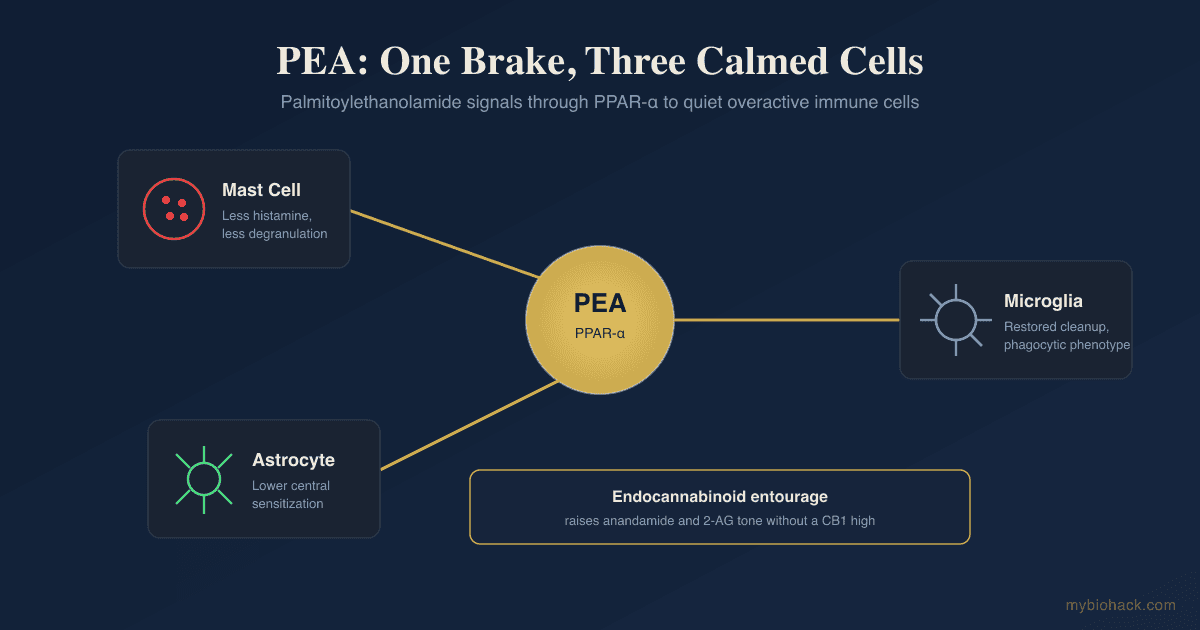
For readers in the Junction Dysfunction (JD) framework, PEA is interesting because it acts on three of the cell types that keep you stuck: mast cells, microglia, and astrocytes.
These are the cells that shed and chew through the glycocalyx during chronic inflammation, so a molecule that calms them without shutting down legitimate immune cleanup is worth understanding.
Benefits Of PEA
The strongest evidence is in pain, where PEA has multiple double-blind randomized controlled trials and pooled meta-analyses behind it.
The benefits below are ordered roughly by the quality of the human evidence, not by how exciting they sound.
1. Neuropathic Pain
A systematic review and meta-analysis of 11 double-blind randomized controlled trials covering 774 patients found that PEA reduced pain scores with a standardized mean difference of 1.68 (95% CI 1.05 to 2.31). R
That is a large effect size for a supplement, and it held up across nociceptive, musculoskeletal, and neuropathic pain in a separate meta-analysis. R
Neuropathic pain is the category where PEA tends to shine, because it works upstream on the glia and immune cells that maintain the pain signal rather than just blunting transmission.
2. Diabetic Peripheral Neuropathy
A quadruple-blinded, placebo-controlled trial gave 600 mg of PEA or placebo daily for 8 weeks to patients with diabetic peripheral neuropathic pain. R
The PEA group showed significant reductions in total pain, pain interference, and neuropathic pain sub-scores, along with improvements in inflammation markers, sleep, and mood. R
This is one of the cleaner designs in the literature and a reasonable template for how to trial PEA yourself.
3. Low Back Pain And Sciatica
A post hoc analysis of a controlled study in low back pain with sciatica reported a number needed to treat of 1.7 for pain and 1.5 for function with micronized PEA at 600 mg/day. R
A number needed to treat under 2 means most people who take it get a meaningful response, which is unusual for any pain intervention, drug or supplement.
Sciatica involves direct nerve compression and the Wallerian degeneration cascade, so the glial mechanism of PEA fits the pathology well.
4. Mast Cell Stabilization (MCAS And Histamine)
PEA down-modulates mast cell degranulation, which is the original ALIAmide effect that started this whole field. R
In a substance P model, PEA suppressed mast cell activation by stimulating diacylglycerol lipase, raising 2-AG, and engaging CB2 receptors to hold the cell shut. R
That is directly relevant to the substance P to mast cell loop behind flushing, histamine intolerance, and Mast Cell Activation Syndrome (MCAS).
In the JD model, connective tissue mast cells degranulate when their tissue goes hypoxic from microcapillary loss, so calming them addresses a symptom while you work on the underlying perfusion problem.
5. Microglia And Astrocyte Modulation
PEA increases CB2 receptor expression on microglia through PPAR-α and shifts them toward a migratory, phagocytic phenotype. R
This matters because it is not simple immune suppression.
PEA appears to restore the microglial ability to clean up debris, which is exactly the cleanup competence that fails when innate immune cells get stuck in the exhausted, endotoxin-tolerant state described in JD.
The same logic applies to the mast cell to glia crosstalk that sustains central sensitization.
6. Long COVID And Post-Viral Symptoms
A real-life retrospective cohort gave long COVID patients 600 mg of PEA twice daily for about 3 months and reported improved post-COVID functional status. R
Combined with luteolin as co-ultramicronized PEA-LUT, it improved validated odor identification scores and reduced parosmia and mental clouding in long COVID patients over 3 months. R
This is the same PEA plus luteolin formulation covered in the PeaLut / Glialia post, and it pairs naturally with a broader long COVID protocol.
There is a big MAYBE here, because these are open-label and retrospective designs, not blinded trials, so treat the post-viral data as promising rather than proven.
7. Fibromyalgia, ME/CFS, And Central Sensitization
PEA has been trialed in fibromyalgia, often added to existing therapy, with reported reductions in pain and improved quality of life.
The evidence here is thinner than in neuropathic pain, with smaller and less rigorously blinded studies, so honesty requires flagging it as preliminary.
Mechanistically it is plausible, because fibromyalgia and ME/CFS both involve glial activation and central sensitization, the same TRPV1 and microglial machinery PEA acts on. R
8. Endocannabinoid "Entourage" Support
PEA raises the tone of your own cannabinoids without binding the CB1 receptor that produces a high.
It does this partly by competing for the enzymes that break down anandamide and 2-AG, and partly by potentiating their actions at TRPV1. R
In an isolated vessel model, PEA and its cousin oleoylethanolamide amplified anandamide-driven vasorelaxation through TRPV1, an effect that is relevant to the vascular side of JD. R
If you want the broader picture, see the endocannabinoid system overview and the post on beta-caryophyllene, the dietary CB2 agonist that pairs well with PEA.
9. Mood And Sleep (Secondary Benefits)
Across the pain trials, improvements in sleep quality, anxiety, and depressive symptoms show up as secondary outcomes. R
Some of this is simply what happens when chronic pain comes down.
Some of it is likely the higher anandamide tone and PPAR-α signaling acting on mood circuits directly.
Natural Sources
PEA was first isolated in 1957 from soy lecithin, egg yolk, and peanut meal. R
It is present in many foods, but only in microgram-per-gram amounts, which is far below any dose used in the trials above.
The realistic takeaway is that you make almost all of your PEA endogenously and that food cannot deliver a therapeutic dose.
Dietary sources (not an exclusive list):
- Alfalfa
- Egg yolk
- Peanuts and peanut meal
- Soy lecithin and soybeans
Because the ALIAmide effect depends on flooding tissue with PEA, supplementation is the only practical way to reach the 600 to 1200 mg daily range studied in humans.
Dosage And Safety
The most common effective dose across trials is 600 mg once or twice daily, for a total of 600 to 1200 mg per day. R
Many protocols load at 1200 mg/day for the first one to two months, then drop to 600 mg/day for maintenance, with a usable range of 300 to 1200 mg. R
PEA works gradually, so give it time.
Most people need around 2 weeks to notice anything and 4 to 8 weeks for the full effect, which is the opposite of an acute painkiller.
Particle size is the single most important purchasing decision, because raw PEA is poorly water soluble and absorbs erratically.
Look for micronized PEA (PEA-m) or ultramicronized PEA (PEA-um), both produced by air-jet milling to shrink the particles and raise dissolution and absorption. R
Micronized and ultramicronized forms outperformed non-micronized PEA on oral efficacy in head-to-head models, so the form genuinely matters here. R
You can find quality options by searching PEA, and the co-ultramicronized PEA-LUT format adds luteolin for extra glial and mast cell coverage.
On safety, PEA has an unusually clean record.
Pooled clinical data found no serious adverse drug reactions for treatment up to 49 days. R
Toxicology testing put the LD50 above 2000 mg/kg and found no genotoxic potential, with four decades of human use at up to 1200 mg/day showing an absence of meaningful adverse effects. R
There are no well-documented serious drug interactions, which is part of why it is often layered on top of existing pain therapy rather than replacing it.
Mechanisms Of Action
Simple:
- PEA is a molecule your body makes to calm pain and inflammation, and taking more of it turns that system up.
- It quiets mast cells so they release less histamine and fewer inflammatory signals.
- It calms the immune cells inside your brain and nerves, called glia, that drive nerve pain and brain fog.
- It protects your own cannabis-like molecules from being broken down, raising your baseline tone without making you high.
Advanced:
- PPAR-α agonism is the primary mechanism, where PEA activates the PPAR-α nuclear receptor to suppress transcription of pro-inflammatory cytokines, mast cell degranulation, and microglial activation, and the anti-inflammatory effect is lost in PPAR-α knockout animals. R
- Mast cell stabilization via the ALIA mechanism works partly indirectly, with PEA stimulating diacylglycerol lipase to produce 2-AG, which then engages CB2 receptors to inhibit substance P-driven histamine release and degranulation. R
- Microglial reprogramming occurs because PEA upregulates CB2 receptor mRNA and protein through PPAR-α, shifting microglia toward migration and phagocytosis rather than blanket suppression. R
- The endocannabinoid entourage effect comes from PEA competing for the degradative enzymes FAAH and NAAA and from allosteric potentiation, which raises anandamide and 2-AG levels and amplifies their actions at TRPV1 channels. R
- TRPV1 activation and desensitization is a key analgesic route, where PEA acts as a PPAR-α-dependent agonist at TRPV1 on sensory neurons and produces stronger desensitization than capsaicin, dampening the TRP channel signaling that drives central sensitization. R
- GPR55 and GPR119 engagement rounds out the receptor profile, as PEA and OEA act as ligands at these orphan G protein-coupled receptors, although the functional weight of GPR55 in PEA signaling is still debated. R
Genetics
PPARA
PPARA encodes PPAR-α, the nuclear receptor that is PEA's primary target and the gatekeeper for fatty acid oxidation and inflammatory gene transcription.
Variants in this gene change how strongly PEA can signal, so they plausibly modify who responds best.
rs1800206 (L162V) is the main functional variant in Western populations, where the V162 allele is roughly half as active as L162 when ligand is scarce but becomes more active than L162 when agonist concentrations are high. R
That ligand-dependence is intriguing, because flooding the system with supplemental PEA is exactly the high-agonist condition where the V162 variant overshoots, and minor-allele carriers also tend to run higher LDL, triglycerides, and Lp(a). R
FAAH
FAAH encodes fatty acid amide hydrolase, the enzyme that degrades anandamide and also contributes to clearing PEA.
Variants that slow the enzyme raise endocannabinoid tone, which is the same direction PEA pushes.
rs324420 (C385A, P129T) reduces FAAH activity and shortens the enzyme's half-life, so A-allele carriers have higher anandamide and N-acylethanolamine levels. R
This variant has been linked to altered pain sensitivity and lower postoperative analgesic requirements, meaning your FAAH genotype sets the baseline tone that PEA then builds on. R
NAAA
NAAA encodes N-acylethanolamine acid amidase, the lysosomal enzyme that is the major route for breaking PEA back down to palmitic acid and ethanolamine.
It is highly expressed in macrophages, which ties PEA clearance directly to immune activation.
There is no well-characterized common functional SNP here yet, but NAAA is the reason the pharmaceutical world is chasing NAAA inhibitors, since blocking it raises endogenous PEA and produces marked anti-inflammatory effects on its own. R
Practically, this means high macrophage NAAA activity in active inflammation can chew through PEA faster, which is part of the case for the larger 1200 mg/day loading dose during flares.
More Research
For biomarker tracking I use the Cardio Zoomer to follow endothelial and inflammatory markers and the Cellular Zoomer for oxidative stress, since these are the downstream readouts that should move if PEA is calming your glial and mast cell load, and members can log them over time in the Health Hub.
Beyond the testing, a few open threads are worth knowing:
- Co-ultramicronization with luteolin (PEA-LUT) is the most studied combination, and the flavonoid adds independent glial and mast cell coverage, which is why the PeaLut / Glialia format keeps appearing in the post-viral literature. R
- Most PEA trials run 8 to 12 weeks, so long-term efficacy and the question of whether benefit is maintained or fades is genuinely under-studied. R
- NAAA inhibitors are an active drug-development target that would raise your own PEA rather than supplementing it, and they may eventually make oral PEA look crude by comparison. R
- The post-viral and long COVID evidence is almost entirely open-label or retrospective, so the effect sizes there are likely inflated relative to what a blinded trial would show. R
- Within the JD framework, PEA's appeal is that it calms the cells that shed the glycocalyx and drive vasoadaptive POTS (VAD) and adrenergic clotting (ABVAD) without suppressing the immune cleanup the body still needs, which makes it a symptom-control layer to run while addressing the upstream Transient Capillary Leak Syndrome (TCLS) covered in the TCLS chapter.
If you want to figure out where PEA fits in your specific case, ask the Biohacking Bot about your symptoms, or book a consultation for personalized guidance on dosing and stacking.
Jacob Gordon
INHC, FMT-C
Integrative Nutrition Health Coach
I cover mold illness, post-viral recovery, methylation, and complex chronic disease, drawing on ten years of clinical research, work inside a functional medicine clinic, and my own recovery from all of it. Every claim here is cited.
Book a ConsultationRelated Protocols & Supplements
Deep-dive chapters and recommended supplements for this topic
Quercetin
500mg 2x/day
SPM Active (Pro-resolving Mediators)
2 softgels/day
Curcumin (Liposomal)
500mg 2x/day