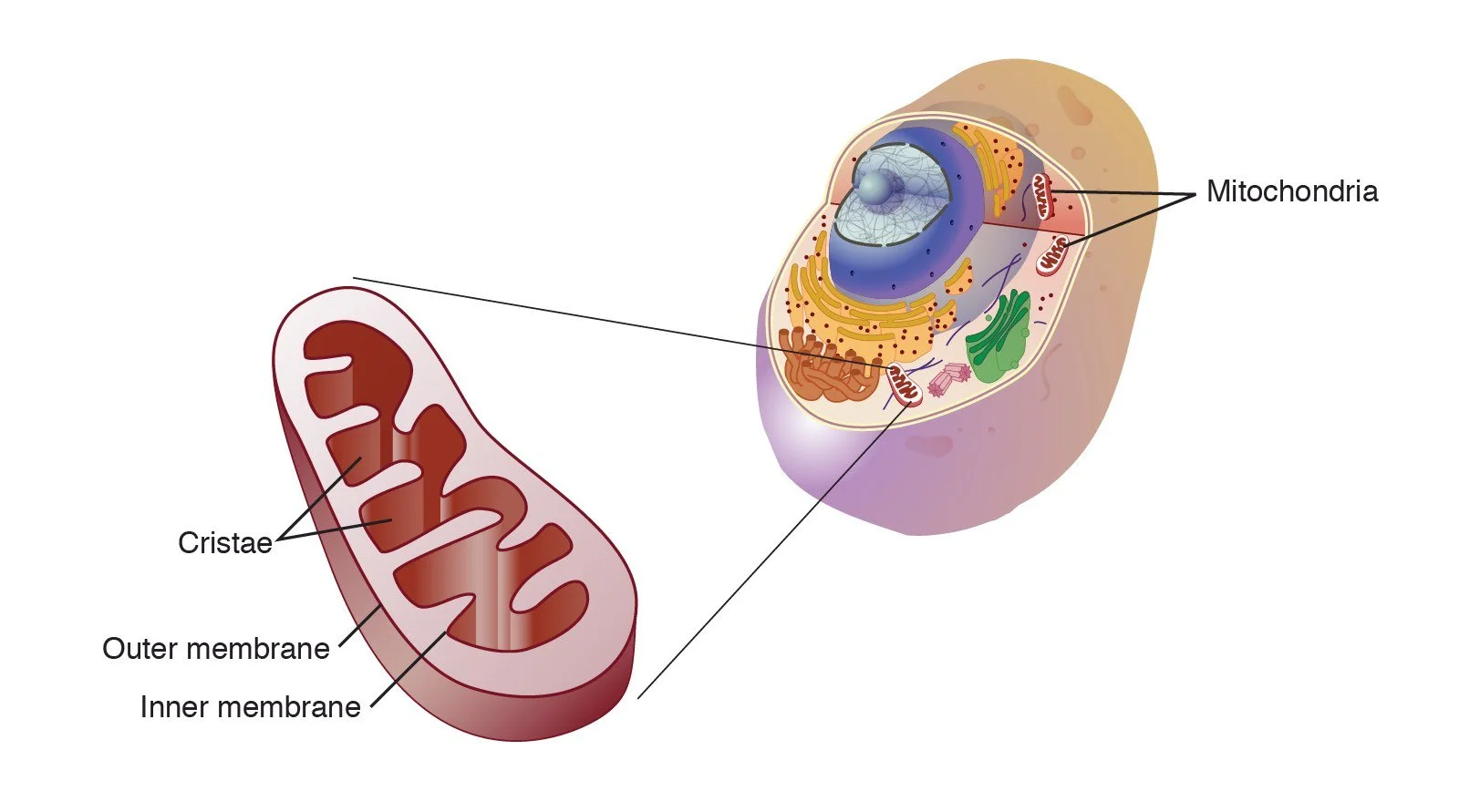
Mitochondria
Mitochondria are vastly important.
Without them you would be dead.
That's not an understatement.
How Did We Get Mitochondria?
The current scientific hypothesis is that mitochondria are actually an evolutionary adaptive symbiotic relationship from bacteria.
Essentially ourselves and bacteria cells combined to form a eukaryotic cell.
This is awesome because our genome only has a certain amount of genes, but these bacteria that we symbiotically acquired have their own mitochondrial genes which transcribe their own biological processes which enhance us.
Bacteria are really cool because they are able to do something what's called horizontal gene transfer, the act of sharing genetic code from one bacteria to another.
There is low quality evidence that this is happening for us as well with mitochondria since we can't do it with our own nucleotide.
Healthy Mitochondria
Anyway the favorable method for mitochondria to make us energy (ATP) is through glycolysis (glucose burning), which essentially uses oxygen and glucose to make carbon dioxide (CO2).
I mean I could get into phosphorus adenosine coenzymes and mitochondrial complexes, but I do not believe that's paramount for this discussion.
This is the healthy state for mitochondria in their M2 state as they rely on Oxidative Phosphorylation (OXPHOS) and FAO (FAO).
When they are fighting an infection they go into a M1 state.
Mitochondria In Hypoxia
When mitochondria are deprived of oxygen (or glucose), they go into an adaptive state and produce lactic acid as a byproduct.
As lactic acid is produced from the mitochonrida, it quickly turns into hydrogen and lactate (generally people mix up these two and use them interchangeably, but the hydrogen molecule is vastly important).
This build up of lactate is why when you exercise and you use up all your glucose reserves, your mitochondria switch over to anaerobic respiration, and the lactate makes your muscles feel sore.
This is also called delayed onset muscle soreness.
Lactate also signals to the brain you're tired.
Post Exertional Malaise
Now when your micro capillaries are destroyed (ischemia) and you can't deliver glucose or oxygen to those mitochondria (hypoxia), you're stuck in a state of M1, and are dependent on anaerobic respiration and every time you use that mitochondria they produce lactic acid.
This also uses up ferritin and moves you to use silicon, which more will be discussed later about Heme Oxygenases.
Anyway, this is essentially post exertional malaise.
The CO2 that is output as well builds up in the system and gives you transient carbon dioxide poisoning (you essentially feel vertigoish, nauseous or dizzy all the time unrelated to your gut), which makes you feel out of breath all the time.
This is different than the gaseous exchange mechanism which we'll talk about later and the angiotensin-based cough many people develop after covid.
Being Stuck In Anaerobia
Anaerobia is the term for cells that do not require oxygen for respiration.
So a lot of people that are stuck in anaerobic respiration cannot do cardio (some can in quick bouts), nor strength training, and a lot of them have to do adaptive diets such as no carb, Atkins, keto, carnivore.
I personally believe when you are healthy it is wise to stress your mitochondria (via mitohormesis, you can read my post on hormesis here) to make them adapt between aerobic and anaerobic states and divide.
This could be through extensive cardio like some examples would be running or sauna, or fasting / intermittent fasting.
Anaerobic respiration requires a lot more cofactors than aerobic respiration - such as:
B vitamins (per your genetics, but when you’re healthy you don’t feel the effects of bad b vitamins)
This is why a lot of people who are stuck in a sickly state require mitochondrial supplements to feel better.
Don't get me wrong here, taking mitochondrial supplements while you're healthy is a huge boost to make your mitochondria work even better.
People who are very health have a really good Phosphagen system (anaerobic as well), which uses creatine phosphate to create ATP.
Mitochondria Against Pathogens
Your mitochondria are essential for fighting infections as they produce a lot of reactive oxygen species which essentially is oxidative stress against that pathogen.
Also, because fighting an infection is very energy intensive, when your mitochondria are worn out and not getting it's nutrients, secondary infections are a lot easier to acquire.
This means when your mitochondria are in an M1 State, your immune system doesn't have the energy to do anything and so you get overburdened by pathogens and toxins.
So this is a two-way street pathogens and toxins can damage mitochondria and damaged mitochondria allow for more pathogens and toxins to accumulate.
Why Herbs and Supplements Make You Feel Worse In Hypoxia
As a normal byproduct of creating ATP, mitochondria create ROS, which normally is cleaned up by antioxidant response enzymes (AREs).
This is by the cleavage of KEAP translocating to the nucleus to turn on NRF2 (your main antioxidant response enzymes initiator).
When you have problems with an enzyme called DJ-1, NRF2 does not translocate to the nucleus and so you don't get those antioxidant responses.
This is why some people can react poorly to phenols and flavonoids in herbs.
The way that flavonoids and phenols work their antioxidant magic is by creating oxidative stress that breaks keap1 and starts the process above.
See my posts on NRF2 and DJ-1 if you want to learn more.
"I once that my herbs helped oxidation by reducing the free radicals that combat inflammation but I now know my herbs they ramp up inflammation for genetic response for antioxidation." - from Jacob's NRF2 song "Not A Doctor"
How To Induce Mitohormesis Safely
My favorite ways for boosting mitochondria are with NRF2 activators:
Broccoli Sprouts - Post on Broccoli sprouts (sulforaphane)
Moringa - Post on Moringa (sulforaphane)
ALA (Vitamin C+ALA)
Hormesis (exercise, fasting)
Proper circadian rhythms thus improving melatonin - post on melatonin synthesis (more on this later)
Infrared (use “mybiohack” for discount)
Sauna (not if you’re vascular adaptation is dysfunctional).
While activating NRF2 can help prevent cancer, I would not take it if I had active cancer as it may possibly make cancer cells more resistant to natural killer cells.
At the same time NRF2 is able to protect against viruses by suppressing their replication, this has been seen with infections like SARS-CoV2, Zika virus, and Herpes Simplex virus infections. R R R
DJ-1 is required for NRF2 to work.
DJ-1 function can be restored through:
Short Chain Fatty Acids (SCFAs), such as sodium butyrate and/or eating resistant starches
Beta-hydroxybutyrate (BHB) and/or getting into ketosis
How To Increase Mitochondrial Respiration
If I were in an unhealthy state and wanted to get my mitochondria working again, I would be taking together:
B vitamins that fit my genetics (you can schedule a 30 min call with me if you want me to check for you)
Ubiquinol (the unoxidized form of CoQ10, the oxidized form of CoQ10 is called ubiquinone and sets redox balance off)
Fulvic and Humic acids like Shilajit or Carboxy (code - WrNETza8)
Getting Mitochondria Out of Hypoxia
Also to get my mitochondria to respond better in hypoxia, I would be taking Heme Oxidase 1 (HO-1) activators.
HO-1 is able to put mitochondria back into a M2 state. R
HO-1 activators are things like: R
Salidrosides in Rhodiola (double edged sword)
Rosemary diterpenes like Rosmarinic Acid
I love HO-1 as it can down-regulate the TLR4 ligand HMGB1, reducing issues with endotoxemia. R R R
It's honestly one of the easiest ways I've found to improve t-regs, but more on that later. R R
Lastly, for the time being because hypoxia induces Hypoxia Inducible Factor 1-alpha (HIF1a), rhodiola isn't the best thing to use and it can upregulate that as well.
But we haven't even begun to talk about Hypoxia Inducible Factor 2-alpha (HIF-2a)… we will later on so stay tuned.
Mast Cells
I have a running joke talking about mast cells as mast sails, as I was an avid sailor in my childhood years.
The mast on a sailboat is essentially the vertical part of the long pole that sticks up straight: it holds the sail together so when wind pushes or pulls on the sail, it has better structural support.
In this regard, I would think those masts are super integral for having a healthy sailboat.
Without them the sail would blow away.
Maybe this is not the best analogy, but I like to think of mast cells similarly in that without them it would be really hard to be a healthy human.
Any infection could blow you away.
History of Mast Cells
Dr Theododaris Theoharides PhD was my mentor when I first learned about mast cells.
He had me try a product called Brain Gain for my mast cells, and the reason why I continue to take it is that it’s potent Glial-Derived Neurotropic Factor (GDNF) activator.
Mast cells were discovered to be the one of the first evolutionary immune cells that were ever developed in eukaryotes.
Today they are a part of our innate and adaptive immune system.
Mast Cells Are Villified
We know that mast cells play a role in brain fog, as well as cancer, and chronic inflammation, but I believe they get too much of the credit.
They often get vilified for allergies with ige and histamine responses, and Histamine Intolerance, Mast Cell Activation Syndrome (MCAS) / Mast Cell Activation Disorder (MCAD), and Central Sensitization.
If you've read my post on histamine intolerance, you know I do not believe in histamine intolerance, and think MCAS and MCAD is improperly thought out.
To me histamine intolerance is just the poor balance of histamine creation and enzymatic destruction.
It is like saying serotonin intolerance or dopamine intolerance lol.
You’ll see why in a second…
Mast Cells In Hypoxia
Mast cells are super resistant to hypoxia, meaning they can survive for a long time without oxygen available.
This is a biological advantage as a conserve as a backup system for secondary infections and to enhance immune function after thrombosis.
When mast cells are in hypoxia, they degranulate much quicker and release many potent vasodilators like histamine, serotonin, PGE2, and hundreds of others.
Similar to how if a healthy person were to go into a sauna or if a healthy person went into the sun, or if they were to exercise and their skin would turn red, this is a result of vasodilation's effect on capillaries.
This is super cool because it helps you move blood faster and get oxygen and waste products out in a highly vascular intensive event or during an infection to improve clearance.
Now, if you're suffering hypoxia, mast cells are acting like a backup system to try to help that highly vascular intensive event move blood and oxygen and waste products out.
The problem arises when there's destruction and blockade of capillaries and microcapillaries that leads to mast cells degranulating more often in trying to do their job, but the structural damage and physics of it makes it much worse.
What they are trying to do is bring that system back online.
Mast Cell Inhibitors Are Band-Aid Solutions
I believe the overuse of Band-Aid use of antihistamines, are prescribed to these people with "mast cell issues”, such as quercetin, rutin, luteolin, Benadryl, ketotifin, etc.
What's funny about most of these herbal solutions is that they are COMT inhibitors, which means that they slow down the breakdown of norepinephrine and other catecholamines (as you now know may not be great for platelet aggregation and hypoxia if you’re stuck in a loop) and somewhat continues to contribute to the problem.
Some of these mast cell stabilizers can be awesome tools when you are healthy or know how to use it appropriately, but obviously don't fix the root issues.
Histamine
Depending on the Histamine Receptor (HR) that histamine binds to, it can act as a vasodilator (I love histamine on the H3R for cognition) or a vasoconstrictor.
Histamine as a vasodilator is very good at opening tight junctions.
This process is vastly important when you are fighting an acute infection.
It allows immune cells to be able to travel in and out of tissue easily to get to its target.
Mast cells helps increase your body temperature to spike a fever, along with mast cells releasing Serotonin (5HT).
If you've ever seen someone with Serotonin Syndrome, you'll know what I'm talking about.
Serotonin
https://www.omicsonline.org/articles-images/2161-0495-6-e123-g001.html
Putative physiological relevance of serotonin receptors in cardiovascular system
Serotonin comes from Sera, of the blood, and tonin, the tonality of the vessel.
It was originally discovered as Enteramine, meaning derived from gut enterocyte cells, and it wasn't until the 1960s when LSD and similar psychoactives were being studied for its effects on the brain that they discovered serotonin.
Years later they realized they're the same molecule and serotonin won The Name Game.
As you may have guessed, serotonin, depending on which serotonin receptor it binds to, can act as vasodilator or vasoconstrictor.
It has many functions beyond being purely a neurotransmitter.
It's been thoroughly debunked that depression is a lack of serotonin, although serotonin is needed for proper vagus nerve function.
The vagus nerve is the 12th cranial nerve that can regulate the sympathetic and parasympathetic nervous system states.
I talk more about serotonin, the vagus nerve, and more in the gut microbiome section.
Anyway it must make note that mast cells also secrete heparin as a blood thinner (in response to heparin loss). R
Are you making the connection yet?
What Would I do for My Mast Cells When Sick?
Mast cells in hypoxia so what I would personally do is take Brain Gain, Neuroprotek, or Neuroprotek LP (if you have a problem with phenols as we discussed earlier) as well as use infrared daily in low doses working slowly and gradually from 30 seconds to get up to 5 minutes then 10 and so on until being in the sun feels good.
I would also focus on my SO2/AAT pathway.
Endogenously we can create Sulfur Dioxide (SO2) from cysteine via Aspartate Aminotransferase (AAT).
Cysteine is easy to get from N-Acetyl Cysteine (NAC, and you get some acetyl groups too) and cruciferous veggies.
It’s important to note, not to take NAC without having your copper status down and has other cofactors we will discuss in the Sulfur Metabolism section.
FYI: Always make sure to heat up your cruciferous veggies as that reduces the goitrogens naturally found in cruciferous veggies.
Goitrogens reduce T4—>T3 conversion as well as dopamine creation.