Respiration is easy, until it's not.
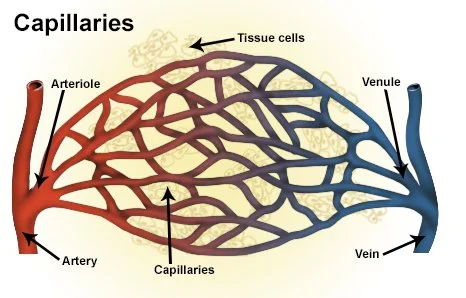
Normally we pick up oxygen from the lungs then travel through arteries and get glucose from the gut and liver, continuing down arteries, artereoles, capillaries, venulous, and back to the lung/heart through veins.
The veins bring along all the waste products that the lymph system doesn't get such as CO2 so it can leave out through the lungs.
Microcapillaries are microscopic and allow one blood cell through at a time. R
This is essential for delivering glucose, oxygen, and other nutrients to the cells of your body, including their mitochondria.
Just look how tiny capillaries are!!!!…. and you can't even see the micro-capillaries without a microscope!
When the glycocalyx is degraded, platelets and immune cells come in to try to save the day as well as fibrin to patch up leaky vessels (more about this in Blood Clots, Platelets, Fibrin and Autonomic POTS section).
As a result, you lose blood supply and thus glucose and oxygen through your microcapillaries to those cells. R
Normal vs Damaged Microcapillaries
In normal healthy people who have other micro capillaries, they have normal micro capillaries and reserve micro capillaries.
This allows them to do vascular adaptation practices, such as standing up, going in heat like a hot shower, exercising.
This is because as you vasodilate and vasoconstrict the volume and pressure of red blood cells changes speed and is able to evenly disperse between your regular and reserve micro capillaries.
But when you've lost those reserve micro capillaries, red blood cells shoot through at a much higher rate (F=ma) because there are less channels to disperse through.
This increases heart rate independent of blood pressure as the veins may still be able to dilate, which feeds back on itself to increase speed while the heart tries to adapt.
This causes tachycardia and is seen in a lot of people with vascular POTS.
I don’t know who named it POTS… it should be called Vaso-Adapative Disorder (VAD).
Soon we will discussed Adrenergic-Based VAD (ABVAD).