Amygdala And Insula Retraining (AIR): The Science Of Brain Retraining For Chronic Illness
By Jacob Gordon, INHC, FMT-CThis article contains affiliate links. As an Amazon Associate, MyBioHack earns from qualifying purchases at no extra cost to you. We only link products we research and stand behind.
Amygdala and Insula Retraining (AIR) treats chronic illness as a threat response that got stuck in the limbic system, and the data behind it is stronger than most people expect from something that costs nothing but time.
In this post, we will discuss what AIR is, the neuroscience of the amygdala-insula loop, what the trials actually show, where it fits inside the Junction Dysfunction framework, how to do limbic work correctly, and the honest limitations of the evidence.
What Is Amygdala And Insula Retraining (AIR)
Amygdala and Insula Retraining (AIR) is a neuroplasticity program, known commercially as The Gupta Program, built on a single hypothesis.
The hypothesis is that a subset of chronic conditions are perpetuated by brain circuits that keep firing danger signals after the original threat is gone.
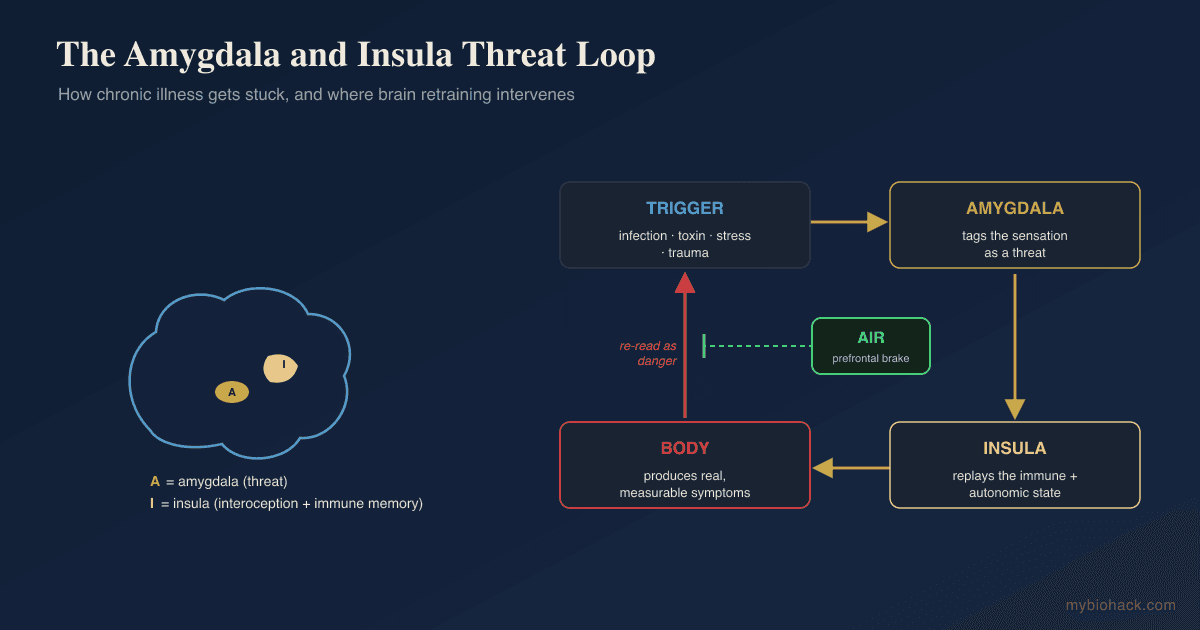
In this model, an infection, a toxic exposure, a period of chronic stress, or a trauma pushes the nervous and immune systems into a hypervigilant state, and instead of standing down once the trigger passes, the brain stays locked in defense mode.
The body's own symptoms then become the new threat the brain reacts to, which produces more symptoms, which the brain reads as more threat.
AIR is designed to interrupt that loop and lay down new neural pathways that signal safety instead of danger. R
The program itself is not exotic.
It is roughly 15 video and audio modules, a daily neuroplasticity practice of 30 to 60 minutes, plus supporting pieces like meditation, alternate nostril breathing, and basic lifestyle changes around sleep and diet. R
It is the same family of approach as the Dynamic Neural Retraining System (DNRS), Pain Reprocessing Therapy (PRT), and neuro-linguistic programming, which I have found to be one of the better tools for chemical sensitivities.
What makes AIR worth a full post is not the branding.
It is that the underlying claim, that the brain can hold a learned immune and autonomic state and that you can unlearn it, now has real mechanistic and clinical evidence behind it.
The Amygdala, The Insula, And The Threat Loop
The model names two brain regions, and they were not chosen at random.
The amygdala is the brain's threat detector.
Its job is to scan incoming signals, decide what is dangerous, and trigger a defense response, and it learns through classical fear conditioning, the same mechanism that makes you flinch at a sound you once associated with pain. R
When the amygdala miscategorizes a harmless internal sensation as a threat, it launches a defense response that was never needed, and it can keep doing this for the same stimulus indefinitely.
The insula (or insular cortex) is the more interesting half.
The insula is your interoceptive cortex, the part of the brain that maps the internal state of the body, from heartbeat and breathing to gut sensation and inflammation. R
It also sits at the interface of the nervous and immune systems, and this is the part that sounds like science fiction until you read the rodent work in the next section.
The proposed loop runs like this.
A real physical insult activates the amygdala and insula together.
The insula stores that bodily and immune state as a kind of memory, and the amygdala tags the associated sensations as dangerous.
After the insult resolves, the regions keep reactivating each other, so the brain keeps broadcasting the inflammatory and sympathetic state it learned, and the symptoms persist with no active injury left to explain them. R
AIR claims to work by strengthening the inhibitory circuits in the prefrontal cortex, insula, and anterior and posterior cingulate that should be putting the brakes on this loop, which reduces the amplification of incoming body signals and lets the autonomic and immune systems settle. R
What The Research Actually Shows
This is where most brain-retraining content either overpromises or hand-waves, so here are the actual numbers.
The long COVID randomized trial
The strongest single AIR study is a randomized controlled trial in long COVID patients, published in Evidence-Based Complementary and Alternative Medicine. R
It compared AIR against a structurally equivalent health and wellness program, which matters, because the control group also got webinars, coaching, and lifestyle education, so this was AIR versus an active comparator, not AIR versus nothing.
After three months, the AIR group cut general fatigue with an effect size four times larger than the control group, and roughly doubled its energy scores, with an effect size twice that of the control. R
The absolute drop in fatigue in the AIR group was more than double the control group's.
The honest caveat is the dropout: 100 people enrolled and only 40 completed all measures, which is a real limitation the authors acknowledge. R
The fibromyalgia three-arm trial
A 2025 randomized controlled trial in Current Psychology did something more ambitious. R
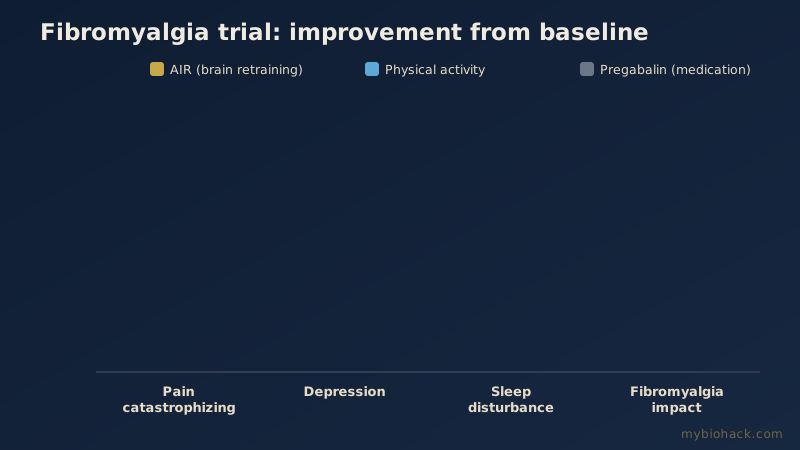
It took 117 Iranian women with fibromyalgia and randomized them to AIR, to physical activity, or to standard Pregabalin medication, and crucially the AIR and exercise groups stopped their fibromyalgia medication entirely, so each intervention had to stand on its own rather than as an add-on.
Both AIR and physical activity beat Pregabalin on every outcome, which is a striking result on its own. R
AIR produced the largest changes from baseline to follow-up: pain catastrophizing fell 50 percent versus 18 percent for exercise and 8 percent for medication, depression fell 49 percent versus 33 and 15, sleep disturbance fell 63 percent, and overall fibromyalgia impact fell 54 percent. R
The between-group effect sizes for AIR versus medication were enormous (Cohen's d of 3.26 for pain catastrophizing and 3.71 for fibromyalgia impact), which is far larger than you see in most drug trials. R
The limitations are a small sample, a 12-week intervention, self-reported outcomes, and the fact that one author consults for the Gupta Program.
The cross-condition data
The broadest study is a cross-sectional survey of 222 people who used AIR for at least three months across 16 different chronic conditions. R
It reported significant improvements in health and functioning for 14 of the 16 conditions, including ME/CFS, fibromyalgia, long COVID, mast cell activation syndrome, multiple chemical sensitivities, Lyme, mold illness, and panic disorder, with an overall improvement of 68 percent. R
People who stuck with it for 12 or more months improved 102 percent on average, versus around 50 percent for those at three to five months, which fits a dose-response pattern.
This one is the weakest by design: no control group, convenience sample, self-selected responders, and self-report, so treat it as a signal of where AIR might help, not as proof of effect size. R
The sister evidence
Two adjacent lines of research make the whole picture more credible.
A pilot randomized trial combined mindfulness with amygdala and insula retraining for women with fibromyalgia and found benefit over treatment as usual. R
More importantly, a 2022 randomized trial in JAMA Psychiatry tested Pain Reprocessing Therapy (PRT), a close cousin that teaches the brain to reinterpret pain as safe rather than dangerous, in 151 people with chronic back pain. R
Two thirds became pain-free or nearly pain-free after four weeks, with effect sizes the lead author called rarely seen in chronic pain trials, and the benefit held at long-term follow-up with matching changes on brain imaging. R
PRT is not AIR, but it rests on the same core idea, it was rigorously controlled against placebo, and it produced objective neuroimaging changes, which is the kind of evidence the AIR trials still lack.
Can The Brain Really Store An Immune Response
The weakest-sounding part of the AIR model, that the brain can hold and replay an immune state, is actually the part with the best hard science.
In 2021, a team at the Technion published a study in Cell showing that neurons in the insular cortex of mice encode specific inflammatory states. R
They captured the insula neurons that were active during two different kinds of induced inflammation, colitis in the gut and peritonitis in the abdomen.
Later, they artificially reactivated just those neurons, with no actual infection present, and the original inflammation came roaring back in the correct tissue. R
That is a brain region storing an immune memory and recreating the body state on command, which is the literal mechanism AIR is built around, demonstrated in a controlled animal model.
This did not come out of nowhere.
Earlier work had already mapped the neural substrates of behaviorally conditioned immunosuppression, showing the insula is central to learning and recalling immune responses through Pavlovian conditioning, the same way Pavlov's dogs learned to salivate at a bell. R
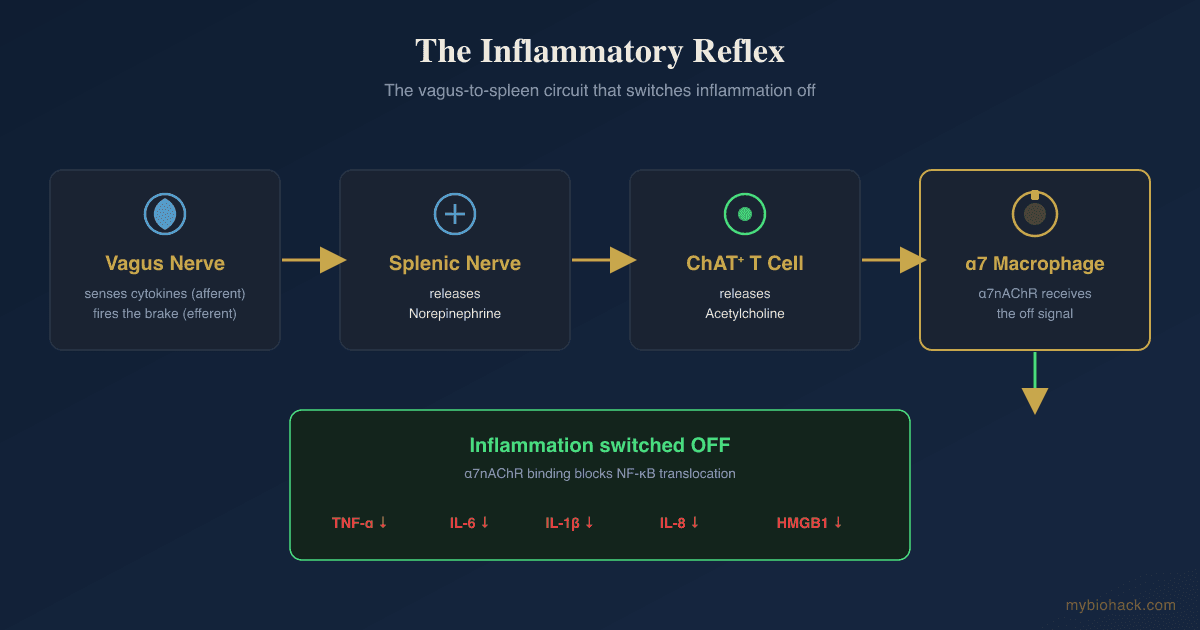
There is also a well-described physical wire between the brain and the immune system called the inflammatory reflex.
The vagus nerve releases acetylcholine onto alpha-7 nicotinic receptors on macrophages, which directly shuts down inflammatory cytokine production, so the nervous system has a real, fast, anatomical brake on inflammation. R
Put these together and the AIR hypothesis stops looking like positive thinking.
A brain region that maps body state (the insula) can store an inflammatory pattern, the threat detector (the amygdala) can keep it switched on, and there is a physical pathway (the vagus and the cholinergic anti-inflammatory reflex) through which calming the brain can actually lower inflammation in the body.
The gap between the mouse data and the human programs is still wide, and nobody has imaged a Gupta user's insula before and after, but the foundation is real.
Where AIR Fits In Junction Dysfunction
Here is where I diverge from how the brain-retraining world usually frames this.
Most AIR and DNRS marketing implies the illness is essentially the loop, that the body is fine and the brain just needs convincing.
I do not believe that, and I think the strongest version of this work refuses that framing.
In my Junction Dysfunction framework, chronic post-viral and environmental illness runs on real physical pathology: a damaged glycocalyx, Transient Capillary Leak Syndrome (TCLS), and Micro-Sepsis (MSS), two terms I coined for the micro-level capillary leak and sub-lethal chronic sepsis that drive the whole cascade.
The limbic loop is real, and it is one of the genuine drivers, but it sits alongside the terrain, not instead of it.
The mechanism by which the loop becomes physical is well documented.
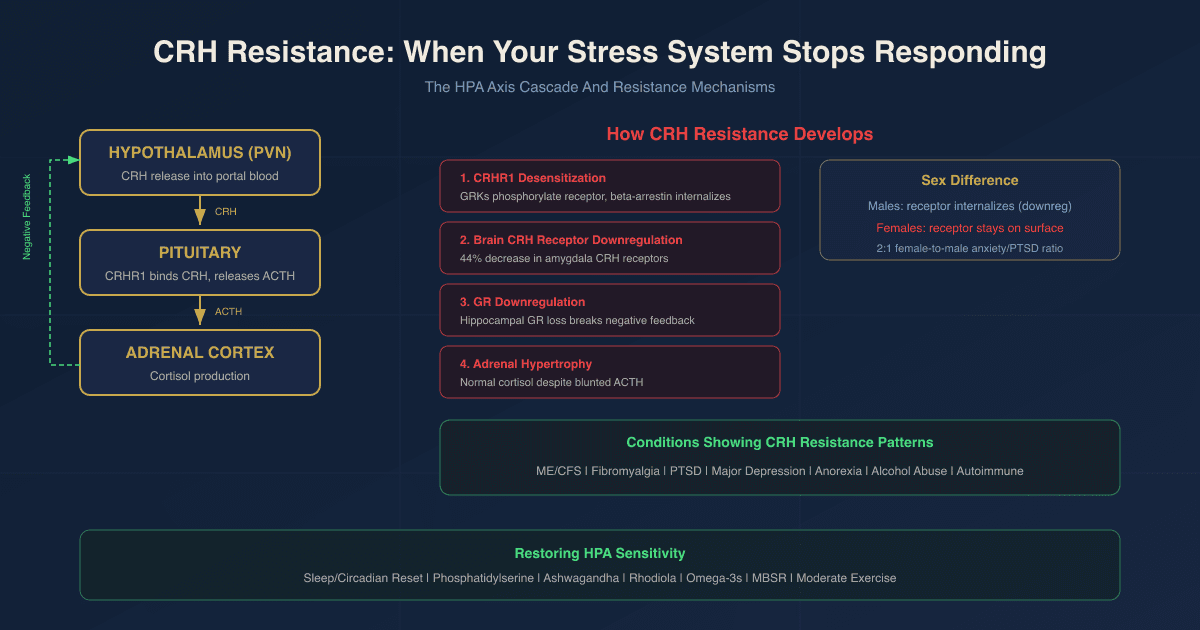
A chronic threat state keeps the Hypothalamic-Pituitary-Adrenal (HPA) axis pouring out cortisol, and over time the glucocorticoid receptors in the hippocampus desensitize, which is the same resistance pattern you see with insulin and leptin.
My clients describe this exact state as the world losing its color, which is glucocorticoid receptor desensitization, not a metaphor.
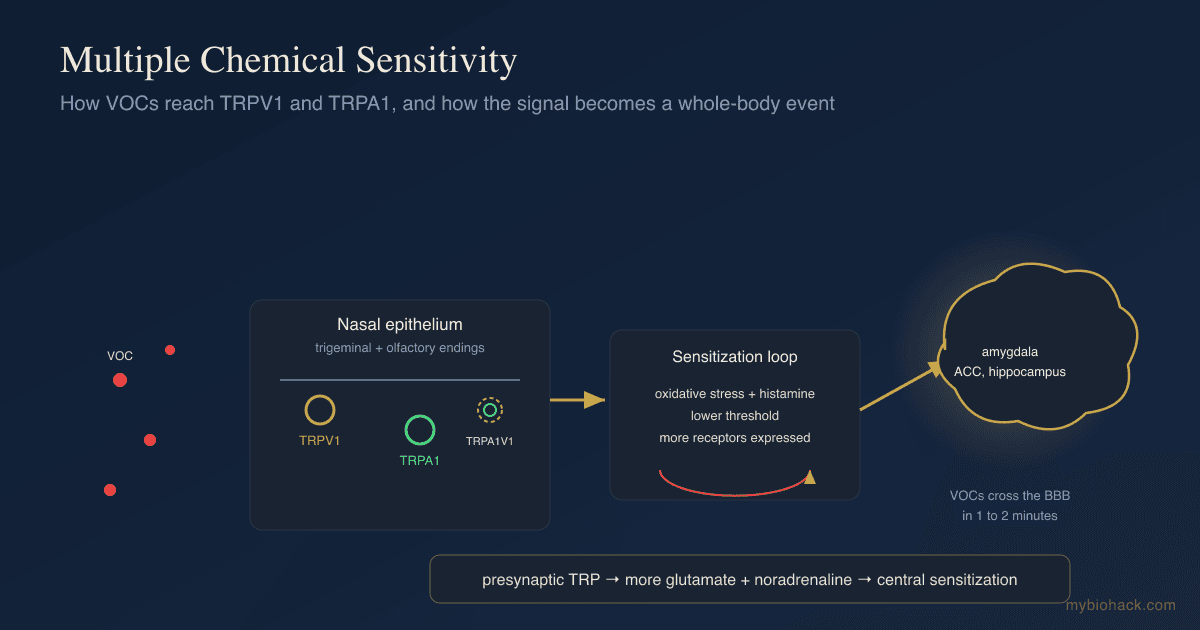
That same stress signaling, through corticotropin-releasing hormone, makes mast cells degranulate, which compounds histamine intolerance and feeds the TRP receptor central sensitization loop, where the more you fire the pain and danger channels, the more of them you build.
This is why the loop is not optional to address.
I do not see people get better, with all the supplements and modalities in the world, without working on their subconscious threat behaviors.
But the reverse trap is just as real, and I have watched it hurt people.
Telling someone with a torn-up glycocalyx, active mold exposure, and organophosphate toxicity that they only need to retrain their brain is how you get a person meditating in a water-damaged building while their actual exposure continues.
The honest position is that AIR is foundational and necessary, and it is not sufficient.
You retrain the limbic system and you fix the terrain, at the same time, because the calmer autonomic state from limbic work restores the vagal tone and acetylcholine signaling that the body needs to clean up debris and complete its healing cycles in the first place.
For the full mechanistic chain, the glycocalyx repair logic, and how the limbic piece connects to the vagus nerve and the rest of the cascade, this is the entire premise of the Junction Dysfunction guide.
How To Actually Do Limbic Retraining
You do not need to buy a specific program to do this work, though structure helps most people stay consistent.
1. Pick a structured method and commit to repetition
The branded programs are Gupta (AIR), DNRS, and Pain Reprocessing Therapy, and the technique I lean on most for chemical and fragrance sensitivities is neuro-linguistic programming.
They share the same core: catch the threat response early, interrupt it, and deliberately replace it with a felt sense of safety, over and over, because new neural pathways only form through repetition.
The trials that worked used 30 to 60 minutes a day for a minimum of three months, and the cross-condition data showed the biggest gains in people who passed the one-year mark, so this is a practice, not a weekend. R
2. Calm the physiology first
You cannot retrain a brain that is in full sympathetic overdrive, so the practice starts by dropping the body into a parasympathetic state.
Slow nasal breathing with a longer exhale, alternate nostril breathing, and basic present-moment practice all raise vagal tone, which is the same cholinergic brake on inflammation described above. R
3. Increase your variables
The single most useful concept I teach here is increasing variables.
A traumatized nervous system narrows life down to a small set of safe, predictable inputs, and that narrowing is itself part of what keeps the loop rigid.
Deliberately introducing novelty, new places, new movement, new social contact, new sensory input, forces the brain to build new connections through Brain-Derived Neurotrophic Factor (BDNF) and the other neurotrophins, which is the raw material of rewiring.
I wrote the full version of this idea in the JD chapter on increasing variables to overcome trauma, and the broader plasticity toolkit in my post on 140+ ways to increase BDNF.
4. Support the rewiring biologically
Supplements do not replace the practice, but a few genuinely make the brain more plastic and the baseline less reactive.
Magnesium L-Threonate: the form of magnesium that raises brain magnesium and supports the NMDA-dependent learning the retraining relies on.
7,8-Dihydroxyflavone: a flavone that acts as a BDNF mimetic at the TrkB receptor, useful when you want plasticity without raising nerve growth factor.
Taurine: calming, raises BDNF, and supports GABA tone.
Lithium Orotate: low-dose nutritional lithium raises BDNF and supports serotonin, which is often depleted in this population.
Ashwagandha: supports plasticity in part through Nogo-A inhibition and lowers the cortisol that desensitizes glucocorticoid receptors.
Theanine: shifts the brain toward a calm, alert state and supports acetylcholine, which I cover in depth in my post on theanine.
A note specific to this population: I am cautious with anything that strongly raises nerve growth factor, because in people with mast cell and pain sensitization, NGF can increase pain and drive mast cell degranulation, so I favor BDNF support over NGF support here.
5. Use bigger levers when appropriate
For people who are deeply stuck, the larger plasticity levers are the psychedelic and dissociative tools, psilocybin, ketamine, and ayahuasca, which open a window of synaptic plasticity that makes the retraining take faster.
I am not linking these because they are controlled or clinical, but they belong in the honest version of this conversation, and they are increasing variables at the strongest dose.
6. Get outside
Forest bathing, morning sunlight, and time near moving water all lower sympathetic tone and raise the parasympathetic, anti-inflammatory state the practice is trying to make permanent.
7. Address the underlying trauma, not just the symptom loop
Much of the time the original threat that started the loop was relational or developmental, not the infection, and that has to be met directly.
I have written separately on coregulation and nervous system dysregulation and on why your nervous system, not your partner, is often the problem, and the fear-extinction machinery that lets a brain finally let go of a learned threat is covered in my post on HDAC inhibition and fear extinction.
What To Stay Away From
The "it is all in your head" trap.
The single biggest failure of brain-retraining culture is implying the disease is not physically real, which is both wrong and cruel, and it pushes people to abandon a legitimate medical workup.
Stopping your physical investigation.
Do the limbic work and still test for mold, stealth infections, organophosphate exposure, dysbiosis, and the markers below, because retraining a brain in a toxic environment is meditating next to a running engine.
Graded exercise as a fix.
Graded Exercise Therapy (GET) is not the same as limbic work, and pushing through Post-Exertional Malaise (PEM) damages the glycocalyx and worsens the condition, so do not let anyone reframe forced exercise as nervous-system retraining.
Toxic positivity and self-blame.
The practice works through repetition and felt safety, not through forcing yourself to feel grateful or blaming yourself for not healing fast enough, which just adds another layer of threat.
Believing the marketing effect sizes uncritically.
Several of these trials are unblinded, rely on self-report, and have authors tied to the program, and the placebo response on subjective symptoms is large, so calibrate your expectations to the honest evidence and give it the real three-to-twelve-month commitment before judging.
Testing
AIR targets a dysregulated threat and stress system, so the objective things worth tracking are the HPA axis, inflammatory load, and the genetics that set your stress reactivity.
There is no lab that diagnoses a stuck limbic loop, so this section is about confirming the downstream biology and ruling out the physical drivers that limbic work alone will not fix.
Blood And Urine Markers
Cortisol rhythm is the central one, and it must be measured at multiple points across the day rather than as a single morning draw, because long haulers frequently have a flipped curve with cortisol high at night and low in the morning, which a single point will miss.
hsCRP, IL-6, and TNF-alpha give a rough read on systemic inflammatory load, which is the body-side output the limbic loop is amplifying.
Functional Lab Panels
I use the Hormone Zoomer (Vibrant Wellness) or the DUTCH Complete (Precision Analytical) to assess the full cortisol rhythm and the downstream sex and adrenal hormones that chronic threat states distort.
For the inflammatory and endothelial picture, I use the Cardio Zoomer (Vibrant Wellness), which captures hsCRP and the vascular markers relevant to the Junction Dysfunction terrain.
Because the loop almost never travels alone, ruling out the physical drivers is part of the workup: the Toxin Zoomer (Vibrant Wellness) for mycotoxins and environmental chemicals, and the Gut Zoomer (Vibrant Wellness) for dysbiosis and intestinal permeability.
Genetics
I use the Methylation Genetics panel (Vibrant Wellness) to assess COMT, and 23andMe raw data analysis for the BDNF and FKBP5 variants below, which set how reactive and how plastic a given nervous system is.
Self-Tracking
Heart rate variability, from any wearable, is the most useful at-home objective metric here, because it tracks the autonomic balance that limbic work is trying to shift, and it tends to move before symptoms do.
Mechanisms Of Action
Simple:
- The brain learns to treat the body's own signals as a threat and keeps firing alarm signals after the real danger is gone, and the practice teaches it to feel safe again.
- A calmer brain sends a calmer signal down the vagus nerve, which physically lowers inflammation in the body.
- Doing new things and repeating the calming practice builds new wiring, so the old danger loop slowly fades.
Advanced:
- Insular encoding of immune state. The insular cortex stores inflammatory patterns at the level of specific neuronal ensembles, and reactivating those ensembles reproduces the original inflammation, which makes the insula a literal site of immune memory and a plausible substrate for symptom persistence without active pathology. R
- Amygdala fear conditioning and prefrontal inhibition. The amygdala assigns threat salience through classical conditioning, and AIR is hypothesized to strengthen top-down inhibitory control from the prefrontal cortex and cingulate onto the amygdala and insula, reducing the magnification of interoceptive signals. R
- The cholinergic anti-inflammatory pathway. Efferent vagal acetylcholine acts on alpha-7 nicotinic receptors on macrophages to suppress NF-kB-driven cytokine release, so raising parasympathetic tone through breathing and calming practice has a direct, anatomically defined anti-inflammatory effect. R
- HPA axis and glucocorticoid receptor desensitization. Chronic threat signaling sustains cortisol output until hippocampal glucocorticoid receptors downregulate, producing the anhedonic, color-drained state, while corticotropin-releasing hormone independently degranulates mast cells and feeds TRP-channel central sensitization.
- Neuroplastic consolidation. Forming the new safety pathways depends on BDNF-driven synaptic plasticity and NMDA-receptor-dependent learning, which is why novelty, repetition, and BDNF support accelerate the process and why the dose-response runs over months. R
Genetics
COMT
COMT encodes catechol-O-methyltransferase, the enzyme that clears dopamine, norepinephrine, and epinephrine from the synapse.
The Val158Met variant slows the enzyme, so Met carriers clear catecholamines more slowly and tend toward higher pain sensitivity, more pain catastrophizing, and a more reactive stress response.
rs4680: the Met (A) allele is associated with greater pain sensitivity and altered neural pain processing, which can make the threat loop easier to trigger and harder to quiet. R
I cover this variant in depth in my post on COMT genetics and catecholamine metabolism.
BDNF
BDNF encodes brain-derived neurotrophic factor, the growth factor that drives the synaptic plasticity all retraining depends on.
The Val66Met variant impairs activity-dependent secretion of BDNF, reducing how much gets released exactly when you are trying to learn something new.
rs6265: the Met (A) allele lowers activity-dependent BDNF release and is found in roughly 15 to 20 percent of people, which can make the rewiring slower and makes BDNF support more worthwhile. R
FKBP5
FKBP5 encodes a co-chaperone that regulates how sensitive the glucocorticoid receptor is, which sets the gain on the entire HPA stress axis.
Risk variants interact with early-life trauma through DNA methylation to produce a more reactive, slower-to-recover stress response in adulthood.
rs1360780: the T allele, combined with childhood adversity, is associated with HPA dysregulation and higher risk of stress-related conditions, which is the gene-by-environment hinge that makes addressing the original trauma, not just the symptom loop, so important. R
More Research
Brain imaging in humans is the missing piece, because the AIR clinical trials still rest on self-report, while the strongest objective evidence for the broader approach is the Pain Reprocessing Therapy trial, which paired large clinical effects with matching neuroimaging changes. R
The cleanest demonstration that the brain can store and replay an immune state is the insular cortex work in mice, and replicating that loop in humans, and showing a retraining program reverses it, would move this field from plausible to proven. R
Be careful interpreting unblinded trials with subjective endpoints, because the asthma placebo study in the New England Journal of Medicine showed that placebo and sham treatments produced subjective improvement equal to a real bronchodilator while doing nothing for objective lung function, which is exactly the failure mode the AIR evidence base has not yet ruled out. R
For biomarker testing I use the Hormone Zoomer or DUTCH Complete to track the cortisol rhythm over time, since a normalizing curve is one of the few objective markers that moves as the threat state resolves.
The most important practical finding across all of this work is the dose-response: the people who improved most were the ones who treated limbic retraining as a daily practice sustained past the one-year mark, not as a quick fix. R
Jacob Gordon
INHC, FMT-C
Integrative Nutrition Health Coach
I cover mold illness, post-viral recovery, methylation, and complex chronic disease, drawing on ten years of clinical research, work inside a functional medicine clinic, and my own recovery from all of it. Every claim here is cited.
Book a ConsultationRelated Protocols & Supplements
Deep-dive chapters and recommended supplements for this topic
Lion's Mane
1000mg/day
Omega-3 (DHA)
2g/day
Phosphatidylserine
100mg 3x/day