COMT Genetics, Catecholamine Metabolism, And Attachment Style
By Jacob Gordon, INHC, FMT-CThis article contains affiliate links. As an Amazon Associate, MyBioHack earns from qualifying purchases at no extra cost to you. We only link products we research and stand behind.
COMT is the enzyme that decides how long dopamine, norepinephrine, and epinephrine linger in your prefrontal cortex, and a single common variant shifts that clearance speed enough to color how you handle stress, threat, and closeness.
In this post, we will discuss what COMT does at a biochemical level, how the Val158Met variant changes catecholamine and estrogen metabolism, what the worrier-warrior framing gets right and wrong, what the research actually shows about COMT and attachment style, how oxytocin and OXTR methylation sit alongside it, why genes do not equal destiny here, and how to support healthy COMT function based on your genotype.
Basics Of COMT
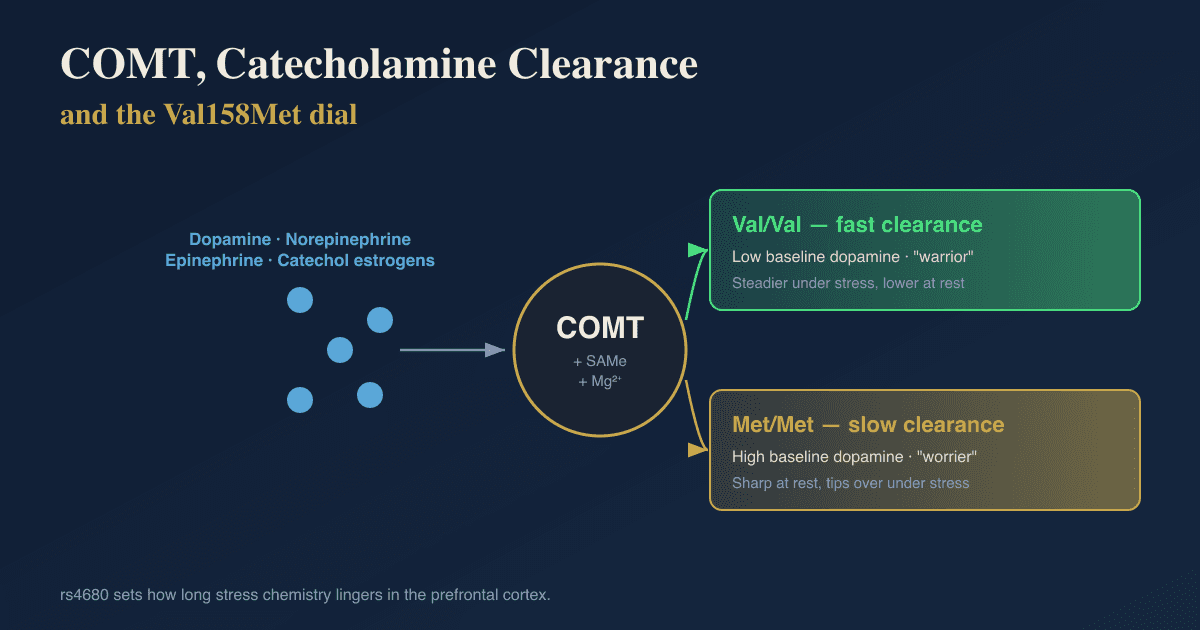
Catechol-O-Methyltransferase (COMT) is one of the main enzymes the body uses to break down catecholamines, the family that includes dopamine, norepinephrine (noradrenaline), and epinephrine (adrenaline). R
It works by transferring a methyl group from S-Adenosylmethionine (SAMe) onto a hydroxyl group of the catechol ring, which tags the molecule for clearance. R
This makes COMT a methylation-dependent enzyme, so its real-world speed depends on how much SAMe you have, which ties it directly to the rest of the methylation cycle.
COMT also requires a magnesium ion in its active site as a cofactor, which is one reason magnesium status matters for catecholamine clearance. R
There are two versions of the enzyme.
The soluble short form (S-COMT) dominates in liver, kidney, and blood, while the membrane-bound long form (MB-COMT) is the form nerve cells in the brain rely on most. R
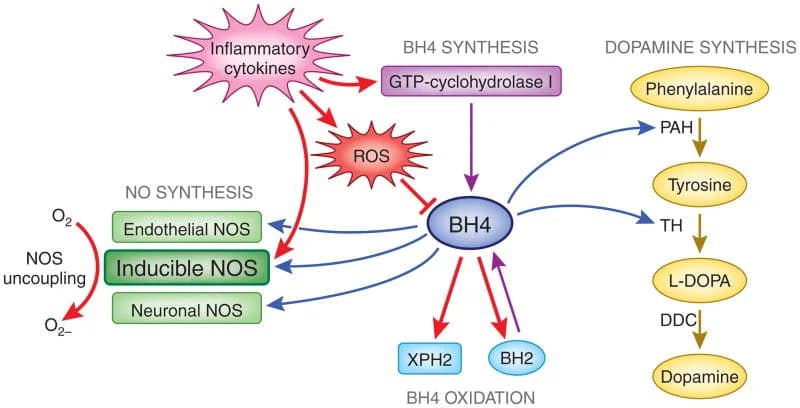
COMT carries a disproportionate load in the prefrontal cortex because that region has very few dopamine transporters, so methylation by COMT, not reuptake, is the main way prefrontal dopamine gets cleared. R
How COMT Metabolizes Catecholamines And Estrogen
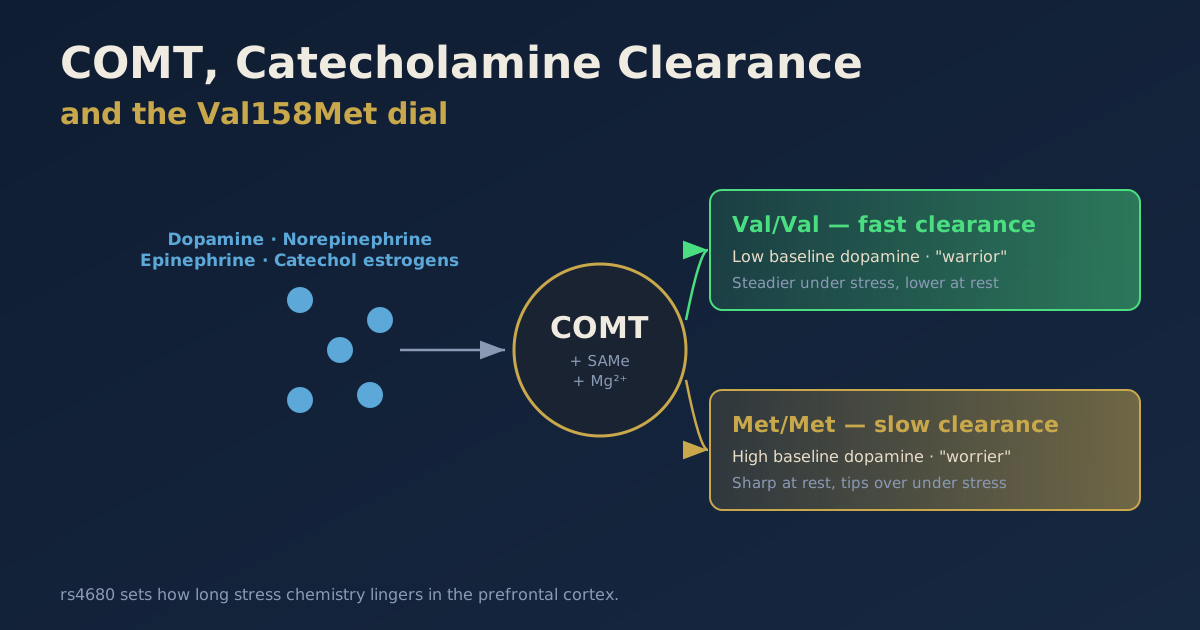
The single most studied variant in this gene is Val158Met (rs4680), a G to A swap that exchanges valine for methionine at position 158 of the protein.
The methionine version is thermally less stable and runs roughly three to four times slower than the valine version. R R
So Met/Met homozygotes clear prefrontal catecholamines slowly and sit on a higher baseline dopamine tone, Val/Val homozygotes clear them quickly and sit lower, and Val/Met heterozygotes land in between. R
COMT does not only handle neurotransmitters.
It is also a primary route for clearing catechol estrogens, the 2-hydroxy and 4-hydroxy metabolites produced when the body processes estrogen.
A slow COMT can let these reactive estrogen metabolites accumulate, which is part of why COMT shows up in conversations about estrogen metabolism and not just mood.
Estrogen itself feeds back on the enzyme, since estrogen lowers COMT expression and activity, so a woman in a high-estrogen state is effectively running an even slower COMT than her genotype alone would predict. R
This is one mechanism behind why catecholamine and estrogen-related symptoms can swing across the menstrual cycle in slow-COMT women.
Because COMT spends SAMe and depends on the methylation cycle, a slow methylator upstream compounds the effect.
An MTHFR variant that reduces 5-MTHF production constrains SAMe availability, which constrains COMT, regardless of which rs4680 genotype you carry.
The Worrier And Warrior Framing
The popular shorthand calls Met/Met the "worrier" and Val/Val the "warrior."
The kernel of truth is real.
Prefrontal dopamine acts on an inverted-U curve, where too little and too much both degrade performance, and your genotype sets where on that curve you start. R
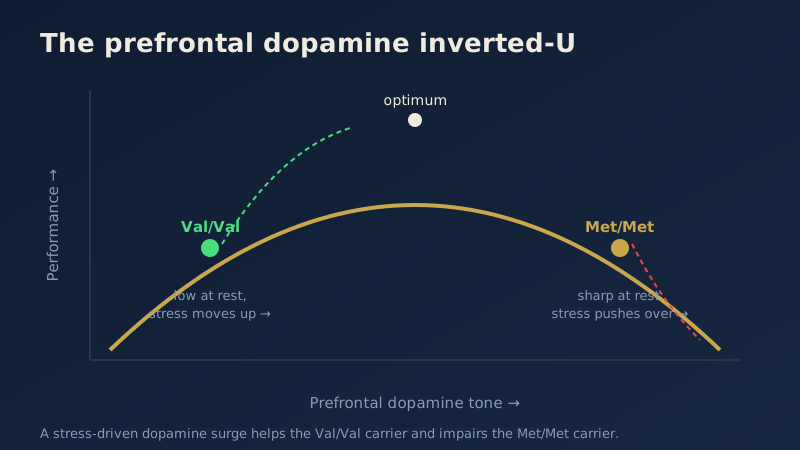
Met/Met carriers, sitting on higher baseline dopamine, tend to perform better on working memory and executive tasks at rest, but a stress-driven dopamine surge can push them over the top of the curve and impair them. R
Val/Val carriers start lower, so the same stress surge can move them toward their optimum, which is the cognitive side of "stress resilience."
On the personality side, the Met allele has been linked to higher neuroticism and anxiety-related traits, an effect that was strongest in women in one sample of 497 adults. R
There is a big MAYBE here, and it deserves to be stated plainly.
The worrier-warrior model is a clean story built on a messy literature, the effect sizes are small, many replications are partial, and the direction of the effect flips depending on sex, baseline stress level, and what outcome you measure. R
Treat your genotype as a dial on catecholamine tone, not a label for your personality.
COMT And Attachment Style
Attachment style describes the patterns you run in close relationships, usually sorted into secure, anxious, avoidant, and disorganized.
These patterns are mostly learned through early coregulation with caregivers, so the honest starting point is that attachment is a relational and developmental phenomenon first, and a genetic one a distant second.
That said, there is direct research linking COMT to attachment.
In a general-population sample, the Val158Met variant exerted a common influence on both avoidant attachment and the inhibited personality dimension, which were themselves tightly correlated at r = 0.77. R
The catch is the shape of the effect.
It followed a pattern of positive heterosis, meaning the Val/Met heterozygotes, not either homozygote, scored highest on avoidant attachment. R
That is not the tidy "Met equals anxious, Val equals avoidant" story the internet sells, and it is a good reminder that the catecholamine system bends attachment-relevant traits in non-linear ways.
The more mechanistic bridge is through threat and fear processing.
In people with PTSD, the Met/Met genotype was associated with the greatest impairment in shutting down fear responses to a safety signal, and that impairment tracked with DNA methylation at specific sites in the COMT promoter. R
Difficulty signaling "you are safe now" is close to the core of insecure attachment, so a catecholamine-clearance gene that modulates fear inhibition is a plausible contributor, even if it is not the cause.
Oxytocin, OXTR Methylation, And The COMT Connection
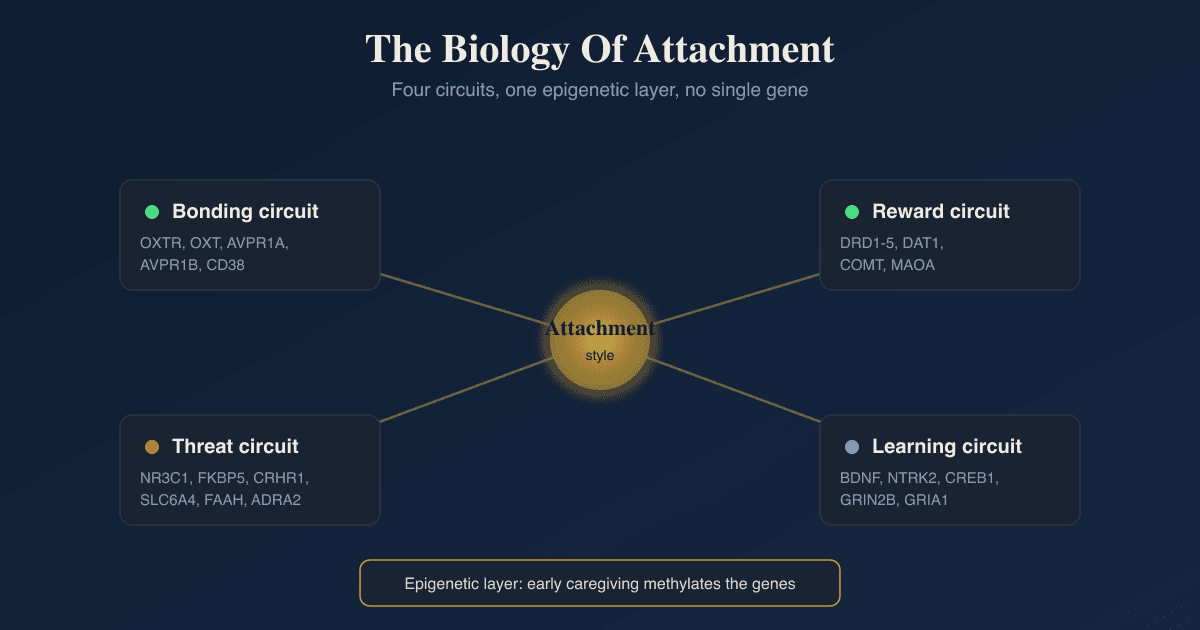
Oxytocin is the neuropeptide that tags closeness, trust, and social safety, and it does most of its work by binding the Oxytocin Receptor (OXTR) that the OXTR gene encodes.
How loudly that receptor is expressed is set in large part by methylation of the OXTR gene, where more methylation means the gene is read less and fewer receptors reach the cell surface. R
This turns out to be a cleaner epigenetic handle on attachment than anything in the COMT literature.
Higher OXTR methylation has been tied to autism-related social traits, blunted activation of social-brain regions, and high callous-unemotional traits, while lower methylation tracks with stronger oxytocin signaling and less attachment anxiety. R R
And that methylation is written early, since childhood maltreatment and low maternal care both raise OXTR methylation in ways that persist into adulthood. R R R
This is the same differential-susceptibility logic seen with COMT, where early caregiving leaves a durable epigenetic mark on a gene that governs how you do closeness.
The COMT connection is mechanistic rather than a single headline study, and it runs through dopamine.
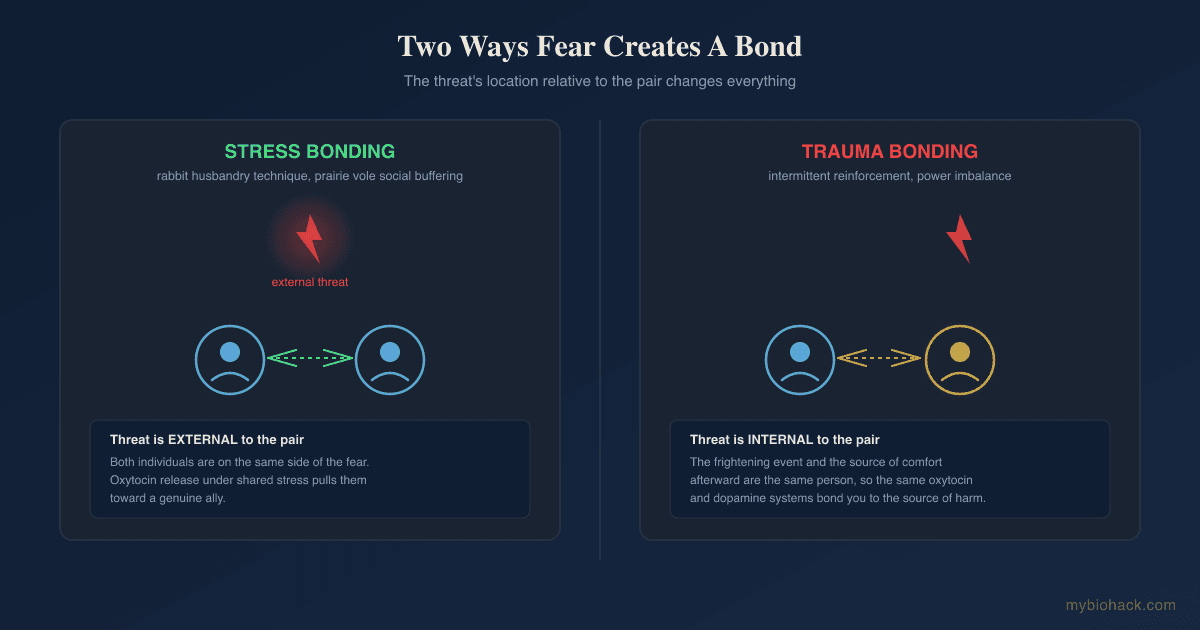
Oxytocin does not create bonding on its own, it works by gating dopamine in the brain's reward circuitry, and pair-bond formation in the nucleus accumbens requires oxytocin and dopamine D2 receptors to be activated together. R
That matters because COMT is the enzyme setting how much dopamine is available in those reward and prefrontal circuits for oxytocin to act on.
So the two genes sit on the same circuit from opposite ends, where OXTR sets the strength of the incoming bonding signal and COMT sets the catecholamine tone that signal has to land in.
A slow COMT that keeps the system in a high-catecholamine, threat-biased state can blunt how rewarding and safe an oxytocin-driven moment of closeness actually feels.
A degraded OXTR signal, from high methylation, can leave the bonding cue too quiet to register even when catecholamine tone is fine.
Insecure attachment, in this framing, can come from either dial being off, which is part of why it never maps cleanly onto a single genotype.
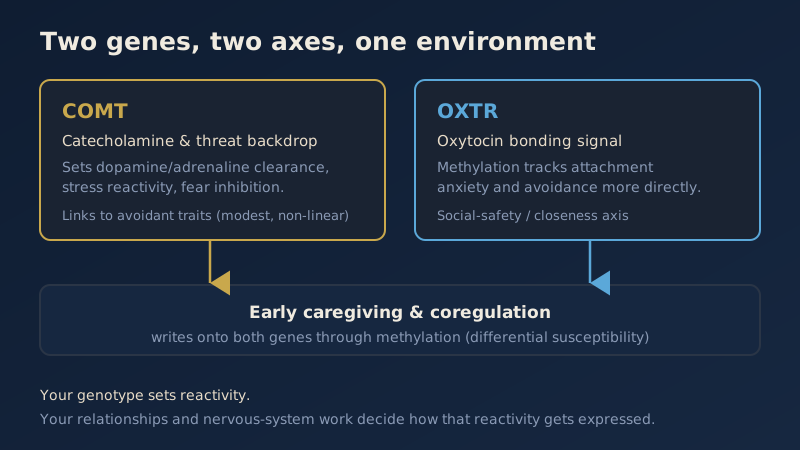
Both dials run on methylation, the same currency the methylation cycle spends, which is why the cofactor and nervous-system work that supports one tends to support the other.
Hold the COMT-to-OXTR crosstalk as mechanistic synthesis rather than settled fact, because direct studies measuring both genes together in humans are still sparse.
Why Genes Do Not Equal Destiny
The most replicated finding about COMT and behavior is not a main effect at all.
It is an interaction, where COMT genotype changes how strongly early environment shapes you.
In 252 healthy adults, early life adversity reshaped the adult cortisol stress response only in Met/Met carriers, who showed progressively blunted cortisol responses as childhood adversity increased, while Val/Val carriers stayed flat regardless of what happened to them. R
In children, the same variant moderated how parenting style translated into outcomes like proactive aggression, internalizing symptoms, and inhibitory control, with the direction depending on sex. R R
This is the differential susceptibility model, where the "risk" allele is better understood as a plasticity allele.
The same genotype that does worst under harsh caregiving often does best under warm, attuned caregiving, which means the genotype is indexing sensitivity to the environment, not a fixed trait. R
The environment writes onto these genes through methylation, which is the same currency COMT itself spends.
Low maternal care in childhood has been associated with altered DNA methylation of attachment-relevant genes including OXTR and BDNF in adulthood. R
The practical takeaway is that your rs4680 genotype sets your reactivity, but your nervous system and your relationships set how that reactivity gets expressed and, over time, how it is methylated.
This is also why I do not see people resolve threat-driven relational patterns through supplements alone, and why limbic and nervous-system work belongs at the foundation, not as an afterthought, alongside the same HPA axis work that any chronically activated stress system needs.
How To Support Healthy COMT Function
The goal is not to "fix" your genotype, it is to keep catecholamine clearance in a workable range and to stop pushing the enzyme in the wrong direction for your variant.
The single most important split is slow COMT (Met/Met, and to a lesser degree Val/Met) versus fast COMT (Val/Val), because the same supplement can help one and hurt the other.
1. Cover the methylation cofactors (everyone, slow COMT especially)
COMT cannot run without SAMe, and SAMe depends on B vitamins and magnesium, so cofactor status is upstream of everything else.
- Magnesium glycinate: the obligatory COMT cofactor, and glycinate is calming and well absorbed
- Pyridoxal-5-Phosphate (P5P): the active B6 needed across catecholamine and methylation metabolism
- Methylfolate and methyl-B12: dose to your MTHFR status, and start low if you are methylation-sensitive
- Riboflavin: supports the MTHFR enzyme so the methyl supply upstream of COMT holds up
2. Buffer an overactive catecholamine tone (slow COMT)
If you run slow, the problem is catecholamines lingering, so the support is calming the system and adding gentle, non-stimulating inhibitory tone.
- L-Theanine: raises alpha activity and takes the edge off catecholamine-driven overarousal without sedation, covered in depth in the theanine post
- Glycine: an inhibitory amino acid that is calming at night and also feeds methylation buffering
- Taurine: membrane-stabilizing, and dampens excitatory tone
- Magnesium L-threonate: crosses into the brain and supports NMDA modulation
3. Add methyl donors carefully (mainly fast COMT and undermethylators)
Methyl donors speed COMT by refilling SAMe, which helps fast clearers and overwhelms slow clearers, so this is the most genotype-dependent step.
- Trimethylglycine (TMG): a methyl donor via the BHMT pathway, useful for undermethylators, often too activating for Met/Met
- SAMe: the direct methyl donor COMT uses, which can lift mood in fast COMT or undermethylators but frequently causes anxiety and irritability in Met/Met carriers, so start very low and stop if you feel wired
4. Support dopamine synthesis (mainly fast COMT)
Fast clearers sit on lower prefrontal dopamine, so precursor support can help them where it would overstimulate a slow clearer.
- L-Tyrosine: the dopamine precursor, reasonable for Val/Val under stress, covered alongside tyrosine hydroxylase and dopamine synthesis, and usually a bad idea for Met/Met
- Creatine: spares SAMe, since creatine synthesis is one of the body's largest methyl sinks, freeing methyl groups for COMT
5. Keep estrogen clearance moving (slow COMT, especially women)
Because COMT clears catechol estrogens, anything that eases that load indirectly protects catecholamine clearance.
- Sulforaphane / broccoli sprout extract: an NRF2 activator that supports phase 2 estrogen and catechol detox, detailed in the sulforaphane post
- Calcium-D-glucarate: supports glucuronidation so estrogen metabolites get excreted rather than recirculated
- DIM: shifts estrogen metabolism toward the less reactive 2-hydroxy pathway
Lifestyle does real work here too, since fasting and ketosis lower the methylation and detox burden, and consistent sleep keeps the catecholamine rhythm from spiking at the wrong times.
Matching Support To Your Pattern
One caveat has to come first, because it is the whole point of this article.
You cannot prescribe supplements by attachment style, since attachment style is a learned relational pattern and not a genotype.
What you can do is treat it as two separate dials and support each one, then let them intersect.
The first dial is your COMT speed and methylation status, which is a real supplement target.
The second dial is the nervous-system state your attachment pattern tends to run on, which is partly catecholamine-driven on COMT's side and partly oxytocin-driven on OXTR's side.
So you support the physiology underneath the pattern, and you bias the genotype-based protocol above toward the state you tend to run in.
- Anxious or preoccupied runs a hyperactivating strategy of hypervigilance, high arousal, and poor self-soothing, which physiologically looks like sympathetic dominance with lingering catecholamines, so it tends to overlap with the slow-COMT pattern. Lean into the catecholamine buffering and cofactor steps above, meaning magnesium glycinate, glycine, L-theanine, taurine, and magnesium L-threonate on top of P5P and methylfolate to keep COMT clearing, and be careful with high-dose methyl donors and stimulating dopamine precursors that push arousal even higher.
- Avoidant or dismissing runs a deactivating strategy of suppressed attachment needs and blunted reward from closeness, which is where the oxytocin-dopamine reward axis matters most. If you are a fast clearer, precursor and reward support like L-tyrosine and creatine plus the oxytocin-signaling nutrients below is reasonable, since flat-feeling closeness is partly a dopamine-availability problem, but if you are a slow clearer you should skip the tyrosine because the deactivation is not a low-catecholamine problem.
- Disorganized or fearful-avoidant oscillates between the two and is the most trauma-linked, and it maps onto the COMT Met/Met fear-inhibition deficit where the "you are safe now" signal does not land. Stabilize first with magnesium, glycine, and NMDA modulation from magnesium L-threonate and NAC on steady cofactors, and treat fear-extinction and limbic work as the main intervention rather than the supplements.
The oxytocin-signaling nutrients are a separate and preliminary lever aimed at the bonding half rather than the catecholamine half.
The ones with mechanistic support are modest but real, and they should be treated as early evidence rather than a protocol.
- Magnesium: oxytocin receptors appear to need magnesium to function, and it increases the action of oxytocin at the receptor
- Taurine: supports the calming, membrane-stabilizing tone that lets a bonding signal register in the first place
- Vitamin C: a cofactor for the amidation enzyme that finishes oxytocin into its active form
- Vitamin D: vitamin D response elements sit on the oxytocin and oxytocin-receptor genes, which is why vitamin D status may regulate oxytocin synthesis and response. R
None of this substitutes for the bonding behavior that actually drives endogenous oxytocin, which is the honest ceiling on the nutrient approach.
The one-line version is to test and support your COMT speed and methylation status directly, use your attachment pattern only to bias which direction you lean, and do the relational and limbic work for the attachment itself, because no supplement reorganizes an attachment strategy.
What To Stay Away From
These matter most if you run slow (Met/Met), because they slow COMT further or flood it with catecholamines it cannot clear.
- High-dose catechol-containing polyphenols: green tea catechins like EGCG, quercetin, and high-dose curcumin are direct COMT inhibitors, so for a slow clearer they can stack catecholamines and catechol estrogens, while a fast clearer often tolerates or even benefits from them
- Caffeine stacked on stress: pushes catecholamines a slow COMT is already struggling to clear
- High-dose methyl donors taken blindly: SAMe, TMG, and large methyl-B12 in Met/Met carriers commonly trigger anxiety, irritability, and insomnia
- L-DOPA and aggressive tyrosine dosing: in slow clearers this floods the exact pathway that is already backed up
- Unmanaged high-estrogen states: without detox support in slow-COMT women, since estrogen further suppresses the enzyme
None of these are universally bad.
They are bad pairings for a specific genotype, which is the whole point of testing first.
Testing
Genetics
The cleanest way to know your COMT speed is to read rs4680 directly.
I use the Methylation Genetics panel to assess COMT along with MTHFR, MTR, MTRR, and BHMT together, because COMT never acts alone and the methylation cycle around it determines how the variant actually expresses (Vibrant Wellness).
You can also pull rs4680, rs4633, rs4818, and rs6269 from 23andMe or Ancestry raw data, which lets you read the full COMT haplotype rather than a single SNP.
Blood And Urine Markers
Homocysteine is the practical readout of whether your methylation cycle has the SAMe to run COMT, and elevated levels suggest the upstream supply is constrained. R
I use the Homocysteine with B12 and Folate panel to see the methylation status and the cofactors in one draw (Quest Diagnostics).
For the estrogen side of COMT, the Hormone Zoomer maps estrogen metabolism and the 2-hydroxy versus 4-hydroxy pathways that COMT is responsible for clearing (Vibrant Wellness).
The DUTCH Complete is the alternative I reach for when I want methylated estrogen metabolites quantified directly in urine (Precision Analytical).
Functional Lab Panels
The Cellular Zoomer covers organic acids and methylation markers, which is useful when you want to see how the catecholamine and methylation machinery is performing rather than just the genotype (Vibrant Wellness).
If you want a full baseline first, the Foundation Zoomer gives CBC, metabolic, thyroid, and liver markers so you are not interpreting COMT in a vacuum (Vibrant Wellness).
For interpreting any of this against your symptoms and history, this is exactly the kind of bioindividual puzzle a consult is built for.
Mechanisms Of Action
Simple:
- COMT is the cleanup crew for dopamine and adrenaline, and the Met version of the gene works slower, so those signals stick around longer.
- Slower cleanup means a higher baseline of stress chemicals, which is calm and sharp when life is calm, but tips into anxiety and overwhelm under pressure.
Advanced:
- Methylation-dependent O-methylation COMT transfers a methyl group from SAMe to a hydroxyl on the catechol ring, requiring a magnesium ion in the active site, which makes catecholamine clearance a direct draw on the SAMe pool shared with DNA, phospholipid, creatine, and estrogen methylation. R
- Val158Met thermostability the valine-to-methionine substitution at codon 158 reduces the enzyme's thermal stability and drops activity three to four-fold, lowering catecholamine clearance capacity rather than substrate affinity. R R
- Prefrontal inverted-U dopamine dynamics because the prefrontal cortex lacks dense dopamine transporters, COMT is the rate-limiting clearance step, so genotype sets resting prefrontal dopamine on an inverted-U where stress-induced tyrosine-hydroxylase-driven dopamine release moves Met/Met carriers past optimum and Val/Val carriers toward it. R
- Catechol estrogen clearance and estrogen feedback COMT O-methylates 2-OH and 4-OH catechol estrogens for excretion, while estrogen transcriptionally downregulates COMT, creating a feedback loop where high-estrogen states functionally slow the enzyme beyond what genotype predicts. R
- Oxytocin-dopamine gating of bonding oxytocin promotes pair bonding by acting together with dopamine D2 receptors in the nucleus accumbens, so the catecholamine tone COMT controls helps set how strongly an oxytocin signal registers as rewarding. R
- Epigenetic regulation of fear inhibition promoter methylation at COMT CpG sites modifies the Met/Met phenotype, and specific methylated sites track with impaired fear inhibition to safety signals, linking the genetic clearance defect to a learned-safety deficit that overlaps with insecure attachment. R
Genetics
COMT
COMT encodes catechol-O-methyltransferase, the enzyme that methylates and clears catecholamines and catechol estrogens.
Variants change how fast that clearance runs, which shifts prefrontal dopamine tone, stress reactivity, pain sensitivity, and estrogen-metabolite load.
rs4680 (Val158Met) — the A (Met) allele lowers enzyme activity three to four-fold for slower catecholamine clearance and higher baseline dopamine, the G (Val) allele clears fast. R
rs4633 — a synonymous variant in tight linkage with rs4680 that is part of the functional COMT haplotype affecting enzyme expression and pain sensitivity.
rs4818 — influences COMT translation efficiency and, combined with rs4680, defines the low, average, and high pain-sensitivity haplotypes that single-SNP testing misses.
rs6269 — a promoter-region variant that, with rs4633, rs4818, and rs4680, forms the haplotype that predicts COMT activity more accurately than rs4680 alone.
MTHFR (interacting)
MTHFR encodes the enzyme that produces 5-MTHF, the folate form that regenerates methionine and ultimately SAMe.
Reduced MTHFR activity constrains the SAMe that COMT depends on, so an MTHFR variant can make a fast genotype behave slow.
rs1801133 (C677T) — the T allele reduces enzyme activity and can lower the SAMe supply COMT needs, compounding a slow rs4680, covered in the MTHFR post.
OXTR (attachment-relevant, separate axis)
OXTR encodes the oxytocin receptor, the docking site for the bonding and social-safety signal.
Its methylation state, more than COMT, tracks attachment anxiety and avoidance directly.
rs53576 and OXTR promoter methylation — lower methylation associates with higher plasma oxytocin and less attachment anxiety in younger adults. R R
More Research
For methylation and catecholamine biomarker testing I use the Methylation Genetics panel and the Cellular Zoomer together, since genotype plus functional methylation markers tell you more than either alone.
Attachment research on COMT is real but should be held loosely, because the cleanest published link runs through avoidant attachment with a positive-heterosis pattern where heterozygotes scored highest, which does not match the simple "Met is anxious, Val is avoidant" claims circulating online. R
OXTR methylation is the more direct molecular handle on attachment, and pairing it conceptually with COMT gives a fuller picture than either gene alone, since one sets the bonding signal and the other sets the catecholamine tone it lands in. R R
Differential susceptibility is the most useful frame, since the Met allele behaves as a plasticity allele that does worst under harsh environments and best under warm ones, so the same genotype can read as a risk or an advantage depending entirely on caregiving. R
Sex strongly moderates everything here, because estrogen suppresses COMT and the COMT-personality and COMT-parenting effects repeatedly differ between men and women, so any COMT interpretation that ignores sex is incomplete. R R
The worrier-warrior dichotomy is a teaching tool, not a law, and its direction flips with stress level, sex, and outcome measured, so use it to understand your catecholamine tendencies, not to box yourself in. R
Jacob Gordon
INHC, FMT-C
Integrative Nutrition Health Coach
I cover mold illness, post-viral recovery, methylation, and complex chronic disease, drawing on ten years of clinical research, work inside a functional medicine clinic, and my own recovery from all of it. Every claim here is cited.
Book a ConsultationRelated Protocols & Supplements
Deep-dive chapters and recommended supplements for this topic
Lion's Mane
1000mg/day
Omega-3 (DHA)
2g/day
Phosphatidylserine
100mg 3x/day