Trauma Bonding vs. Stress Bonding: The Biology Of Bonding To The Person Hurting You
By Jacob Gordon, INHC, FMT-CTrauma bonding is the reason someone stays attached to a person who is hurting them, and unhealed attachment trauma is the reason the same pattern shows up again with the next partner or the next friend.
In this post, we will discuss what trauma bonding actually is, how it differs from stress bonding, a much gentler phenomenon borrowed from rabbit behavior, what drives the bond at a mechanistic level, how it overlaps with codependency, addiction, and personality disorders, why an unresolved bond follows you into a new relationship, and how to break the cycle.
Basics Of Trauma Bonding
Trauma bonding is a strong emotional attachment that forms to a person who alternates harm with affection, so that the same individual is both the source of the pain and the source of the relief from it.
The term was coined by psychologists Donald Dutton and Susan Painter, who proposed that two structural conditions are enough to produce it regardless of the relationship type: a power imbalance between the two people, and intermittent, unpredictable good treatment inside a pattern of bad treatment.
They tested the theory empirically in 75 women who had recently left abusive relationships and found that the strength of emotional attachment to the abuser correlated with how intermittent the abuse had been and how large the power differential was, and that attachment had only dropped by roughly 27% six months after leaving. R
That is the load-bearing finding in this entire field.
Leaving does not turn the bond off.
It starts a slow decay curve, and most people underestimate how long that curve takes.
Popular writing usually describes trauma bonding with a three-phase cycle: tension building, an incident, then reconciliation, sometimes with a fourth calm phase before tension starts climbing again.
That cycle structure predates the term itself and comes from Lenore Walker's 1979 cycle-of-violence model, but it maps cleanly onto what Dutton and Painter later showed drives the attachment.
Walker's model itself has only been tested empirically once in a rigorous way, and the result was mixed: a daily time-series study of 16 women found just 3 of them actually followed the clean, periodic tension-incident-reconciliation pattern, while the rest showed more chaotic, non-cyclic dynamics. R
Treat the cycle as a real and useful subpattern, not a universal law every trauma bond obeys on schedule.
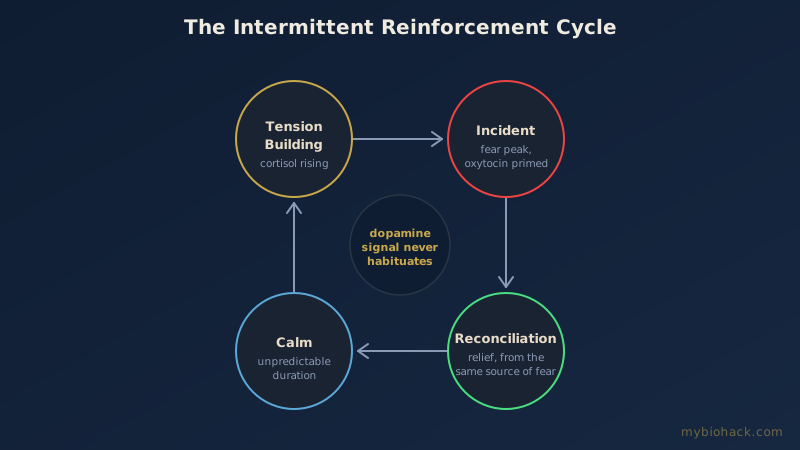
The reconciliation phase is doing the actual biological work.
It is not the absence of harm that people become attached to, it is the relief that follows the harm, delivered by the same person who caused it.
Most of the peer-reviewed literature on trauma bonding comes from severe, extreme populations, particularly sex trafficking survivors and their traffickers, not general dating relationships or friendships.
A 2022 scoping review of that literature identified the same recurring structure across studies: a power imbalance favoring the trafficker, deliberate and intentional alternation between positive and negative treatment, prior trauma history increasing a victim's vulnerability to the bond forming in the first place, and residual love for the trafficker persisting even after the survivor exits the situation, often enough to make her decline to testify against him. R
I want to be direct about what that means for the rest of this post.
The mechanism generalizes conceptually.
The evidence base does not automatically generalize to milder situations, a controlling boyfriend, a manipulative best friend, a parent who cycles between rage and doting attention.
Where the underlying structure, power imbalance plus unpredictable reinforcement, is present in a weaker form, expect a weaker version of the same bond, not the absence of one.
Trauma bonding is not limited to romantic partners.
The same power imbalance and intermittent reinforcement structure produces the identical attachment pattern with a friend who oscillates between making you feel like the most important person in the room and freezing you out, a parent, or a boss.
The label changes with the relationship, the underlying wiring does not.
Trauma Bonding Vs. Stress Bonding
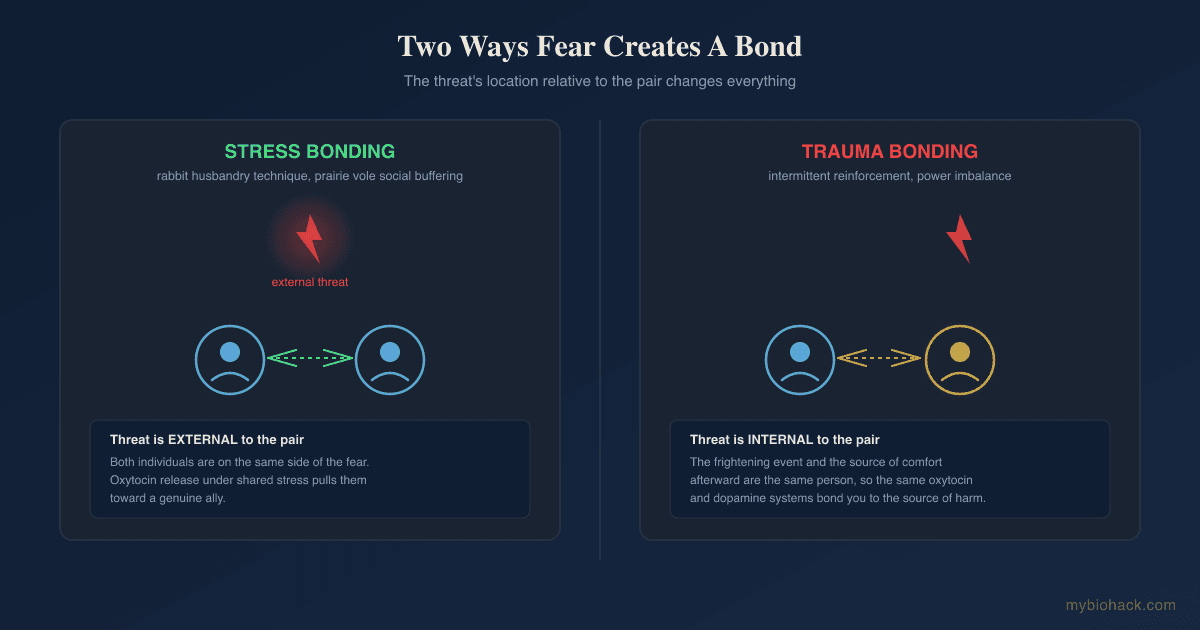
Stress bonding is a rabbit husbandry technique used to introduce two unfamiliar rabbits without a fight.
The two rabbits are placed together somewhere mildly frightening, an unfamiliar car, a bathtub, a new room, so that neither one feels safe enough to be territorial.
Rabbits are a prey species with a strong drive to seek proximity to another rabbit when afraid, so the shared, mild fear response pushes them toward each other instead of toward a fight, and a tentative friendship forms faster than it would in a neutral, low-stakes setting.
This is not a fringe folk technique.
It maps directly onto a real, well-documented mammalian bonding circuit.
The clearest animal data comes from prairie voles, a species that forms lifelong monogamous pair bonds and has become the standard model for the neuroendocrinology of bonding.
Oxytocin release in the paraventricular nucleus of the hypothalamus rises during stress, and in voles that are allowed to recover from stress next to a bonded partner, that oxytocin release stays elevated through the recovery period in a way it does not when the animal recovers alone.
Blocking oxytocin receptors during that window eliminates the anxiety-reducing and cortisol-reducing benefit of the partner's presence. R
The human version of this system is best described by psychologist Shelley Taylor's tend-and-befriend model, which proposed that alongside fight-or-flight, humans, especially under female-typical hormonal patterns, run a second stress response built around seeking social contact, mediated by oxytocin and modulated by estrogen and endogenous opioids. R
Fear and affiliation share circuitry.
That is the whole basis of the rabbit technique, and it is real biology, not folklore.
The human evidence is not limited to voles.
In 37 men put through a standardized stress test, the combination of social support from a friend and intranasal oxytocin produced lower cortisol and lower subjective stress than either alone, and lower than no support at all. R
Oxytocin and a genuinely supportive person are doing the same buffering job in a human stress lab that they do in a vole cage.
Here is where the analogy has to break, and this is the part worth sitting with.
In stress bonding, the threat is external to the pair.
The car, the bathtub, the new environment, whatever is frightening the two rabbits, is not either rabbit.
Both animals are on the same side of the fear, and the oxytocin-cortisol response pulls them toward a genuine ally.
In trauma bonding, the threat is internal to the pair.
The frightening event and the source of comfort afterward are the same person.
You are not two rabbits huddling against a shared outside danger.
You are one rabbit, and the bathtub occasionally pets you.
Taylor's later work made this distinction explicit at the physiological level: oxytocin released alongside positive, supportive contact reliably lowers stress, but oxytocin released alongside hostile or unsupportive contact from the same source can amplify the psychological and biological stress response instead of buffering it. R
Same hormone, same receptor system, opposite outcome, depending entirely on whether comfort and threat share an address.
That single variable, whether the thing you are bonding against is outside the relationship or is the relationship, is the entire difference between a rabbit making a friend and a person who cannot leave.
What Actually Drives The Bond
Stress-induced affiliation explains why fear and closeness get linked in the first place.
It does not explain why the bond gets stronger over time instead of weaker, and that is a separate mechanism: intermittent reinforcement.
Dopamine neurons do not simply fire in proportion to how good a reward is.
They fire in proportion to how unpredicted the reward is, a computation known as reward prediction error, and a fully predictable reward, even a large one, eventually stops generating much dopamine signal at all. R
This is the mechanism behind every variable-ratio reward schedule, including slot machines, and it shows up directly in the neuroimaging of gambling disorder, where anticipation of an uncertain reward drives disproportionate activation in dopaminergic reward circuitry compared to a certain one. R
A partner or friend who is warm on an unpredictable schedule is, from the reward system's point of view, running the same schedule as the machine.
I want to flag the honest limit of this claim.
No study has directly measured dopamine reward prediction error inside an ongoing abusive relationship.
What exists is the reward-neuroscience literature above, applied here as a mechanistic bridge because the reinforcement structure is identical, not because someone ran the scanner on it.
Treat it as the best available explanation, not a settled finding.
The addiction framing is not just a metaphor at the level of behavior.
An fMRI study of 15 people who had recently been rejected by a partner but were still describing themselves as intensely in love found activation in the ventral tegmental area and other reward and craving regions that functionally overlap with the circuitry activated by cocaine craving. R
Losing access to an intermittent-reward attachment figure recruits the same machinery as losing access to a drug, which is one reason "just leave" undersells how physiologically real the withdrawal is.
Layer the stress bonding mechanism from the previous section back on top of this, and the loop closes.
The incident phase produces fear, cortisol, and a spike in oxytocin release primed for affiliation.
The reconciliation phase then delivers the affiliative contact that oxytocin was primed to seek, from the only person available to provide it, who is also the person who caused the fear.
The unpredictability of when reconciliation arrives is what keeps the dopamine signal from habituating.
Three separate systems, threat-linked oxytocin, reward prediction error, and craving circuitry, are all pointed at the same target, and none of them are malfunctioning.
They are working exactly as designed, aimed at the wrong source.
Trauma Bonding And Overlapping Conditions
(not exclusive list)
- Addiction: the reward-prediction-error and craving-circuitry overlap covered above is not incidental, and insecure attachment patterns independently predict addictive behavior across substances and behaviors, with emotion dysregulation acting as the mediating pathway. R
- Attachment-driven substance use (self-medication framing): anxious attachment is the single strongest attachment-style predictor of substance use disorder risk in the theoretical and empirical literature reviewing this link. R
- Borderline personality disorder (BPD): the idealization-devaluation cycle commonly described in relationships involving BPD traits is a naturally occurring version of the intermittent reinforcement structure covered above, and a computational modeling study found people with BPD show a significantly stronger, more rigid, more all-or-nothing swing between idealizing and devaluing another person than controls do, when tested directly on social impression-formation tasks. R A systematic review separately found early childhood trauma is consistently and specifically associated with BPD development, more so than with most other personality disorders. R
- Codependency: I want to be direct about the evidence quality here the same way I was in Twin Codependency. Codependency has no entry in the DSM or ICD, no consensus operational definition, and the foundational psychometric work behind it has been criticized as imported wholesale from an outdated disturbed-personality model rather than empirically derived. R A 2026 integrative review of 30 studies described the construct as conceptually fragmented and recommended reframing it as a relational process rather than a fixed trait. R What the data does support is that codependent traits correlate heavily with basic personality dimensions and general psychopathology rather than forming a clean, separate construct, which fits trauma bonding better than a standalone diagnosis does: codependency looks less like a disorder you have and more like the behavioral residue of having been the less powerful person in an intermittent-reward relationship. R
- Narcissistic personality disorder (NPD): pathological narcissism in a partner is specifically associated with coercive control, the deliberate manufacturing of the power imbalance and unpredictability that trauma bonding runs on, in a study of 135 partners and relatives of people high in narcissistic traits, with personality disorder severity acting as an additional risk factor for coercive control specifically. R
- Personality disorders and intimate partner violence broadly: a meta-analysis of 163 studies found antisocial and borderline personality traits carry the most robust effect sizes predicting intimate partner violence perpetration of any personality pathology measured. R
A caveat that matters more than any single citation above: population-level statistics about personality disorders and abuse risk are not a diagnostic tool, and they are not a license to armchair-diagnose a partner or an ex from a blog post.
Most people with NPD or BPD traits are not abusive, and the traits exist on a spectrum in every person to some degree.
What the research supports is narrower and more useful: certain traits, when present and severe, make the specific reinforcement structure that produces trauma bonds easier to manufacture, intentionally or not.
Why Unhealed Relationships Follow You Into The Next One
Trauma bonding does not require an active relationship to keep exerting force.
An unresolved bond to an ex, or to a friend you never fully separated from emotionally, functions as a running attachment schema that shapes who feels familiar, who feels safe, and who feels boring in every relationship that comes after it.
Psychiatrist Bessel van der Kolk's foundational paper on this described it as the compulsion to repeat: disrupted attachment bonds from trauma produce durable behavioral effects, including an unconscious pull toward re-creating the same relational dynamic, even a harmful one, because it is the dynamic the nervous system has been trained to recognize as normal. R
Treat this the way it should be treated.
It is a well-established clinical framework built from decades of trauma treatment observation, not a randomized controlled trial, and it should carry the weight of clinical consensus rather than the weight of proven causation.
There is more direct evidence for the vulnerability half of the equation.
A study using the Adult Attachment Interview in 45 survivors of sex trafficking-related coercive bonding found that unresolved or insecure attachment stemming from earlier complex trauma increased vulnerability to entering a new coercive bond, and that the tactics involved were manipulative enough to eventually ensnare even people who started out securely attached. R
Read the second half of that finding carefully.
Secure attachment is protective, not immune.
A sufficiently deliberate, sufficiently patient bad actor can build the trauma bond structure from scratch on almost anyone, and prior unresolved trauma simply speeds up how fast it takes hold and how hard it is to interrupt.
The carryover is not only psychological.
A prolonged trauma bond leaves a measurable mark on the stress axis.
Allostatic load, the cumulative physiological wear of a chronically activated Hypothalamic-Pituitary-Adrenal (HPA) axis, is the framework that best describes what an intermittent-reward, high-threat relationship does to a body over months or years. R
A review of intimate partner violence survivors found flattened diurnal cortisol slopes, elevated evening cortisol, and a blunted cortisol awakening response, alongside broader inflammatory and epigenetic changes tied to chronic threat exposure. R
Hair cortisol, which reflects roughly three months of cumulative output rather than a single moment, has independently been shown to differ measurably between women with and without intimate partner violence exposure. R
A dysregulated cortisol rhythm does not reset the moment the relationship ends.
You do not walk into the next relationship with a clean stress axis, you walk in with whatever axis the last one built, and that axis is part of what makes chaos feel like home and calm feel like a red flag.
People already managing a chronically dysregulated nervous system from PTSD or another chronic condition are not starting from the same baseline as someone without that load, and the relational stress compounds rather than simply adding on top of it.
How To Break The Bond
1. Cut the reinforcement schedule completely
Partial contact does not slow the bond down, it refreshes it.
Because the attachment is being driven by an unpredictable reward schedule, any contact after a period of no contact, a text, a like, a mutual friend passing along news, functions exactly like an unpredicted reward hitting the reward prediction error system described above.
Full no-contact is not a moral stance, it is the only way to let an intermittent reinforcement schedule actually extinguish rather than get periodically renewed.
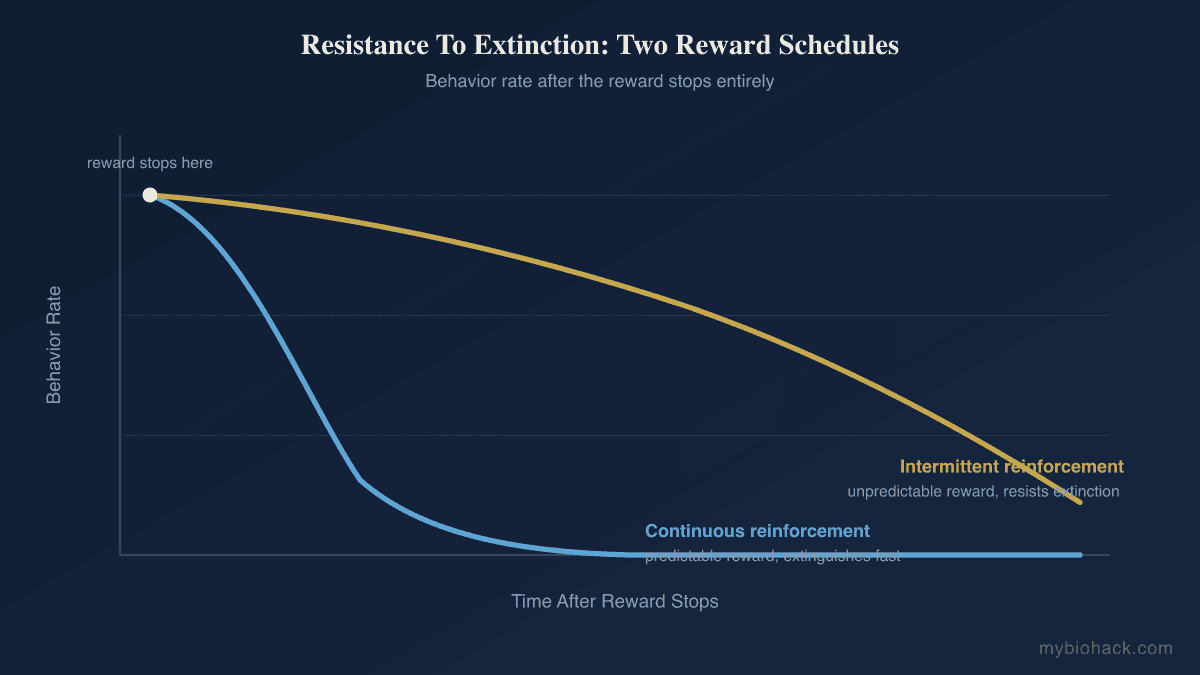
This has a name in behavioral psychology: the partial reinforcement extinction effect.
Behavior trained on an intermittent schedule takes measurably longer to extinguish than behavior trained on a consistent one, a finding that holds up in modern controlled human testing. R
A computational model built on the same dopaminergic reward-prediction-error machinery covered in the mechanism section proposes why: intermittent reward builds an additional "omission expectancy" that has to be unlearned on top of the original association, which is a theoretical framework rather than direct neuroimaging evidence, but it fits cleanly with everything else in this post. R
2. Separate the nervous system work from the narrative work
Understanding intellectually why the relationship was harmful rarely resolves the physiological pull on its own, because the bond lives in the same threat and reward circuitry covered in the mechanism section, not primarily in conscious belief.
TRE (Tension And Trauma Releasing Exercises) targets the neurogenic tremor mechanism directly and is one of the more evidence-backed ways to discharge stored autonomic activation rather than just talk about it.
3. Rebuild coregulation with people who are actually safe
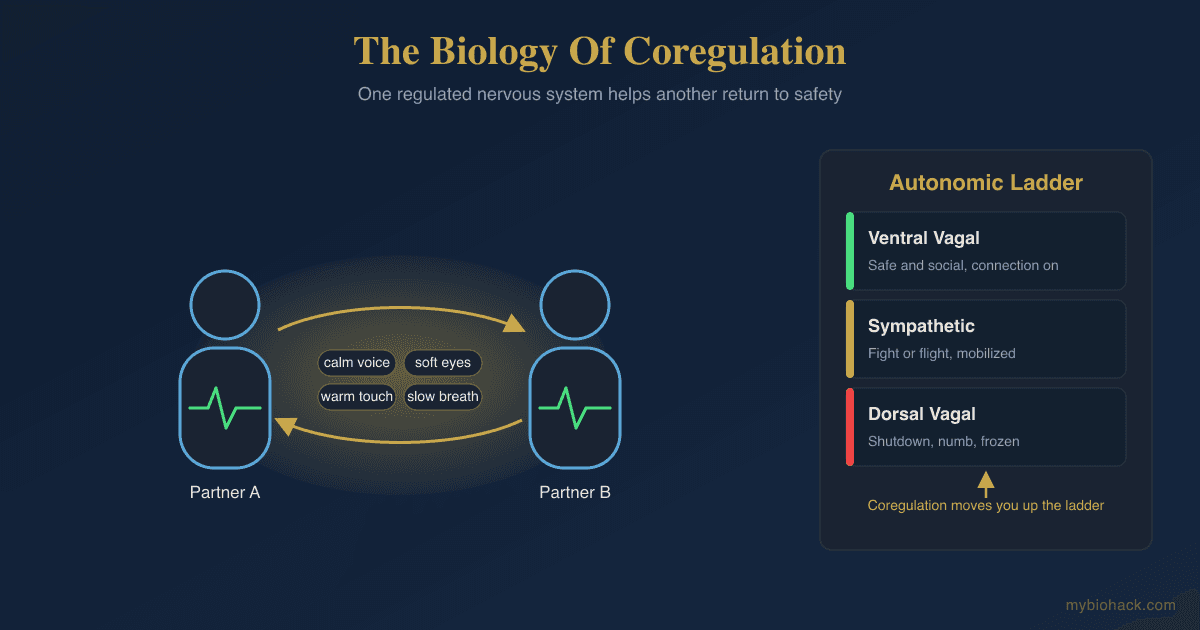
The oxytocin-driven pull toward proximity under stress is not the enemy, it is a normal system that got aimed at the wrong person.
Coregulation with a genuinely safe partner, friend, or therapist gives that same system a target that will not exploit it, and rebuilding the capacity to feel calm without vigilance is a slower, less dramatic process than the highs of the old relationship, which is exactly why it initially feels flat rather than good.
4. Work on fear extinction directly if the memory itself keeps firing
If specific memories or triggers keep reactivating the fear-reconciliation loop months or years later, that is a fear extinction problem, not a willpower problem, and HDAC inhibition and the epigenetics of fear extinction covers what is actually happening at the level of traumatic memory consolidation and how to work with it.
5. Expect the decay curve, do not expect a light switch
Dutton and Painter's own data showed attachment dropping by roughly a quarter after six months of no contact, not to zero. R
Plan your timeline around a slow decay, not a clean break, and do not treat a relapse in longing as evidence that the work is not working.
What To Stay Away From
(not exclusive list)
- Jumping straight into a new relationship to regulate the nervous system: this outsources the coregulation work covered above to someone new before your own baseline has stabilized, and it is how the same schema gets exported onto a person who did not create it
- "Just this once" contact: a single message, even a purely logistical one, can re-arm the entire reinforcement schedule described in the mechanism section
- Mistaking a calm partner for a boring one: a nervous system trained on chaos will interpret consistency as a lack of chemistry at first, which is a withdrawal symptom, not useful data
- Rumination framed as processing: replaying the relationship on a loop keeps cortisol and the reward system engaged with the same target rather than letting either one down-regulate
- Self-diagnosing or diagnosing an ex with a personality disorder from internet content: the population data in the overlapping conditions section describes group-level risk, not an individual verdict, and only a clinician assessing the actual person can make that call
- Treating "no contact" as punishment aimed at the other person: it is a physiological intervention aimed at your own reward circuitry, and reframing it that way makes it easier to sustain
Testing
There is no lab test for a trauma bond itself, but the physiological wreckage it leaves behind is measurable.
Cortisol Rhythm
A single morning cortisol draw misses the flattened diurnal slope and blunted cortisol awakening response documented in intimate partner violence survivors. R
I use the Hormone Zoomer (Vibrant Wellness) or the DUTCH Complete (Precision Analytical) to map the full diurnal curve rather than a single point.
Heart Rate Variability
Heart rate variability is the most accessible ongoing window into how activated your autonomic nervous system is running, and it is more useful tracked as a weekly trend on a wearable than as a single number. R
A rising baseline over the weeks after no-contact begins is one of the more honest signals that your physiology is actually decoupling from the old reinforcement schedule, independent of how you feel emotionally on any given day.
Inflammatory Markers
Chronic threat exposure and a dysregulated stress axis both feed systemic inflammation, so hsCRP and IL-6 are worth tracking alongside the hormone picture, which I assess with the Cardio Zoomer (Vibrant Wellness).
A note on oxytocin specifically: peripheral blood oxytocin does not reliably reflect central nervous system oxytocin activity, so despite how central it is to everything in this post, I do not recommend testing it directly.
If you want any of this interpreted against your full clinical picture, that is what a consultation is for.
Mechanisms Of Action
Simple:
- Fear and comfort share neural wiring, so a person who alternates between scaring you and comforting you gets bonded to on both counts
- Unpredictable warmth trains your brain's reward system harder than reliable warmth does, the same reason slot machines are more compelling than a vending machine
- Ending contact does not erase the bond, it starts a slow biological decay process that takes months, not days
- Chronic stress from the relationship reshapes your cortisol rhythm, and that reshaped rhythm is still running when the next relationship starts
Advanced:
- Reward prediction error in midbrain dopamine neurons scales with how unpredicted a reward is rather than with its absolute value, so a fully predictable reward stops generating a dopaminergic signal over time while an intermittent one keeps generating a strong one indefinitely, which is the computational basis for why variable-ratio reinforcement outcompetes consistent reinforcement at driving attachment. R
- Oxytocin release in the paraventricular nucleus rises during acute stress and, in the presence of a bonded affiliative target, stays elevated through the recovery window in a way that buffers cortisol and anxiety, an effect that is eliminated by oxytocin receptor blockade, meaning the calming effect of proximity is causally oxytocin-dependent rather than incidental. R
- Ventral tegmental area and striatal craving circuitry activate during romantic rejection in a pattern that functionally overlaps with substance craving circuitry, which is the mechanistic basis for describing withdrawal from an intermittent-reward relationship in addiction terms rather than purely emotional ones. R
- Allostatic load from chronic HPA axis activation produces cumulative wear across the endocrine, immune, and cardiovascular systems, distinct from an acute stress response, and is the framework for why a trauma-bonded relationship leaves lasting physiological residue rather than resolving once the relationship ends. R
Genetics
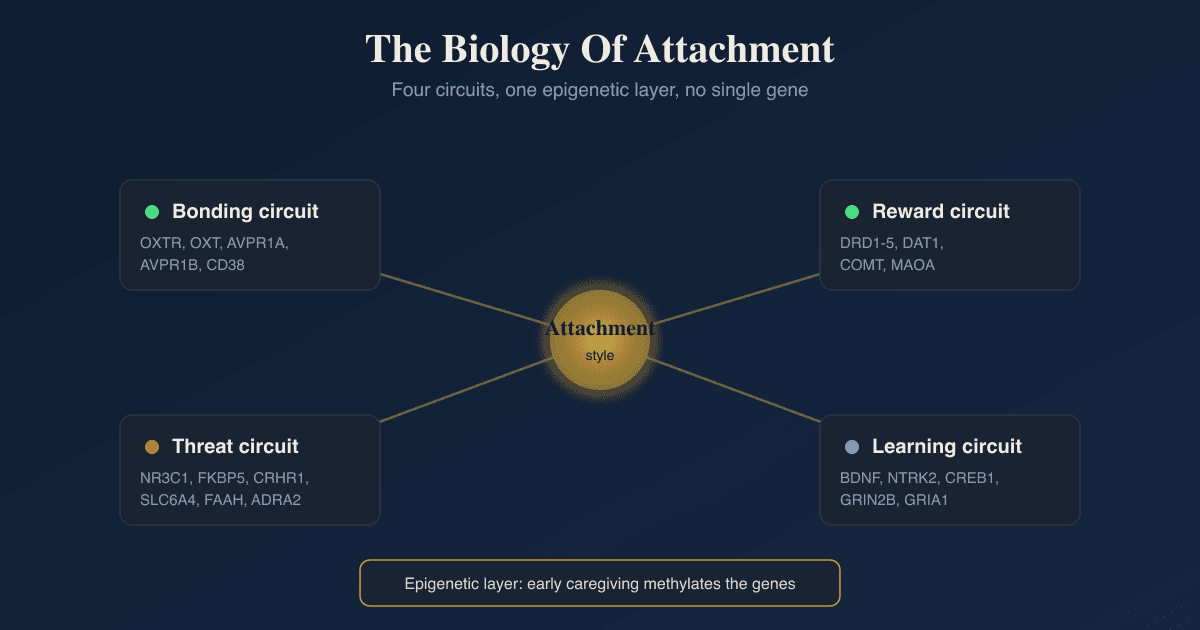
The genetics of bonding and stress reactivity are covered in far more depth in The Epigenetics Of Attachment Style and COMT Genetics And Attachment Style, so this section stays narrow to the two genes most directly relevant to trauma bonding specifically.
OXTR
Encodes the oxytocin receptor, the direct target of the affiliative bonding signal covered throughout this post.
Variation in OXTR has been associated with differences in social sensitivity and stress buffering from close relationships.
In 194 healthy men, carriers of the common rs53576 G-allele who received social support before a stress test showed significantly lower cortisol and subjective stress than AA homozygotes given the same support, meaning the same supportive contact buffers some genotypes far more than others. R
That plausibly affects how strongly a given person's affiliation system responds when oxytocin and cortisol are co-released around the same partner, though effect sizes for OXTR and relationship quality specifically, as opposed to general stress buffering, run smaller and less consistent, the same replication caution covered in full in the attachment epigenetics post linked above.
CRHR1
Encodes the receptor for corticotropin-releasing hormone, the first hormone released in the HPA axis cascade that ultimately produces cortisol.
Variants here shape how reactive a person's stress axis is to an unpredictable environment in the first place, which is relevant to trauma bonding because a more reactive stress axis means more frequent, more intense activation of the exact fear-then-relief cycle that drives the bond.
In 422 adults, CRHR1 genotype moderated how strongly childhood abuse predicted adult depressive symptoms, with certain variants amplifying the effect of an unpredictable, threatening early environment and others buffering against it. R
More Research
- Codependency's evidentiary weakness is the single biggest handle-with-care item in this entire post. It is a popular clinical framework with partial grounding in attachment theory, not a validated diagnostic construct, and treating it as more settled than it is does a disservice to how genuinely useful the concept still is descriptively. R
- No one has run the direct study this post is built around. A design that measures dopamine reward prediction error or real-time oxytocin and cortisol co-release inside an active, ongoing intermittent-reward relationship, human or animal, does not appear to exist yet, and it would settle a great deal that is currently bridged from adjacent literatures.
- Secure attachment reduces but does not eliminate vulnerability to a new coercive bond. A study using structured attachment interviews found manipulative bonding tactics were sufficient to eventually ensnare even securely attached individuals, not just those with prior trauma. R Resist the instinct to treat a strong attachment history as full protection against this happening again.
- The prairie vole and rabbit stress-bonding parallels are animal models of bonding under shared external threat, not bonding to the threat itself. R They explain the shared circuitry convincingly, but no animal model directly replicates a bonded pair where one animal is both the threat and the safe haven, which is the specific configuration that makes human trauma bonding so hard to escape.
- The trauma bonding literature is disproportionately built on severe populations, sex trafficking survivors and women who have left physically abusive relationships, not milder situationships or friendships. The structural mechanism almost certainly scales down, but the dose-response relationship between severity of intermittent reinforcement and strength of bond has not actually been measured across that full range.
- Vasopressin, oxytocin's close structural relative, plays a parallel role in male-typical pair bonding and stress response that this post did not have room to cover in depth. Vasopressin is worth reading alongside this post for the fuller hormonal picture.
For personalized guidance working through any of this, including sequencing the nervous system work against the relational work, you can book a consultation.
Jacob Gordon
INHC, FMT-C
Integrative Nutrition Health Coach
I cover mold illness, post-viral recovery, methylation, and complex chronic disease, drawing on ten years of clinical research, work inside a functional medicine clinic, and my own recovery from all of it. Every claim here is cited.
Book a ConsultationRelated Protocols & Supplements
Deep-dive chapters and recommended supplements for this topic
Lion's Mane
1000mg/day
Omega-3 (DHA)
2g/day
Phosphatidylserine
100mg 3x/day