TRE (Tension And Trauma Releasing Exercises): The Neurogenic Tremor Mechanism, The Evidence, And How To Do It Safely
By Jacob Gordon, INHC, FMT-CThis article contains affiliate links. As an Amazon Associate, MyBioHack earns from qualifying purchases at no extra cost to you. We only link products we research and stand behind.
TRE is a set of physical exercises that fatigue the muscles around the hips and legs until the body produces an involuntary tremor, on the theory that this shaking discharges the survival activation a stressed nervous system stores and cannot switch off.
In this post, we will discuss what TRE actually is, the neurogenic tremor mechanism it uses, what it does to your autonomic nervous system, how it fits the conditions I work with, how to do it safely, what to avoid, how to test the systems it targets, the mechanisms of action, and the genetics that shape your stress response.
What TRE Is
Tension And Trauma Releasing Exercises (TRE) is a somatic self-help practice built around a single physiological event: a self-induced, involuntary muscular tremor.
It was developed in the 1990s by David Berceli, a social worker and trauma specialist who worked in conflict zones and noticed that people instinctively shook during and after bombings.
The method is a short sequence of exercises that fatigue the legs, hips, and deep core until the muscles begin to tremble on their own, at which point you lie down and let the tremor run.
Berceli called this a neurogenic tremor, meaning a tremor generated by the nervous system rather than by cold or fear alone.
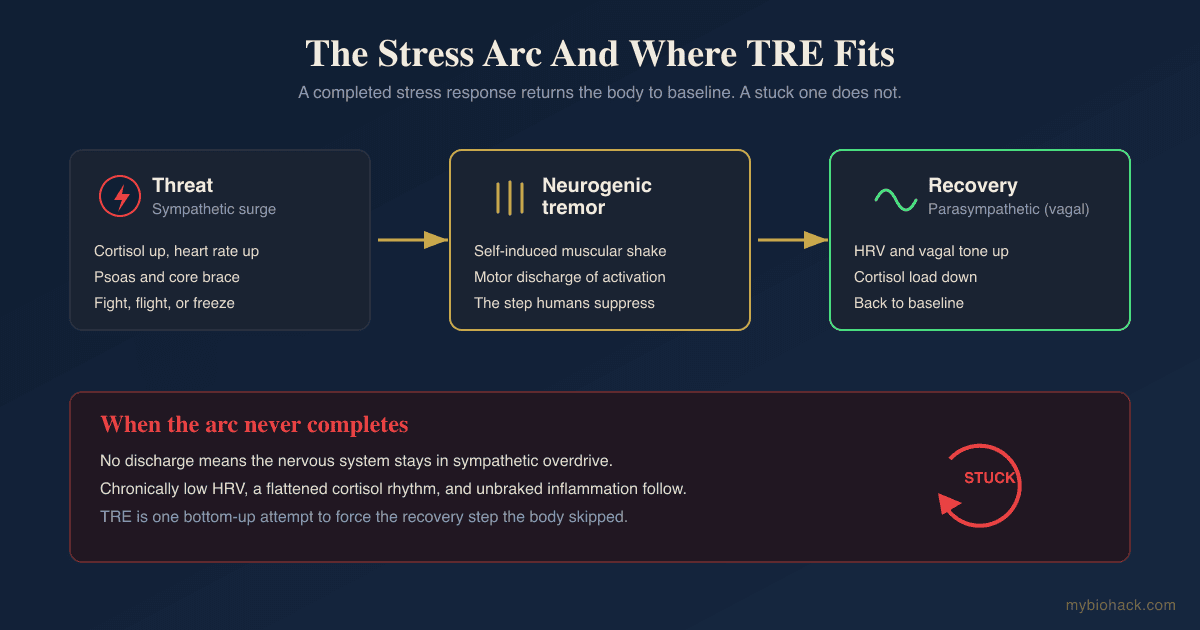
The underlying claim is borrowed from animal behavior: a gazelle that escapes a predator will often tremble violently for a minute and then walk away as if nothing happened.
The idea is that the tremble completes the stress response and returns the animal to baseline, and that humans suppress this same reflex and stay stuck in activation instead.
I want to be honest about the category here before going further.
TRE is a nervous-system self-regulation practice, not a medical treatment, and the direct clinical evidence for it is early and thin, meaning small pilots and a handful of small trials, which I cover below.
What is not thin is the physiology of the systems TRE is trying to move, and that is where this post spends most of its time.
The Neurogenic Tremor Mechanism
The tremor in TRE is a fatigue-driven motor phenomenon, not magic.
When you hold a muscle in sustained low-level contraction to the point of fatigue, the feedback loops between muscle spindles, the spinal cord, and descending motor drive start to oscillate, and the limb shakes.
TRE deliberately targets the psoas and the surrounding hip flexors, the deep muscles that connect the lumbar spine to the femur and that reflexively contract when you curl into a protective posture.
The psoas is genuinely a postural and flexion muscle recruited when the body braces or crouches, which is why somatic practitioners call it a "fight or flight" muscle, although the specific claim that it "stores trauma" is a theoretical framing, not a demonstrated fact.
The more grounded version of the mechanism is a defensive-physiology argument.
Under threat, mammals run through a defense cascade of fight, flight, and freeze, and freezing in particular is a parasympathetically dominated state of behavioral inhibition with heart rate deceleration, distinct from the sympathetic acceleration of fight or flight. R
When the threat passes, the animal has to transition back out of that state, and post-threat trembling accompanies the return to a mobile baseline. R
TRE's premise is that voluntarily inducing a tremor gives a chronically activated human the same off-ramp.
This is a reasonable hypothesis, and it is plausible, but it is important to separate what is established from what is inferred.
What is established is that tremor is a real motor output and that the freeze-to-recovery transition in animals is real and involves autonomic shifts.
What is inferred is that a self-induced tremor in humans specifically "discharges stored trauma" through the same pathway.
That specific claim has not been isolated in a controlled human study, so you should treat it as the working model TRE is built on rather than as settled science.
One more distinction matters, especially for my readers.
The therapeutic tremor of TRE is something you produce on purpose and can stop at will, and it is not the same thing as the pathological body buzzing and internal tremors that show up in post-viral illness, dysautonomia, and nerve injury.
Those internal tremors are driven by adrenergic overactivation, hypoxia, hypoglycemia, and in some cases actual nerve damage and Wallerian degeneration, and they are not the same phenomenon as a fatigue-induced tremor you can turn off by straightening your legs.
What TRE Actually Does To Your Nervous System
The honest way to evaluate TRE is to look at the systems it is trying to move, because those systems are measurable even when the practice itself is under-studied.
TRE is aiming at one thing: shifting you out of sympathetic dominance and back toward parasympathetic (vagal) tone.
The autonomic nervous system (ANS) runs on a balance between the sympathetic "gas pedal" and the parasympathetic "brake," and chronic stress leaves people stuck with the gas pedal pressed.
The most practical window into that balance is heart rate variability (HRV), the beat-to-beat variation in your heart rate, which at rest is largely driven by vagal (parasympathetic) modulation. R
Higher resting HRV, and specifically the root mean square of successive differences (RMSSD), tracks with stronger cardiac vagal tone, and lower HRV is one of the most reproducible physiological signatures of chronic stress across the literature. R R
This is the lever every calming body practice pulls, and it is why the mechanism is credible even where TRE-specific trials are lacking.
Slow, diaphragmatic breathing at roughly six breaths per minute reliably raises HRV, increases respiratory sinus arrhythmia (RSA), and shifts sympatho-vagal balance toward the parasympathetic side. R
Trauma-sensitive yoga, another bottom-up body practice, produced clinically meaningful reductions in PTSD symptoms in a randomized controlled trial, with over half of the yoga group no longer meeting PTSD criteria afterward. R
TRE is trying to reach the same downshift through a different door, the door of motor discharge and muscular release, and the plausibility comes from the shared destination rather than from the specific route.
There is also an immune angle that matters for the chronically ill.
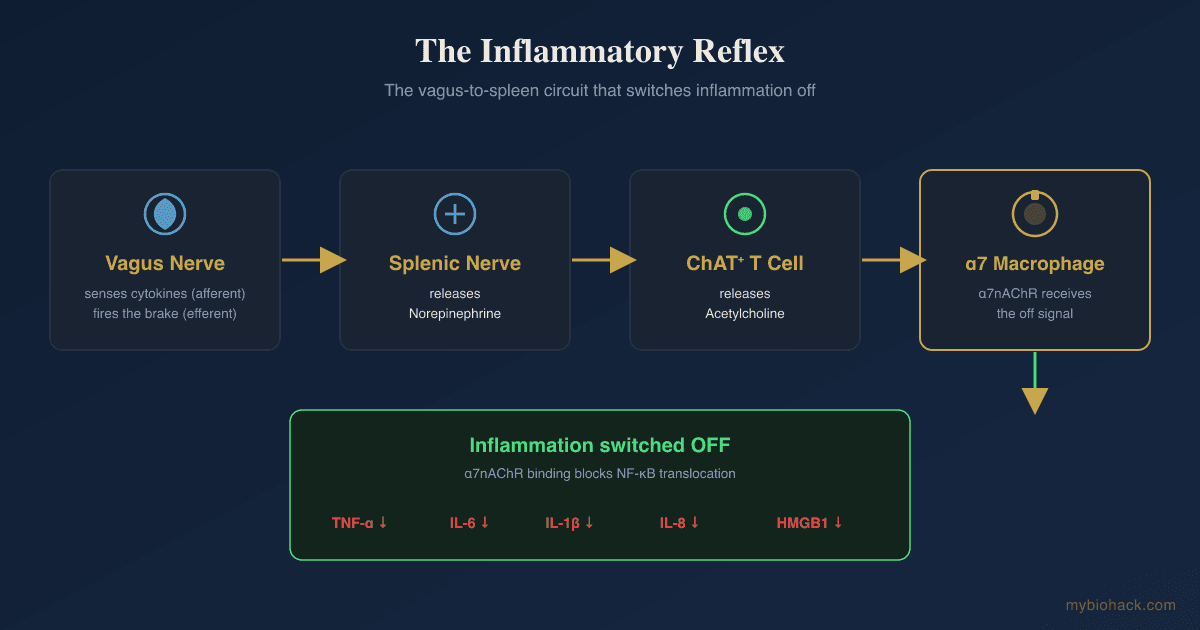
Vagal tone is not just about calm, it is anti-inflammatory through the cholinergic anti-inflammatory pathway, in which vagal signaling drives acetylcholine onto alpha-7 nicotinic receptors on macrophages and suppresses TNF-alpha and other inflammatory cytokines. R
That circuit is a large part of why restoring parasympathetic tone is not a soft, feel-good goal but a mechanistic one.
On the stress-hormone side, chronic activation keeps the hypothalamic-pituitary-adrenal (HPA) axis running hot, and over time the hippocampal glucocorticoid receptors that are supposed to shut cortisol off become desensitized, which degrades the negative feedback that normally ends the stress response. R
Anything that reliably triggers parasympathetic recovery takes load off that axis, which is the theoretical basis for TRE lowering perceived stress.
A note on the framing you will hear everywhere.
TRE is almost always explained through polyvagal theory, Stephen Porges's model of a hierarchy of vagal states, but I am going to avoid leaning on it, because the core physiological premises of polyvagal theory have been formally challenged in the peer-reviewed literature and several of its anatomical assumptions do not hold up. R
You do not need polyvagal theory to justify TRE.
The established autonomic physiology above, meaning vagal tone, HRV, the HPA axis, and the cholinergic anti-inflammatory pathway, is enough to explain why a practice that reliably produces parasympathetic recovery would help, and it does not require any contested claims.
TRE And Overlapping Conditions
The direct TRE trial evidence is small, so I will present it plainly and let you weigh it.
The strongest signal is in stress and fatigue populations rather than in any one disease.
In people with multiple sclerosis, an exploratory pilot found significant drops across all nine self-reported symptoms plus stress and fatigue, with the Modified Fatigue Impact Scale falling from 43.7 to 22.0 after a nine-week program. R
A subsequent small randomized controlled trial in people with multiple sclerosis reported the practice was safe and feasible with reductions in fatigue and stress, while noting the sample was small and larger trials are needed. R
A randomized controlled trial in restless legs syndrome used the TRE exercises specifically to fatigue the lower limbs and invoke therapeutic tremors, and reported reduced symptom severity relative to a control discussion group. R
The foundational pilot on the method itself found improved quality of life in non-professional caregivers who used self-induced therapeutic tremors. R
Every one of these studies is small, several are pilots, and some appear in low-impact journals, so the correct read is "promising and low-risk," not "proven."
For the conditions I work with most, TRE fits as one tool inside the nervous-system layer, not as a standalone fix.
Post-traumatic stress and nervous-system dysregulation are the most natural fit, and the broader body-based literature on yoga and breathwork supports bottom-up approaches for trauma even where TRE itself is under-studied, which is why I treat it alongside the material on coregulation and PTSD and overcoming trauma through the limbic system.
I will say this directly, because it is a load-bearing part of how I practice and how I recovered: I do not see people get better with all the supplements and modalities in the world without working on the subconscious, nervous-system layer, and TRE is one of the accessible, free entry points into that work.
For the POTS and dysautonomia population, TRE needs modification, because standing leg-fatigue work and a big autonomic swing can provoke symptoms in people whose vaso-adaptation is already impaired, so this group should do the tremor lying down and keep sessions short, as covered in the cautions below.
The same caution applies to the hypermobility, MCAS, and POTS triad, where connective tissue laxity means you must not push range of motion during the exercises.
How To Do TRE
The full method is a seven-exercise sequence that fatigues the calves, legs, and hips before eliciting the tremor, and it is worth learning the full version from a certified provider or Berceli's own materials, especially if you have a trauma history.
What follows is the safe, general shape of the practice, not a substitute for proper instruction.
The goal is titration, meaning you want a small, tolerable amount of tremor that leaves you calmer, not a big cathartic flood that leaves you wired or dissociated.
1. Set up a safe space
Use a padded floor and give yourself privacy and time, because feeling watched or rushed keeps you in sympathetic mode and defeats the purpose.
An exercise mat is the only equipment you need.
2. Fatigue the legs and hips
Do gentle, sustained lower-body work to pre-fatigue the muscles, for example calf raises held to fatigue, a wall sit held until the thighs shake, and slow standing hip movements.
The point is not a hard workout, it is enough sustained load that the muscles are primed to tremble.
3. Invoke the tremor lying down
Lie on your back, put the soles of your feet together, and let your knees fall open toward the floor, then lift the knees slightly toward the ceiling until you feel a tremor begin in the inner thighs.
Let the tremor happen on its own rather than forcing a shake, and if nothing comes, adjust the knee angle until the muscles find it.
4. Let it run, then stop early
Allow the tremor to move through the legs and pelvis, keeping your breathing slow and your jaw loose.
Start with five to ten minutes total for your first several sessions, and stop before you feel overwhelmed, because more is not better here.
5. Down-regulate and integrate
Straighten your legs to end the tremor, lie still for a few minutes, and let your system settle before you get up.
Slow breathing at about six breaths per minute during this phase reinforces the parasympathetic shift you just created. R
Stacking TRE with other nervous-system support
TRE works best as part of a broader down-regulation practice rather than in isolation, and a few low-risk supports pair well with it:
- Glycine, calming at the level of inhibitory neurotransmission and useful in the evening wind-down
- Magnesium glycinate, for muscular relaxation and nervous-system support, and note that oral is the route that matters because topical magnesium does not meaningfully cross the skin
- Theanine, which nudges alpha-wave activity and calm without sedation, with more in the post on theanine
Body-based practices that pull the same parasympathetic lever, like forest bathing and getting into the present moment, stack cleanly with TRE.
What To Stay Away From
TRE is low-risk for most healthy people, but it is not risk-free, and the failure modes are specific.
The biggest mistake is over-tremoring, meaning long, forced, cathartic sessions that flood an already dysregulated nervous system and leave you more activated, not less.
The following situations call for caution, professional supervision, or avoidance:
- Acute injury, recent surgery, or hernia, where the leg and core loading can strain healing tissue
- Active psychosis, severe dissociation, or unstable mental health, where an uncontained somatic release can worsen symptoms
- Dysautonomia and POTS, where the tremor should be done lying down with good hydration and kept short, because large autonomic swings and standing leg fatigue can provoke symptoms
- Epilepsy or an uncontrolled seizure disorder, given the involuntary motor activation involved
- Hypermobility and the Ehlers-Danlos spectrum, where you must not push joint range of motion during the fatigue exercises
- Pregnancy, where deep psoas and core work should be cleared with your provider first
- Severe or unmanaged cardiovascular disease, where any new physical exertion should be cleared first
- Severe PTSD or complex trauma, where the first sessions should be done with a certified TRE provider rather than alone, so the release stays titrated and contained
The general rule is simple: smaller and shorter, done consistently, beats big and dramatic.
Testing
TRE is free, so the testing here is not about qualifying for the practice, it is about objectively tracking the systems it targets so you know whether your nervous-system work is moving the needle.
Heart Rate Variability
HRV is the single most practical at-home metric for parasympathetic tone, and a wearable that reports morning RMSSD trends will show you whether your baseline is drifting up over weeks of practice.
Treat the trend over time as the signal, not any single day, because HRV is noisy and sensitive to sleep, alcohol, and illness. R
Cortisol Rhythm
Because TRE is aimed at HPA-axis load, a multi-point cortisol measurement is far more informative than a single morning blood draw, since chronically stressed and post-viral patients frequently have a flattened or shifted curve rather than a simple high or low value.
I use the Hormone Zoomer (Vibrant Wellness) to assess the cortisol rhythm alongside sex-hormone and estrogen-metabolism markers, and the DUTCH Complete (Precision Analytical) is an excellent urine-based alternative for mapping the daily cortisol pattern and its metabolites.
Inflammatory Markers
If your interest in TRE is downstream inflammation via the cholinergic anti-inflammatory pathway, it helps to have baseline inflammatory markers, and I use the Cardio Zoomer (Vibrant Wellness) for its inflammatory and endothelial panel, or the Foundation Zoomer (Vibrant Wellness) for a broad baseline including CBC, metabolic, and liver markers.
For The Dysautonomia Population
If you are approaching TRE as one piece of a post-viral or dysautonomia recovery plan, the POTS Bundle (Vibrant Wellness) combines the cellular, hormone, gut, and neural panels that map the systems underneath vaso-adaptation, and personalized interpretation is what a consultation is for.
Mechanisms Of Action
Simple:
- Fatiguing your leg and hip muscles makes them tremble on their own, and letting that tremble run while you breathe slowly helps flip your body out of stress mode and into recovery mode.
Advanced:
- Motor origin of the tremor Sustained submaximal contraction of the psoas and hip musculature drives muscle-spindle and Golgi-tendon feedback into an oscillatory regime, producing a low-frequency clonic tremor once descending motor control and afferent feedback desynchronize under fatigue, which is a peripheral motor event rather than a centrally commanded shake.
- Autonomic reweighting The practice targets a shift from sympathetic to parasympathetic dominance, indexed by rising HRV and RMSSD, both of which reflect vagal modulation of the sinoatrial node at rest. R
- Defense-cascade completion Freezing is a parasympathetically mediated immobility state distinct from sympathetic fight-or-flight, and post-threat motor discharge accompanies the transition back to a mobile baseline in animal models, which is the behavioral template TRE is attempting to recruit in humans. R
- Cholinergic anti-inflammatory signaling Increased vagal efferent activity releases acetylcholine onto alpha-7 nicotinic receptors on macrophages, attenuating TNF-alpha and other pro-inflammatory cytokines through the inflammatory reflex. R
- HPA-axis unloading Repeated parasympathetic recovery reduces sustained hypothalamic-pituitary-adrenal drive, relevant because chronic glucocorticoid exposure desensitizes hippocampal receptors and erodes the negative feedback that terminates the cortisol response. R
- Respiratory coupling Pairing the tremor and recovery phase with slow breathing near six breaths per minute augments respiratory sinus arrhythmia and baroreflex sensitivity, reinforcing the vagal shift the tremor is meant to trigger. R
Genetics
Your stress response is partly heritable, and a few variants shape how hard your nervous system swings and how well it recovers, which is useful context for why body-based practices land differently for different people.
COMT
COMT encodes catechol-O-methyltransferase, the enzyme that breaks down catecholamines like dopamine and noradrenaline in the prefrontal cortex.
The Val158Met variant changes enzyme activity, with Met carriers clearing catecholamines more slowly, and under stress this shifts prefrontal dopamine into a range that can degrade performance and emotional regulation.
rs4680: the Met allele (slower catecholamine clearance) interacts with early-life adversity to shape the adult cortisol response to psychological stress. R
FKBP5
FKBP5 encodes a co-chaperone that regulates the sensitivity of the glucocorticoid receptor and, through it, the HPA axis.
Risk variants raise FKBP5 expression in response to early stress and impair the shutoff of the cortisol response.
rs1360780: the risk allele interacts with childhood trauma to increase the risk of PTSD symptoms in adulthood. R
BDNF
BDNF encodes brain-derived neurotrophic factor, central to synaptic plasticity and to the fear-extinction learning that lets the nervous system unlearn a threat association.
The Val66Met variant reduces activity-dependent BDNF secretion.
rs6265: the Met allele alters fear-extinction circuitry and is linked to impaired fear extinction, which matters for how readily bottom-up and exposure-based approaches retrain the system. R
More Research
Evidence quality.
The direct TRE literature is early, meaning mostly small pilots, a few small randomized trials in multiple sclerosis and restless legs, case reports, and studies in low-impact journals, several of them run by people connected to the method, so selection and expectancy effects are real concerns and the honest verdict is promising and low-risk rather than proven.
The tremor-specific question is unanswered.
No controlled human study has isolated the tremor itself as the active ingredient, so it remains possible that the benefits people report come from the muscular fatigue, the lying-down recovery, the slow breathing, and the ritual of dedicated down-regulation, rather than from the shaking specifically, and a proper trial would compare TRE against a matched relaxation protocol without the tremor.
What would be convincing.
A well-powered randomized controlled trial with objective autonomic endpoints such as resting RMSSD, cortisol slope, and inflammatory cytokines, plus an active comparator, would settle whether TRE outperforms simpler parasympathetic practices, and until that exists TRE is best understood as one accessible option among several bottom-up nervous-system tools.
On polyvagal framing.
Most TRE explanations you will encounter rest on polyvagal theory, whose central premises have been challenged in the peer-reviewed literature, so I ground the rationale in established autonomic physiology instead, and you should be skeptical of any source that presents polyvagal claims as settled. R
Clinical measurement.
For tracking the systems TRE targets I use the Hormone Zoomer or DUTCH Complete for cortisol rhythm, the Cardio Zoomer for inflammatory and endothelial markers, and morning HRV trends from a wearable as the cheapest ongoing readout, and I treat all of them as trend data over weeks rather than single snapshots.
Jacob Gordon
INHC, FMT-C
Integrative Nutrition Health Coach
I cover mold illness, post-viral recovery, methylation, and complex chronic disease, drawing on ten years of clinical research, work inside a functional medicine clinic, and my own recovery from all of it. Every claim here is cited.
Book a ConsultationRelated Protocols & Supplements
Deep-dive chapters and recommended supplements for this topic
Lion's Mane
1000mg/day
Omega-3 (DHA)
2g/day
Phosphatidylserine
100mg 3x/day