Table of Contents
Chapter 28
Chapter 28 of 47

8 min readPro Guide

If You Skip This You Will SIGNIFICANTLY Hurt Your Progress Back To Your Old Self
People with post-viral illnesses very rarely get better without this next step.

I repeat, I do not see people get better (with all the supplements and modalities in the world) without working on your subconscious behaviors.

This is not me gaslighting you.

This is me speaking from vast experience and I will explain the science.

I can also walk you through the techniques and coach you on this in my weekly telegram group video calls.

If you skip this step, than this was just purely a fun book/blog post to read and not a transformation-able resource.

Remember this is all subconscious and you do not consciously realize this happens.

I did not have big movements in my health, until I started working on this.

The Reticular Formation

Your Reticular Formation (RF) is basically the part of your brain that is able to filter out what is not important and help you focus on your task or pay/not pay attention to something.

It also regulates things like sleep (consciousness and unconsciousness).

There are many hormones and neurotransmitters that affect it such as a orexin and histamine, but that's not what I'm going to talk about here and if you want to learn more about it see this post on the Reticular Activation System.

When we become aware or enlightened of something new, your reticular formation is able to pick up on that. On the other spectrum, your reticular formation is also able to block out background noise.

The reticular formation creates a filter in which way you see the world, it's kind of like looking through glasses or goggles.

Default Mode vs Task Positive Networks

The reticular formation depends highly on your Default Mode Network (DMN), the part of your brain that does and goes it pleases, will think and daydream, and will perform your subconscious tasks.

The default mode network is counterbalanced by your Task Positive Network (TPN) in which you can use your prefrontal cortex of the frontal lobe to executively oppose and control it.

Back to the glasses analogy before.

Meditation is awesome because it allows you to look at those glasses or goggles and see if the lens is dirty, smudgy, or is being blocked by something, etc...that way when you put the glasses back on you're able to see things more clearly.

Events and trauma (yes post viral illness is subconsciously traumatic)

You do not get to actively see your subconscious, but you can see it play out, if you pay attention to it.

The subconscious is the part of the brain that picks up on everything around you that the reticular formation hadn't filtered out.

It is highly influenced by meaning and emotion and is controlled by the limbic system.

The limbic system consists of the cingulate gyrus (acts as an emotional filter), the hypothalamus (regulates the autonomic nervous system), the hippocampus (forms and recalls memories), and the amygdala (responds to fear).

They all talk to each other in a complexification, and that's what we call the limbic system.

Through all of this, it's able to attach emotion and memory to your environment and events, and change the way you emotionally feel day to day subconsciously.

I am going to repeat subconsciously many many times because too many people think that they're not in trauma or in fight or flight and like I said you do not actively see your subconscious but you can see it play out if you pay attention to it.

I could talk about attention in the form of attention deficit which many people experience day to day but I don't think that's relevant to this discussion.

That's all about renewing saliency appropriately and there are many techniques that can entrain that process.

See my video on attention.

The Limbic System


The limbic system, like other parts of the body, likes to reserve energy and it does this by using loop-processing.

Essentially, it repeats itself over and over again, that's how happy people are able to be happy and stay happy, even through what should seem like a traumatic event, and why people in a trauma loop get stuck in a trauma loop. 

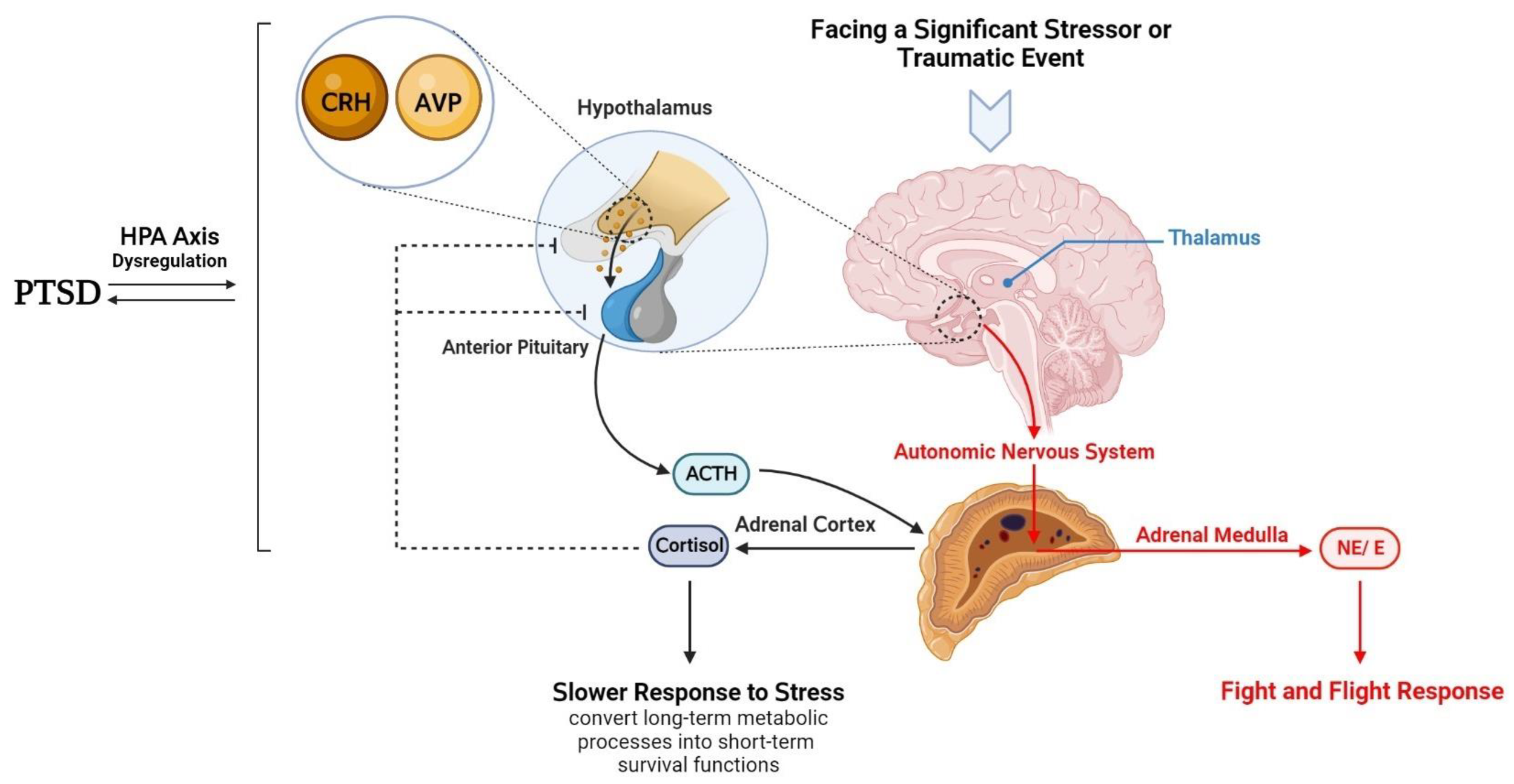
When stuck in a trauma loop, the hypothalamus puts your nervous system into a fight-or-flight sympathetic dominant state. It does this by signalling to the pituitary gland to release corticotropin releasing hormone (CRH).

That hormone tells the adrenal glands that sit on top of your kidneys to release cortisol.

The complex between the hypothalamus, pituitary, and adrenal glands is called the HPA-axis.

Back to cortisol. It is amazing!

Cortisol makes you strong and ready to fight.

Cortisol is awesome because makes you ready to go, take on the day, and feel strong.

It also has the powerful ability to dampen immune-based inflammation, that is why people are usually prescribed corticoids for autoimmune conditions.

If you are healthy, cortisol follows a circadian rhythm, it's higher in the morning and plateaus and falls throughout the day into the evening.

Having a flipped cortisol circadian rhythm will make you feel tired during the day and feel like you're finally waking up once the sun comes up.

You can test for that with a multi-capture point saliva test.

If you are stuck in this post viral trauma loop, subconsciously the HPA-axis continues to excrete CRH and thus cortisol.

The hippocampus has glucocorticoid receptors (GR) on it.

GRs are able to pick up on cortisol and this makes people feel that rush from cortisol inducing things. R

It also kind of inhibits your ability to create a clear picture right away.

What happens in this trauma-loop is that overstimulation of GRs, cause down-regulation of GR sensitivity in the hippocampus.

This is similar to how insulin hypersecrtion and binding causing insulin insensitivity and insulin resistance.

You can also get this with leptin and eating, called leptin resistance and thus you feel unsatiated after a big meal.

This down-regulation makes it harder for the hippocampus to form new memories and the best way I could describe it is that the world has lost it's color.

It makes things feel more dull, and many people relate this to depressive behaviors.

Adaptogens are really good for this GR desensitization process and HPA-axis imbalance, although it's not a fix, it is a helpful adjunct.

CRH can also cause mast cells to degranulate, so being stuck in this loop sets you up for histamine imbalances (see my post on histamine intolerance).


Central Sensitization and Desensitization

Sensitization and central sensitization happen through what are called transient receptor potential (TRP) receptors, notably TRPV1 and TRPA1.

You've probably experienced their effects from heat shock therapies, even as simple as capsaicin and from spicy food.

Transient Receptor Potential

TRP receptors can work for you or against you, and for those who have central sensitization they are working against you in a positive feedback loop.

The more you activate TRP, the more TRP receptors you make!

This is an adaptive process to protect you from threats.

Histamine makes TRP receptors express more often.

The key to fixing this process is not necessarily blocking it, but directing it in the way that you want to create connections.

You can do this through many psychotechnologies (tools that enhance brain fluency) such as meditation or Neuro Linguistic Programming aka NLP (which is my favorite as I use it for chemical sensitivities), or by increasing the variables and laying down tons of wire such as psilocybin, ketamine, or ayahuasca can help reset the reticular formation and default mode network.

Cognance is able to “tickle” the same 5HT2a receptors as psilocybin, thus enhancing /biohacking this process. R

“Turning Up The Variables” as I like to call it, creates synaptic plasticity through Brain Derived Neurotropic Factor (BDNF) as well as NGF, CNTFGDNF, CDNF, and MANF.

Things like Shinrin-yoku (Japanese word for forest bathing) and SSRIs also work on this pathway.

I am able to do this without drugs though and teach this.

I've only tried psilocybin a couple times during my high-school party days.

On my telegram group, I do weekly training.


If you're not utilizing these psychotechnologies, you are severly missing out on all the amazing things your nervous system can do!

Not Instant, It’s An Adaptation Process

Your brain is able to "lay down wire" (form neuronal connections) faster when it's connected to an emotion.

This is why many fearful and traumatic events we experience take up such great real estate in the brain.

That is why it's paramount when you're re-brainwashing (rewiring new wire and pruning old connections) yourself out of trauma to connect to positive emotions that you have and create positive associations from there.

Working on your limbic system and doing things like meditation do not work right away.

It’s Not A Vacation, It’s Exercise

Too many people think of meditation as a vacation and a way to relax, it is not.

It is an exercise.

And just like an exercise it needs time to adapt.

Let me ask you this: when you were healthy, how often were you ready to run a marathon after maxing out your work out?

For most people, I would say close to ZERO!

This is because your muscles and nerves need to go through an adaptation and remodeling process and you don't see that benefit until days or weeks later.

The same thing happens with the nerves in your brain.

Muscle memory is a poorly described term for what is more of nervous system memory.

Sample Training Technique

Explanation

Watch this video first before doing the training.

Training

Ok, now you’re ready for the practice.

This only works if it’s practiced.

Organizing Messy Thoughts

I developed the Tri-Split Method, which is is my favorite way to organize messy thoughts and get clarity on bullshit (trauma) vs truth (what you actually want).

End of Chapter 28
Up Next
Unlock with Pro