Vestibular Migraine and Chronic Vertigo: The Dysautonomia Connection
By Jacob Gordon, INHC, FMT-CThis article contains affiliate links. As an Amazon Associate, MyBioHack earns from qualifying purchases at no extra cost to you. We only link products we research and stand behind.
Vestibular migraine is the most common cause of recurrent spontaneous vertigo, and most people who have it are told they have an anxiety disorder or an inner-ear problem instead.
In this post, we will discuss what vestibular migraine actually is, how it differs from classic migraine and from inner-ear diseases like Meniere's and BPPV, the trigeminovascular mechanism that drives it, why it overlaps so heavily with POTS and mast cell activation, and an evidence-based approach to prevention and acute treatment.
Basics Of Vestibular Migraine
Vestibular Migraine (VM) is a migraine subtype in which the dominant symptom is vertigo or dizziness rather than head pain.
Many people with VM never get a classic headache during their attacks, which is exactly why it gets missed.
The diagnostic criteria were set jointly by the Bárány Society and the International Headache Society and sit in the appendix of the International Classification of Headache Disorders (ICHD-3). R
To meet criteria you need all of the following. R
- At least five episodes of moderate or severe vestibular symptoms lasting between 5 minutes and 72 hours
- A current or past history of migraine with or without aura per ICHD-3
- One or more migraine features during at least half of the episodes (headache with at least two of: one-sided, pulsating, moderate to severe, worse with activity; or photophobia plus phonophobia; or visual aura)
- Symptoms not better explained by another vestibular or headache diagnosis
The "vestibular symptoms" that qualify are not just spinning vertigo.
They include internal spinning, external spinning, positional vertigo triggered by head movement, visually induced vertigo, and head-motion-induced dizziness with nausea. R
Attacks can last minutes, hours, or up to three days, and the duration alone often does not match any single inner-ear disease, which is a diagnostic clue in itself.
Vestibular migraine affects roughly 1 to 3 percent of the general population and is far more common in women. R
It is the most common cause of recurrent spontaneous vertigo across all age groups, yet it remains underdiagnosed because clinicians anchor on the word "migraine" and expect a headache.
What Causes Vestibular Migraine
Vestibular migraine is not one thing.
It is the vestibular expression of the same underlying migraine brain, driven by a lowered threshold for neuronal activation and sensory processing gone haywire.
Root drivers and triggers (not an exclusive list):
- Cortical spreading depression (CSD), the slow wave of neuronal depolarization that underlies aura, which can spread into areas that process balance R
- Dysautonomia and orthostatic intolerance, which overlap with VM at high rates R
- Estrogen fluctuation, which is why many women flare perimenstrually and around perimenopause
- Genetic susceptibility, with a strong familial pattern and specific risk variants R
- Mast cell activation and histamine release near the meninges and inner ear R
- Sensory triggers such as bright or flickering light, visual motion, poor sleep, dehydration, weather and barometric shifts, alcohol (especially red wine), aged and fermented foods, and skipped meals
The core problem is not the trigger.
It is a nervous system that has a low threshold for switching into a migrainous state, so relatively ordinary inputs (a scrolling phone screen, a fluorescent-lit grocery aisle, standing up too fast) tip it over.
This is why a mechanistic approach beats a trigger-avoidance approach.
You can spend your life avoiding triggers, or you can raise the threshold so triggers stop mattering as much.
How The Trigeminovascular System Creates The Problem
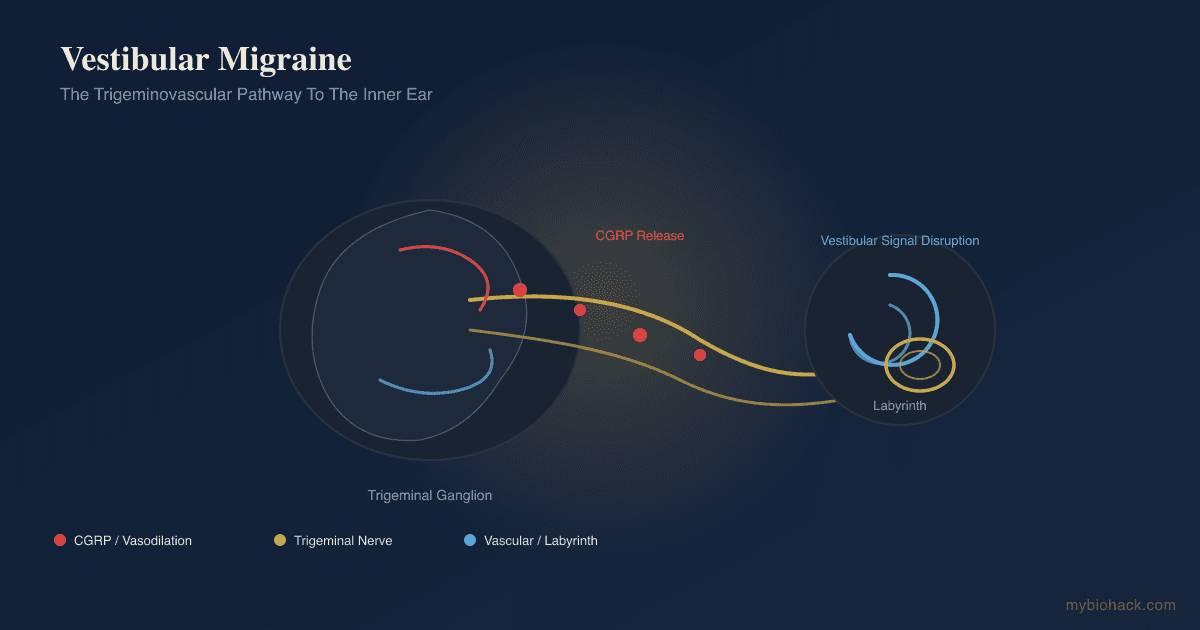
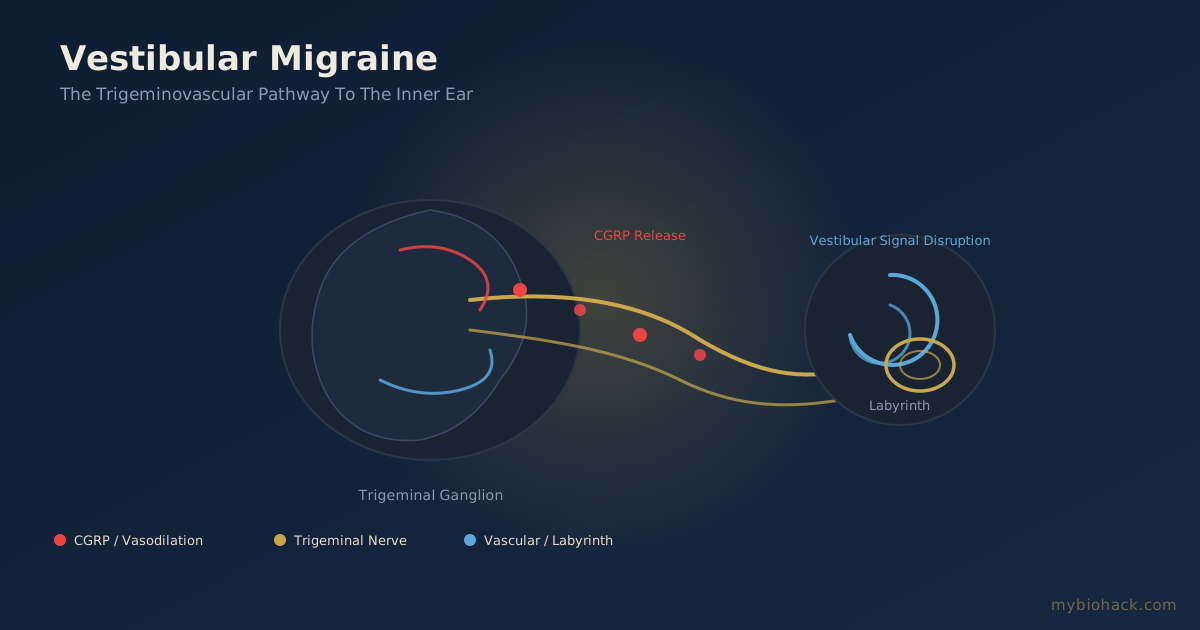
The engine of migraine is the trigeminovascular system, the network where the trigeminal nerve wraps around the blood vessels of the head and meninges.
When this system activates, trigeminal nerve endings release Calcitonin Gene-Related Peptide (CGRP), a potent vasodilating neuropeptide. R
CGRP release triggers vasodilation, increases nitric oxide synthesis, and sensitizes the trigeminal nerves so that normal signals start being read as pain and threat. R
In vestibular migraine, the twist is anatomical.
The trigeminal nerve also innervates the blood vessels of the inner ear (the labyrinth), and vasoactive neuropeptides sit in those perivascular nerve terminals. R
When the trigeminovascular system fires, it can drive plasma protein leakage and inflammatory mediator release right into the inner ear, plus there are direct reciprocal connections between the brainstem vestibular nuclei and the structures that process trigeminal pain signals. R
That is the short version of why a migraine can present as pure vertigo with no headache: the same neurochemical storm is being routed through balance circuits instead of, or in addition to, pain circuits.
Mast cells are the amplifier in this loop.
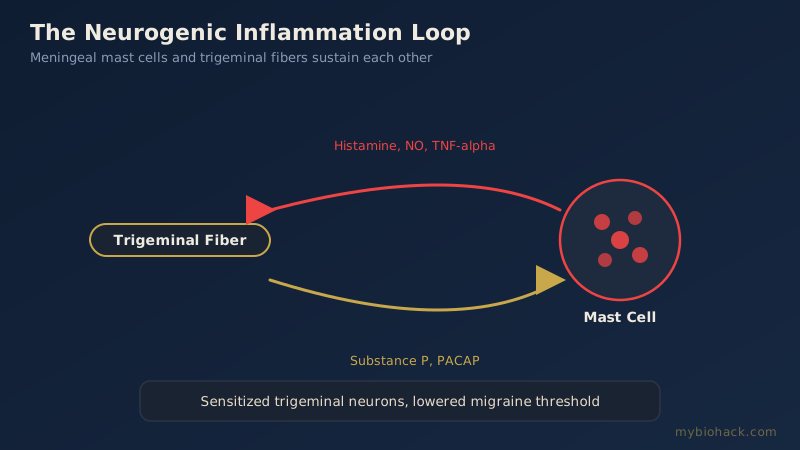
Meningeal mast cells sit right next to trigeminal nerve fibers, and when they degranulate they dump histamine, nitric oxide, and tumor necrosis factor alpha, all of which sensitize sensory neurons and dilate vessels. R
Neuropeptides released from those same sensory neurons, including substance P and PACAP, then degranulate the mast cells right back, creating a self-feeding neurogenic inflammation loop. R
This is the same substance P and neurogenic inflammation cycle that shows up across chronic illness, and it is a big reason histamine-driven people get vertigo.
Vestibular Migraine And Overlapping Conditions
Vestibular migraine rarely travels alone.
The most important overlaps to understand are the dysautonomia cluster, the mast cell cluster, and the inner-ear diseases it gets confused with.
POTS And Dysautonomia
Postural Orthostatic Tachycardia Syndrome (POTS) and vestibular migraine overlap to a degree that is hard to explain by chance.
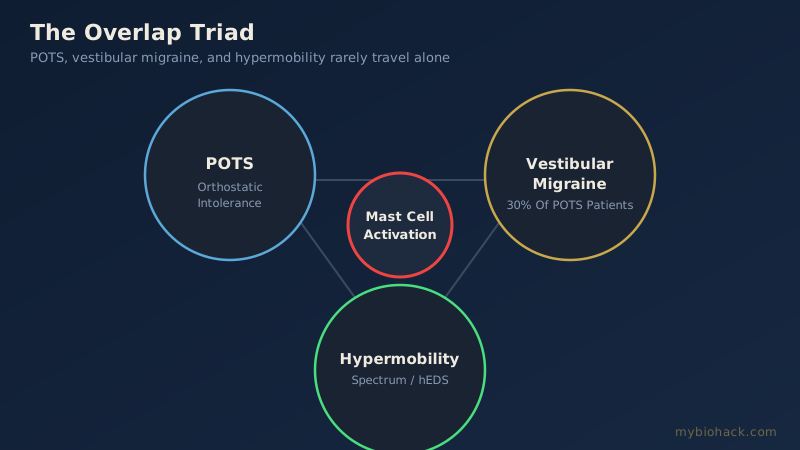
In a 2025 vestibular study of POTS patients, 84 percent had migraine and 30 percent met full criteria for vestibular migraine. R
Migraine is one of the most common comorbidities of POTS, hypermobility spectrum disorders, and mast cell activation syndrome, and the reverse is also true. R
If you have POTS and chronic dizziness, you have to sort out how much of the dizziness is orthostatic (blood pooling, poor cerebral perfusion on standing) versus how much is vestibular migraine, because the treatments differ.
This is where Jacob's Junction Dysfunction framework offers a hypothesis worth sitting with.
Jacob renames the vascular form of POTS Vaso-Adaptive Disorder (VAD), his hypothesis for a microvascular perfusion problem in POTS that would plausibly extend to the tightly vascularized inner ear and brainstem balance centers in someone who already has a migrainous threshold, though this remains Jacob's hypothesis rather than established science.
His deeper writeup lives in microcapillaries and vascular POTS.
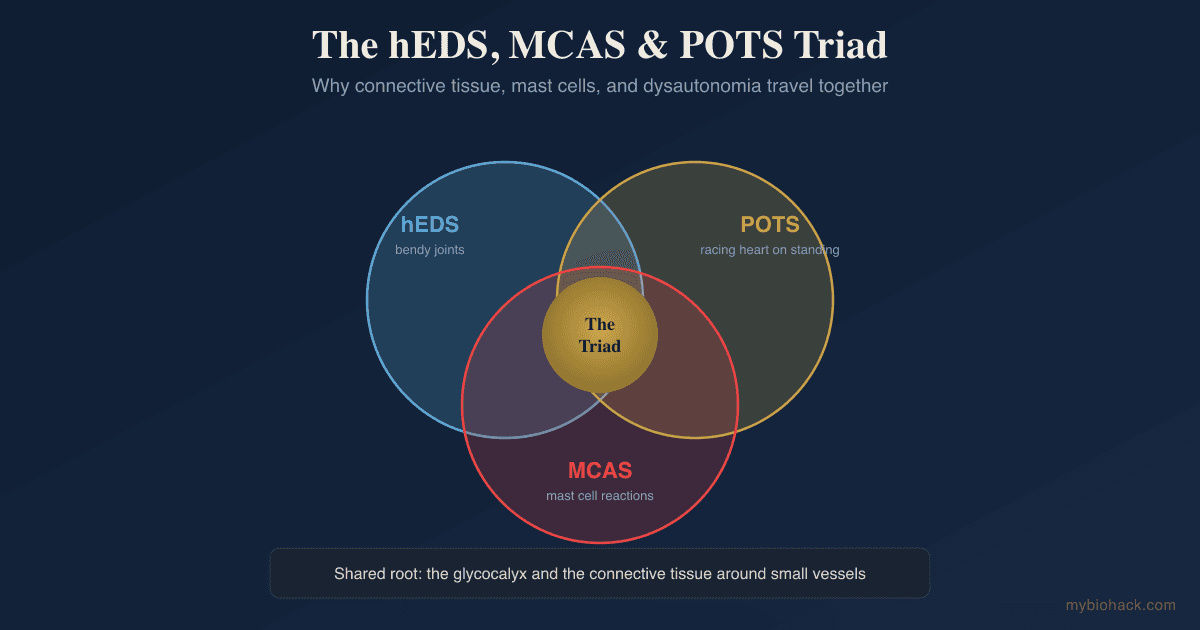
Mast Cells, Histamine, And The Hypermobility Triad
The overlap of hypermobility, dysautonomia, and mast cell activation is common enough that it gets called a triad, and migraine sits right in the middle of it. R
Given that meningeal mast cells directly drive the trigeminovascular loop, it makes sense that people with MCAS and the hEDS-POTS triad get more vertigo, and that some of them improve on histamine-lowering strategies.
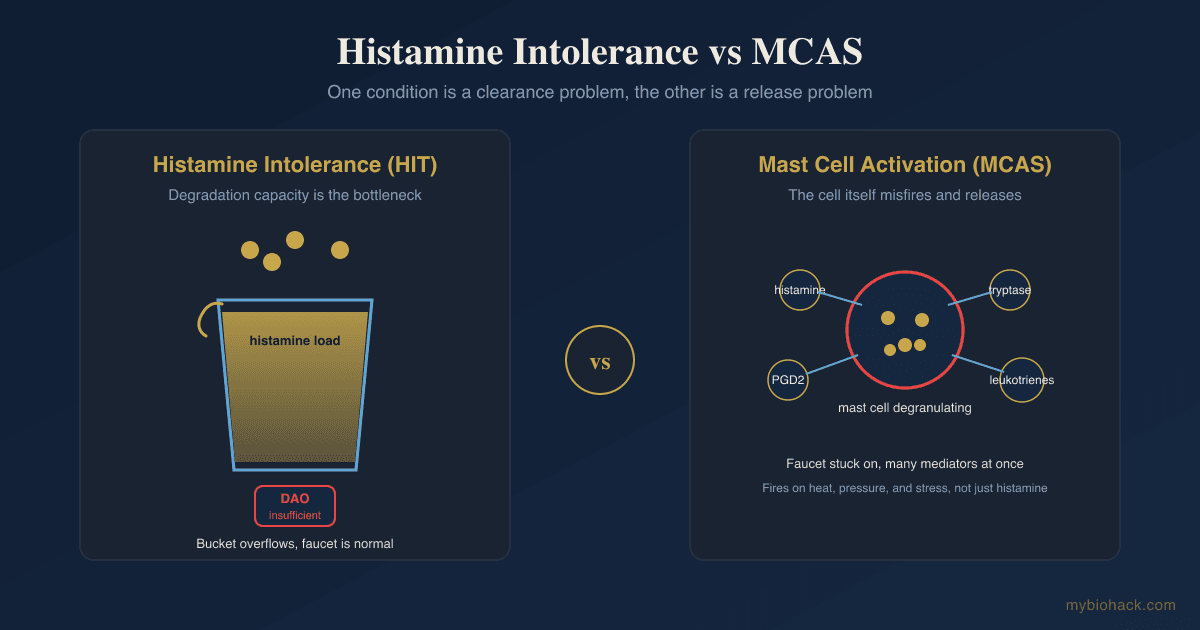
If your attacks track with flushing, hives, food reactions, or a racing heart, read histamine intolerance versus MCAS and consider the mast cell angle seriously.
Meniere's Disease, BPPV, And PPPD
Three inner-ear diagnoses get confused with vestibular migraine constantly.
Meniere's disease shares nausea, vomiting, photophobia, phonophobia, tinnitus, and subjective hearing loss with VM, and the confusion runs both ways because some VM patients have no headache and some Meniere's patients do. R
The distinguishing feature is progressive low-frequency hearing loss, which belongs to Meniere's, not to vestibular migraine.
Benign Paroxysmal Positional Vertigo (BPPV) causes brief spinning triggered by specific head positions and is caused by displaced inner-ear crystals, so it responds to repositioning maneuvers, not migraine prevention.
Persistent Postural-Perceptual Dizziness (PPPD) is a chronic functional dizziness of constant unsteadiness made worse by upright posture, motion, and complex visual environments, and it frequently develops after a bout of vestibular migraine. R
Getting the diagnosis right matters, because a VM patient wrongly treated as Meniere's can be pushed toward inner-ear procedures that do nothing for a brain-driven condition. R
How To Improve Vestibular Migraine
The strategy is to raise the migraine threshold with mitochondrial and neuronal support, calm the trigeminovascular and mast cell loop, retrain the balance system, and stabilize the autonomic nervous system.
Give any preventive at least 8 to 12 weeks before judging it, because migraine prophylaxis works slowly.
1. Load The Mitochondrial Prophylaxis Stack
The migraine brain runs an energy deficit, and the three best-studied nutrients all feed mitochondrial energy production.
A combination of magnesium, riboflavin, and CoQ10 outperformed placebo for migraine in a randomized, double-blind, multicenter trial. R
-
Oral magnesium at 600 mg daily cut attack frequency by about 42 percent versus 16 percent for placebo in the Peikert trial, though a separate trial using a different magnesium salt found no benefit, so the salt and dose matter. R R
-
This form crosses into the central nervous system better than most, which is useful when the target is brain excitability rather than gut motility. R
-
High-dose riboflavin (vitamin B2) at 400 mg daily beat placebo for attack frequency and headache days, with 59 percent of patients responding versus 15 percent on placebo. R
-
CoQ10 at 300 mg daily was superior to placebo for attack frequency, headache days, and nausea days, and CoQ10 deficiency in children and teens with migraine responded to supplementation. R R
2. Calm The Mast Cell And Histamine Loop
If your VM tracks with histamine symptoms, quieting the mast cells often quiets the vertigo.
A trial of a lower-histamine diet is the cheapest first step, and it doubles as a way to find your food triggers.
-
A mast cell stabilizer and natural antihistamine that blocked human mast cell cytokine release more effectively than cromolyn in vitro and worked prophylactically, and it pairs well with luteolin. R
-
Crosses into the brain and calms neuroinflammation and mast cell activation, which is directly relevant to the meningeal loop above. R
The gut is part of this too, since most of the body's serotonin is made there and it feeds vagal tone.
See gut serotonin and mast cell activation for how the two systems talk to each other.
3. Retrain The Balance System With Vestibular Rehabilitation
Vestibular Rehabilitation Therapy (VRT) is a structured program of gaze-stabilization and habituation exercises done with a trained physical therapist.
A 2026 systematic review and meta-analysis found VRT reduced Dizziness Handicap Inventory scores by a pooled 29 points, well past the 18-point threshold for clinically meaningful improvement, though the studies were heterogeneous. R
VRT is especially valuable when vestibular migraine has tipped into PPPD, where the brain has learned to over-rely on visual and postural cues.
4. Stabilize Sleep And Circadian Rhythm
Poor and irregular sleep is one of the most reliable migraine triggers, and the circadian system gates trigeminal pain processing.
-
Beyond its sleep effect, melatonin has direct migraine-preventive signals and is worth trying at a low sublingual dose.
In a randomized, double-blind trial, melatonin 3 mg reduced migraine frequency more than placebo and matched amitriptyline 25 mg with fewer side effects. R
Anchor your wake time, get morning sunlight and manage blue light at night, and keep meals on a regular schedule so blood sugar stays stable.
5. Support The Autonomic Nervous System
If POTS or orthostatic intolerance is part of your picture, treating it can reduce the dizziness load that stacks on top of the migraine.
The mainstream basics are increased fluid and sodium, compression garments, and gradual recumbent-to-upright reconditioning, all covered in the POTS post.
Vagal tone work (slow nasal breathing, humming, cold exposure to the face) shifts you out of the sympathetic dominance that both POTS and migraine feed on.
What To Stay Away From
Some of these are triggers, and some are interventions that make the wrong bet about mechanism.
- Aged, fermented, and high-histamine foods (aged cheese, cured meat, red wine, kombucha) if you are in the mast cell overlap group
- Chronic caffeine escalation, which drives rebound and destabilizes sleep even though a single dose can abort an attack
- Dehydration and salt restriction if you have coexisting POTS, since both worsen orthostatic dizziness
- Medication overuse, where taking acute painkillers or triptans more than about 10 days a month converts episodic migraine into a chronic daily pattern R
- Unnecessary inner-ear procedures offered on a mistaken Meniere's diagnosis, which do nothing for a brain-driven vestibular condition R
- Visual overstimulation, meaning long unbroken stretches of scrolling, fluorescent lighting, and busy patterns, which are potent VM triggers
One more caution specific to Jacob's framework.
Reflexively reaching for nitric oxide boosters like high-dose L-arginine is a bad bet in this population, because CGRP already drives extra nitric oxide synthesis during attacks and adding fuel can worsen the vasodilatory cascade. R
See the nitric oxide post for the nuance on when NO support helps and when it hurts.
Testing
There is no single blood test for vestibular migraine, so diagnosis is clinical and testing is used to rule out mimics and to map root causes and overlapping conditions.
Bedside And Audiologic Testing
An audiogram is the key test to separate VM from Meniere's, because progressive low-frequency hearing loss points to Meniere's rather than migraine. R
Caloric testing and videonystagmography help distinguish the two, since significant canal paresis favors Meniere's over vestibular migraine. R
A Dix-Hallpike maneuver identifies BPPV, and an active stand test or tilt-table study identifies POTS and orthostatic intolerance.
Functional Lab Panels
I use the POTS Bundle (Vibrant Wellness, combining cellular, hormone, gut, and neural panels) to work up the dysautonomia and neuroinflammation side of a dizzy patient.
The Neural Zoomer (Vibrant Wellness) assesses blood-brain-barrier integrity, demyelination, and peripheral neuropathy markers when the presentation is heavily neurologic.
The Cellular Zoomer (Vibrant Wellness) covers organic acids, mitochondrial function, and oxidative stress, which is the terrain the mitochondrial prophylaxis stack is aimed at.
For the mast cell overlap, I use the Immune Zoomer (Vibrant Wellness) for mast cell and autoantibody markers, and pair it with a Plasma Histamine (Quest) and Tryptase (Quest) drawn ideally near a flare.
For hormone-triggered patterns, the Hormone Zoomer (Vibrant Wellness) maps the estrogen and cortisol rhythm behind perimenstrual and perimenopausal attacks.
Genetics
The Methylation Genetics panel (Vibrant Wellness) covers MTHFR and the methylation cycle variants discussed below, and a standalone MTHFR add-on is available if that is all you want.
Mechanisms Of Action
Simple:
- Vestibular migraine is a migraine that plays out in the balance system instead of, or in addition to, the pain system, driven by an over-excitable brain running on low cellular energy.
- Magnesium, riboflavin, and CoQ10 top up the mitochondrial fuel the migraine brain is short on, which raises the threshold for an attack.
- Mast cells sitting next to nerve fibers in the head dump histamine and inflammatory chemicals that light up the vertigo circuit, so calming them calms the dizziness.
Advanced:
- Trigeminovascular activation and CGRP. Trigeminal afferents that wrap the meningeal and labyrinthine vasculature release CGRP, which drives vasodilation, ramps up nitric oxide synthesis, and sensitizes the primary trigeminal neurons; the reciprocal connections between brainstem vestibular nuclei and trigeminal nociceptive relays route this signaling into balance processing, producing vertigo with or without pain. R R
- Neurogenic inflammation via meningeal mast cells. Meningeal mast cells lie adjacent to trigeminal fibers and degranulate to release histamine, nitric oxide, and TNF-alpha, sensitizing sensory neurons; neuropeptides from those neurons (substance P, PACAP) degranulate the mast cells in return through MRGPRX2/B2 signaling, sustaining a self-reinforcing inflammatory loop that lowers the migraine threshold. R
- Cortical spreading depression. A slow self-propagating wave of neuronal and glial depolarization sweeps the cortex, underlies migraine aura, and is thought to activate trigeminal afferents and downstream vestibular structures; genetic lowering of the CSD threshold (as in CACNA1A calcium-channel mutations) increases susceptibility to both migraine and its vestibular expression. R R
- Mitochondrial energy deficit. Migraine brains show reduced riboflavin, magnesium, and CoQ10 in plasma and brain tissue; because all three are required for oxidative phosphorylation, their depletion lowers the energy reserve that neurons need to maintain ion gradients, which raises excitability and the probability of an attack. R
Genetics
CACNA1A
CACNA1A encodes the alpha-1A subunit of the Cav2.1 (P/Q-type) voltage-gated calcium channel that controls neurotransmitter release.
Gain-of-function missense mutations increase calcium influx and glutamate release, lowering the threshold and raising the velocity of cortical spreading depression.
These mutations cause familial hemiplegic migraine type 1, the Mendelian migraine subtype, and knockin animal models confirm the increased CSD susceptibility. R
TRPM8
TRPM8 encodes a cold-and-menthol-gated ion channel that is highly expressed in trigeminal ganglion sensory neurons.
Genome-wide association studies flagged variants near TRPM8 (along with PRDM16 and LRP1) as robust common-migraine risk loci in the general population.
rs10166942 near TRPM8 is associated with migraine and the effect may be stronger in women. R
MTHFR
MTHFR encodes methylenetetrahydrofolate reductase, the enzyme that generates the active folate needed to recycle homocysteine.
Reduced enzyme activity raises homocysteine, which is vascularly irritating and pro-excitatory.
rs1801133 (the C677T variant, encoding Ala222Val) is associated with migraine risk, with meta-analyses showing the strongest signal for migraine with aura. R
If you carry it, the methylation guide and the BH4 and A1298C post explain how to support the pathway.
COMT
COMT encodes catechol-O-methyltransferase, which clears catecholamines like dopamine, norepinephrine, and epinephrine.
The slow (Met/Met) variant leaves catecholamines circulating longer, which can raise the adrenergic tone that both migraine and the adrenergic form of POTS feed on.
rs4680 (Val158Met) shapes how fast you clear these stimulatory signals, as covered in the COMT genetics post.
Meta-analyses do not tie rs4680 to overall migraine risk, but the slow Met/Met genotype tracks with the chronic migraine phenotype and greater pressure pain sensitivity in women. R
More Research
CGRP-targeted drugs are the first migraine-specific class to reach the vestibular subtype.
The gepants (small-molecule CGRP receptor antagonists) and the anti-CGRP monoclonal antibodies (erenumab, fremanezumab, galcanezumab, eptinezumab) block the exact neuropeptide described in the mechanism section, and a systematic review and meta-analysis found the monoclonal antibodies reduced vertigo burden in vestibular migraine, though the evidence base is still early and mostly observational. R
Estrogen withdrawal is a well-recognized migraine trigger, which is why attacks cluster perimenstrually and often shift at perimenopause; stabilizing the drop rather than chasing a single hormone level is the more useful clinical frame. R
Persistent Postural-Perceptual Dizziness frequently develops on the back of vestibular migraine and responds to a different toolkit (vestibular rehabilitation, SSRIs, and cognitive behavioral therapy) than migraine prevention, so recognizing the transition matters. R
The dysautonomia link deserves more study, since the shared pathophysiology between migraine, POTS, hypermobility, and mast cell activation is well documented as an association but poorly understood mechanistically. R
Jacob's Junction Dysfunction framework offers one candidate unifying model through microvascular perfusion and glycocalyx integrity, though it remains a hypothesis rather than established science.
The glymphatic angle is worth watching, because impaired clearance of neuroactive solutes and the glutamate and glymphatic feedback loop plausibly interact with migraine excitability; the meningeal lymphatics sit at the interface of brain waste clearance and the same meningeal territory the trigeminovascular system serves.
For biomarker and root-cause testing I use the POTS Bundle and the Cellular Zoomer to map the mitochondrial and autonomic terrain behind a chronically dizzy patient, and the Immune Zoomer when the mast cell overlap is on the table.
Jacob Gordon
INHC, FMT-C
Integrative Nutrition Health Coach
I cover mold illness, post-viral recovery, methylation, and complex chronic disease, drawing on ten years of clinical research, work inside a functional medicine clinic, and my own recovery from all of it. Every claim here is cited.
Book a ConsultationRelated Protocols & Supplements
Deep-dive chapters and recommended supplements for this topic
Electrolyte Complex
1 scoop/day
CoQ10
200mg/day
Magnesium Glycinate
400mg at bedtime