Sabroxy (Oroxylum Indicum): How The Bark Extract Works On Dopamine, BDNF, And Aging Memory
By Jacob Gordon, INHC, FMT-CThis article contains affiliate links. As an Amazon Associate, MyBioHack earns from qualifying purchases at no extra cost to you. We only link products we research and stand behind.
Sabroxy is a standardized bark extract of the Indian trumpet tree (Oroxylum indicum) that reached the nootropic market as a natural methylphenidate candidate, and the evidence on it now runs from an 82-person randomized trial to an eight-fold BDNF signal in neurons.
In this post, we will discuss what the extract is standardized to, what the trial and the published RCT behind it actually found, how oroxylin A blocks dopamine reuptake, why the BDNF effect is bigger in a dish than in blood, and the dosing, cautions, and genetic context you should know before you try it.
What Is Sabroxy
Sabroxy is a Sabinsa-branded, standardized extract of the dried stem bark of Oroxylum indicum, a medium-sized deciduous tree in the Bignoniaceae family that grows across the Indian subcontinent, Southeast Asia, and southern China. R
The bark has been a fixture of Ayurvedic formulas like Dasamula and Chyawanprash for centuries, where it is credited with treating cough, diarrhea, jaundice, ulcers, and inflammation. R
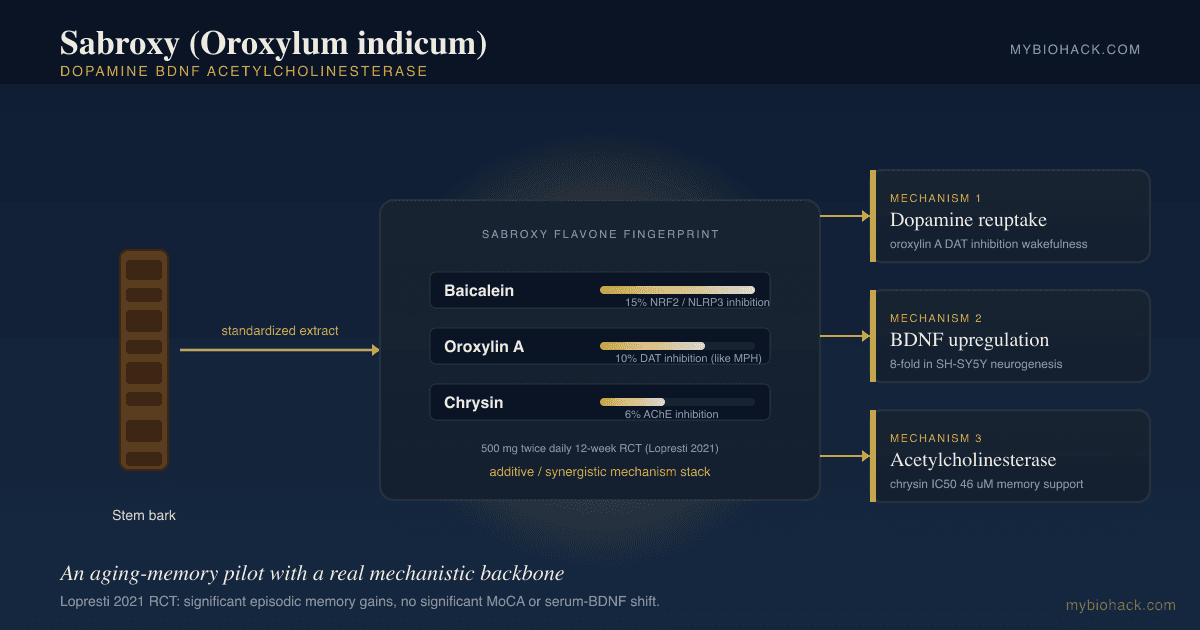
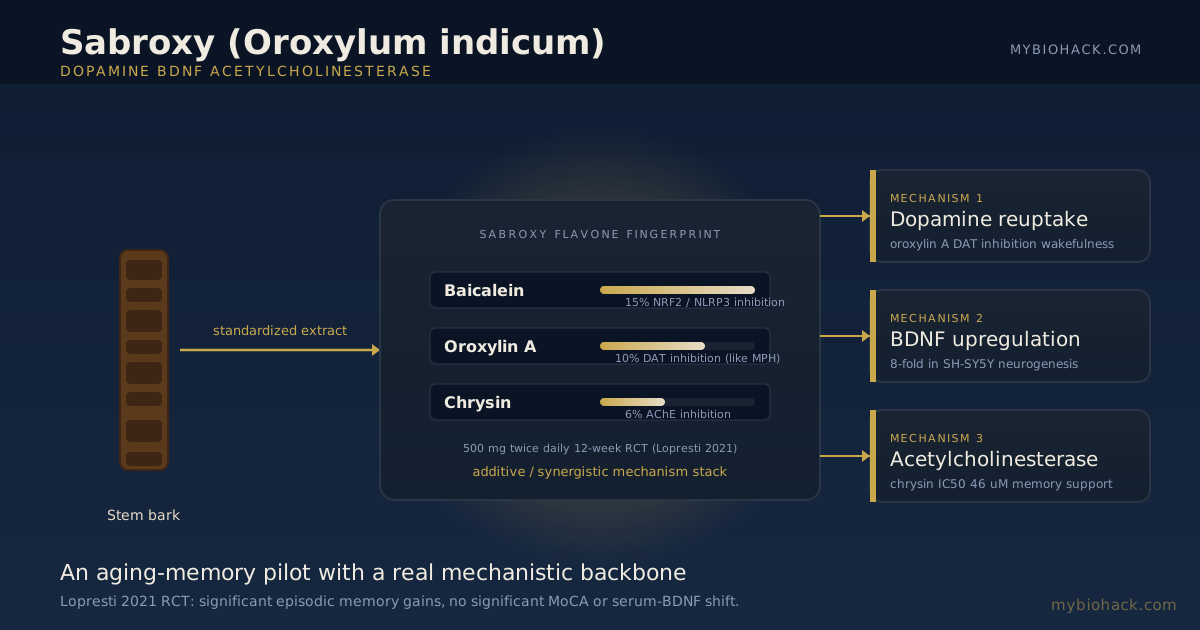
The modern extract is standardized to a fingerprint of three hydroxyflavones: roughly 15% baicalein, 10% oroxylin A, and 6% chrysin, with the balance made up of related flavones and glycoside prodrugs. R
Each flavone carries a different primary mechanism, and the claim is that the three add up rather than compete. R
Baicalein is the antioxidant and anti-inflammatory member of the trio, and it drives most of the NRF2 and NLRP3 effects in published work. R
Oroxylin A is the dopamine-active member, and it inhibits dopamine reuptake in the transporter assay that gave the product its nickname. R
Chrysin is the most potent acetylcholinesterase inhibitor of the three in vitro. R
The natural methylphenidate tag comes from that transporter assay, and it is a mechanistic analogy, not a clinical equivalence, which matters when we get to the trial data. R
Sabroxy (Oroxylum Indicum Extract) is sold in capsules, typically 100 mg, and the human trial used the same standardized material at five times that capsule strength. R
The Clinical Trial And What It Actually Says
The registered trial NCT07189754 is a completed randomized, quadruple-masked, placebo-controlled study of 500 mg of Sabroxy twice daily for 12 weeks in adults aged 60 to 85 with self-reported mild cognitive impairment. R
Primary outcomes were change from baseline on the Montreal Cognitive Assessment (MoCA) total score and on the Computerized Mental Performance Assessment System (COMPASS) composite accuracy and reaction time, with serum BDNF and adverse events as secondary outcomes. R
The registry lists 70 participants, which matches the 70 people in the paper who provided paired blood samples, and the study ran from November 2020 to February 2021, even though the ClinicalTrials.gov entry was only posted in September 2025, roughly four and a half years after the data existed. R
The trial itself was prospectively registered with the Australian New Zealand Clinical Trials Registry back in 2020, so the late ClinicalTrials.gov posting is a documentation gap rather than a sign that the study was never registered. R
It still matters, because the ClinicalTrials.gov entry is the record most readers will find, and its registration date trails the study by four years.
The paper itself came from the same Australian group in 2021, Lopresti, Smith, Majeed, and Drummond in Frontiers in Aging Neuroscience, and it ran the same 12-week, 500 mg twice daily protocol in 82 older adults with subjective memory complaints. R
The active arm improved significantly more than placebo on episodic memory, immediate word recall, numeric working memory accuracy, and the rate of learning on a computerized location task. R
The nulls matter just as much: no difference on the MoCA total score, on quality of life, on a cognitive failures questionnaire, or on serum BDNF. R
So the honest read is that Sabroxy helped on a narrow set of computerized memory and learning endpoints in a narrow population, and it did not move global cognition or the neurotrophin everyone talks about. R
What The Evidence Supports
The list below is ordered by how well the evidence is established, not by how interesting the mechanism sounds.
Most of the mechanistic lines are cellular or rodent work, and the human data is concentrated in older adults with subjective memory complaints, which is the caveat that applies to everything on this list. R
1. Episodic Memory And Learning Rate In Older Adults
The only human trial in this space found significant gains on episodic memory, immediate word recall, and the rate of learning on a location task after 12 weeks at 500 mg twice daily. R
The gains were real but modest, they appeared in adults aged 60 to 85 with subjective complaints, and they did not show up on the MoCA, the broader cognitive screen. R
I read that as a signal for working memory and learning efficiency in aging brains, not as evidence of reversal of impairment.
2. Dopamine Reuptake Inhibition, The Methylphenidate Analogy
Oroxylin A inhibits the dopamine transporter (DAT) in vitro in a way that is functionally similar to methylphenidate, which is where the natural methylphenidate nickname comes from. R
In the spontaneously hypertensive rat model of ADHD, oroxylin A improved hyperactivity, impulsivity, and inattention, and haloperidol, a dopamine antagonist, blocked the effect, which pins the behavior on dopamine signaling rather than the GABA angle. R
The GABA-A antagonism at the benzodiazepine site adds a wakefulness edge that most DAT inhibitors lack, which may explain the alert-without-jitters reports in the nootropic community. R
None of that is clinical equivalence to a stimulant, and the human trial did not measure stimulant-like outcomes. R
3. An Eight-Fold BDNF Signal In Neurons
The strongest quantitative molecular finding is that the standardized extract raised Brain-Derived Neurotrophic Factor (BDNF) mRNA roughly eight-fold in differentiated human neurons under basal conditions, and about five and a half-fold under lipopolysaccharide-induced inflammation. R
That is a transcription-level signal in a dish, and the human trial saw no difference in serum BDNF between Sabroxy and placebo, so the gap between the lab and the bloodstream is the honest caveat on the entire BDNF story. R R
4. Cholinergic Support Through Acetylcholinesterase Inhibition
Chrysin is the most potent acetylcholinesterase (AChE) inhibitor of the three flavones, with an IC50 around 46 micromolar, followed by oroxylin A around 87 and baicalein around 159. R
Docking work puts chrysin and oroxylin A in the catalytic active site while baicalein sits at the peripheral anionic site, a multi-site cholinergic profile rather than a single-target hit. R
The caveat is that in vitro IC50 values are not serum concentrations, so this line is a plausible contributor to the memory signal, not proof that it drives it.
5. Chemobrain Reversal And Mitochondrial Restoration In Mice
In mice given doxorubicin and cyclophosphamide, the extract at 250 or 500 mg per kg restored performance on the Y-maze, novel object recognition, and the Morris water maze, the standard chemobrain battery. R
Brain tissue showed restored mitochondrial Complex-I and Complex-IV activity, replenished glutathione, and lower lipid peroxidation. R
This is rodent-only work, but it is the most novel claim in the extract family, because it ties the cognitive signal to mitochondrial repair rather than receptor pharmacology. R
For the broader mitochondrial electron-carrier picture, my methylene blue post covers the parallel story.
6. NLRP3, NF-kB, And The NRF2 Antioxidant Axis
The extract suppresses Nuclear Factor Kappa B (NF-kB) and the NLRP3 inflammasome across tissues, with downstream reductions in TNF-alpha, IL-1beta, and IL-6, including in brain tissue under immune challenge. R
It also induces Nuclear factor erythroid 2-related factor 2 (NRF2) and its antioxidant response element program, raising superoxide dismutase and glutathione, which is the same hormetic defense axis that other redox-active nootropics lean on. R
That matters for the aging-memory story, because neuroinflammation and redox stress are the environment BDNF has to work in.
7. Beta-Amyloid Protection And Survival Signaling
In SH-SY5Y neurons challenged with beta-amyloid, the extract protects against oxidative stress through Akt, ERK1/2, and CREB phosphorylation and Bcl-2 upregulation. R
The leaf extract repeats the pattern, with the same Akt/ERK1/2/CREB survival signaling against amyloid insult in the same cell line. R
These are cell models of a single toxic input, so they belong in the mechanism column, not the Alzheimer's treatment column.
Sources And Forms
Oroxylum indicum grows across the Indian subcontinent, southern China, Indochina, the Philippines, and Indonesia, usually near riverbanks and in disturbed lowland forest. R
The Ayurvedic tradition uses stem bark, root bark, seeds, and leaves, but the cognitive literature is bark-centric, because the stem bark carries the highest oroxylin A and baicalein content. R
You cannot reach the studied flavone doses from eating the pods or leaves, which is why the standardized bark extract is the only practical delivery form for the cognitive effects.
The leaf extract studied by Palachai and colleagues in 2025 carries the same hydroxyflavone family with a different fingerprint, so it is not interchangeable with the bark product. R
Dosage And Safety
The clinical dose in the trial was 500 mg twice daily, with or without food, a thousand milligrams of the standardized extract per day. R
That is the dose behind both the registry entry and the published RCT. R
Sabroxy is typically sold in 100 mg capsules, so the studied dose means five capsules twice a day.
Tolerability in the trial was good, with slightly more mild digestive complaints and headaches in the active arm and no serious adverse events. R
The animal safety work is unusually thorough for a supplement: 500 mg per kg per day for four weeks in mice produced no changes in liver histology and no shift in ALT, AST, alkaline phosphatase, or bilirubin. R
Scaled by body surface area, that mouse dose sits well above the human dose, so there is a real margin on top of the human tolerability data. R
The cautions are pharmacological rather than toxicological, and they follow directly from the two mechanisms that make the extract interesting.
Cytochrome P450 modulation.
Baicalein and its related flavones inhibit the cytochrome P450 enzymes CYP1A2, CYP2C9, and CYP3A4 in human liver microsomes, so drugs cleared by those enzymes, such as theophylline, cyclosporine, some statins, and some antidepressants, could shift in level when the extract is added. R
Dopamine transporter pharmacology.
Do not stack the extract with prescription stimulants or monoamine oxidase inhibitors unless a clinician is managing the combination, because the DAT blockade is additive. R
GABA-A modulation at the benzodiazepine site.
Oroxylin A is a negative modulator at the benzodiazepine site, so large doses late in the day could theoretically blunt sleep architecture in sensitive users. R
Trial exclusions.
The RCT excluded people on anticoagulants, anticholinergics, acetylcholinesterase inhibitors, or systemic steroids, and anyone with a clinical dementia diagnosis, so it gives no clean answer for those combinations or for frank Alzheimer's disease. R
The chronic-illness context deserves a slower ramp: in the mind-mitochondria patterns I see in practice, a dopamine reuptake inhibitor plus GABA-A modulation is not inert in a sensitized nervous system.
I take it with breakfast and lunch on high-cognitive-load days, I do not stack it with prescription dopaminergics, and that is my call for my situation, not a recommendation for yours.
Mechanisms Of Action
Simple:
- Sabroxy is a three-flavone cocktail in which oroxylin A blocks dopamine reuptake, baicalein lifts BDNF and calms neuroinflammation, and chrysin slows the enzyme that breaks down acetylcholine.
- The standardization matters, because the three flavones are thought to hit different brain targets at the same time, and the extract is built to deliver them together.
Advanced:
Dopamine transporter blockade (oroxylin A).
Oroxylin A inhibits dopamine uptake in vitro in a manner functionally similar to methylphenidate, and in spontaneously hypertensive rats the improvement in ADHD-like behavior was attenuated by haloperidol but not by a GABA-A agonist, which localizes the behavioral effect to dopamine signaling. R
GABA-A negative allosteric modulation.
Oroxylin A binds the benzodiazepine site of the GABA-A receptor as a negative modulator, reducing inhibitory tone, which is the mechanistic basis for the wakefulness profile and for the caution about evening dosing. R
BDNF transcription through a five-target footprint.
At 50 micrograms per milliliter the extract raised BDNF mRNA about eight-fold under basal conditions and five and a half-fold under LPS, and the proposed footprint spans GABA-A, adenosine A2A, estrogen receptor, anti-inflammatory, and mitochondrial ROS targets, which is how the flavones are thought to cooperate. R
Multi-site acetylcholinesterase inhibition.
Chrysin and oroxylin A dock to the catalytic active site of acetylcholinesterase while baicalein occupies the peripheral anionic site, giving a multi-target cholinergic profile. R
Mitochondrial Complex-I and Complex-IV restoration.
In chemobrain mice the extract restored Complex-I and Complex-IV activity in brain mitochondria, replenished glutathione, and cut lipid peroxidation, the most novel claim in the family because it points at mitochondrial repair rather than receptor pharmacology. R
NLRP3 and NF-kB suppression.
The extract suppresses NF-kB activation and NLRP3 inflammasome assembly, lowering TNF-alpha, IL-1beta, and IL-6 across tissues including brain. R
NRF2-ARE antioxidant induction.
NRF2 induction turns on the antioxidant response element program, raising superoxide dismutase and reduced glutathione, the same hormetic defense axis used by other redox-active nootropics. R
Akt/ERK1/2/CREB survival signaling.
Against beta-amyloid insult the extracts drive Akt, ERK1/2, and CREB phosphorylation and Bcl-2 upregulation while suppressing ROS and caspase activity, a survival signature shared by the bark and leaf extracts. R R
Of that list, the dopamine and BDNF lines are the most reproducible, the cholinergic line is plausible but probably under-dosed at human serum levels, and the mitochondrial line is the one I would watch, because it is unique to this extract family.
Genetics
The genetics matter more for Sabroxy than for most supplements, because the extract acts directly on the dopamine and BDNF axes, and polymorphisms in those systems change the baseline the extract lands on.
COMT
Catechol-O-methyltransferase (COMT) encodes the enzyme that clears synaptic dopamine in the prefrontal cortex.
The Val158Met variant (rs4680) sets enzyme activity: Val/Val carriers clear dopamine fast and run lower tonic prefrontal dopamine, while Met/Met carriers clear it slow and run higher tonic levels.
A DAT inhibitor lands on top of that baseline, so slow metabolizers may feel a louder effect from the same dose, which is the group I would start low.
I cover the full COMT genetics, catecholamine metabolism, and attachment story in its own post.
SLC6A3 (DAT1)
SLC6A3 encodes the dopamine transporter itself, the protein oroxylin A blocks.
The DAT1 9-repeat versus 10-repeat variable number tandem repeat sits in the transporter gene, and imaging studies found the 9-repeat allele associated with higher striatal DAT availability, which is the opposite of the direction most supplement commentary assumes. R
The blockade should engage both genotypes, but a transporter that is already more abundant in 9-repeat carriers means the same dose may land differently across genotypes.
BDNF Val66Met (rs6265)
The Val66Met polymorphism (rs6265) reduces activity-dependent BDNF secretion by roughly 30 percent in Met carriers. R
The eight-fold BDNF signal from Sabroxy is transcription-level, and whether it translates into more secreted BDNF in Met carriers is an open question. R
Met carriers may therefore see a smaller real-world boost than Val homozygotes, and I cover how to increase BDNF naturally regardless of genotype.
APOE
APOE encodes apolipoprotein E, and the e4 allele is the strongest genetic modulator of late-life cognitive decline trajectory.
The RCT excluded clinical dementia but did not genotype for APOE, so the data is APOE-agnostic. R
If you carry e4, any cognitive-protective intervention becomes worth weighing more carefully, and it is also worth being honest that this extract has no specific data in that subgroup.
More Research
Chemobrain is the most interesting untested clinical extension.
The mouse work shows the extract restoring mitochondrial Complex-I and Complex-IV activity after chemotherapy and recovering three standard memory tasks, and nobody has run that in humans. R
If it holds, it matters beyond chemobrain survivors, because the same bioenergetic pattern shows up in post-viral brain fog, and my PQQ and methylene blue posts cover the parallel mitochondrial levers.
The evidence window is twelve weeks.
Both the trial and the published RCT ran for twelve weeks, so daily-dosing data past ninety days does not exist, and long-term tolerability and efficacy are open questions. R
There are no head-to-head comparisons.
No trial pits Sabroxy against modafinil, semax, L-theanine, bacopa, or alpha-GPC, so every comparison you read, including this one, is mechanism-based extrapolation.
The drug interaction surface is understudied.
The CYP1A2, CYP2C9, and CYP3A4 inhibition seen in human liver microsomes deserves a real clinical pharmacology study before combining the extract with chronic theophylline or immunosuppressants, and nobody has published one. R
The post-viral angle is mechanistically tempting and clinically unproven.
A pattern of downregulated BDNF and upregulated neuroinflammation is exactly the profile this extract targets on paper, which is why it keeps showing up in long COVID forums, and no trial has tested it in that population.
The glutamate and neuroinflammation loop post covers why that pattern is so common after viral illness.
Confidence checks belong next to the green signal.
The RCT was industry-supported with a Sabinsa Science Director as coauthor, the placebo was cellulose, lactose, and magnesium stearate, and the 2025 registration of NCT07189754 came years after the data existed. R
Where I land.
I keep Sabroxy in rotation as a cognitive day-tool for high-load days rather than a daily brain-health intervention, and I cycle it instead of running it continuously.
For biomarker work I use the Vibrant Wellness Cellular Zoomer (Vibrant Wellness) to assess mitochondrial function and organic acids when a complaint pattern lines up with the chemobrain or post-viral picture this extract targets.
For personalized guidance on whether Sabroxy fits your dopamine, BDNF, and aging-memory stack, the Biohacking Bot can run your symptoms, sleep, labs, and current stack through a mechanistic analysis.
This post is education, not medical advice, and is not a substitute for diagnosis or treatment by a qualified clinician.
Jacob Gordon
INHC, FMT-C
Integrative Nutrition Health Coach
I cover mold illness, post-viral recovery, methylation, and complex chronic disease, drawing on ten years of clinical research, work inside a functional medicine clinic, and my own recovery from all of it. Every claim here is cited.
Book a ConsultationRelated Protocols & Supplements
Deep-dive chapters and recommended supplements for this topic
Lion's Mane
1000mg/day
Omega-3 (DHA)
2g/day
Phosphatidylserine
100mg 3x/day