8+ Benefits of PQQ (Pyrroloquinoline Quinone) For Mitochondrial Biogenesis
By Jacob Gordon, INHC, FMT-CThis article contains affiliate links. As an Amazon Associate, MyBioHack earns from qualifying purchases at no extra cost to you. We only link products we research and stand behind.
Pyrroloquinoline Quinone (PQQ) is a small redox-active compound sold as a way to grow new mitochondria, and the marketing has run ahead of the human data.
In this post, we will discuss what PQQ actually is, the benefits with the strongest mechanistic and clinical support, where it shows up in food, how to dose it, how it pairs with CoQ10, and where the evidence is thin.

What Is PQQ
PQQ is a small ortho-quinone molecule that acts as a redox cofactor, meaning it shuttles electrons the way a battery charges and discharges.
It was first identified as the cofactor for bacterial dehydrogenase enzymes, and it is not made by human cells, so the only way to get it is through diet or supplementation.
Whether PQQ qualifies as a true vitamin for mammals is still debated, but animals raised on PQQ-deficient diets show reduced mitochondrial content, impaired reproduction, and altered immune function, which is why some researchers describe it as a conditionally essential micronutrient. R
Two features make it interesting for anyone tracking mitochondrial health.
The first is that it signals cells to build new mitochondria (mitochondrial biogenesis) rather than just supporting the ones you already have.
The second is that it is an unusually stable antioxidant that can cycle through electron transfers thousands of times before it degrades, unlike vitamin C, which is spent after a handful. R
If you think of the cell's energy economy as a redox ledger of electron carriers, PQQ sits in the same conceptual space as NAD and NADPH, moving electrons to where they are needed.
It is worth separating PQQ from the other mitochondrial levers people stack it with.
PQQ builds new mitochondria, which is close to the opposite of what urolithin A does when it clears damaged mitochondria through mitophagy, and it is a different mechanism again from the mitochondrial-derived peptides like MOTS-c and humanin.
Benefits Of PQQ
The list below is ordered by how the mechanisms build on each other, not by strength of evidence, so read the caveats.
Most of the strongest data is in cells and rodents, and the human trials that exist are small and often funded by the ingredient manufacturer.
1. Stimulates Mitochondrial Biogenesis
This is the headline claim and the best-characterized mechanism.
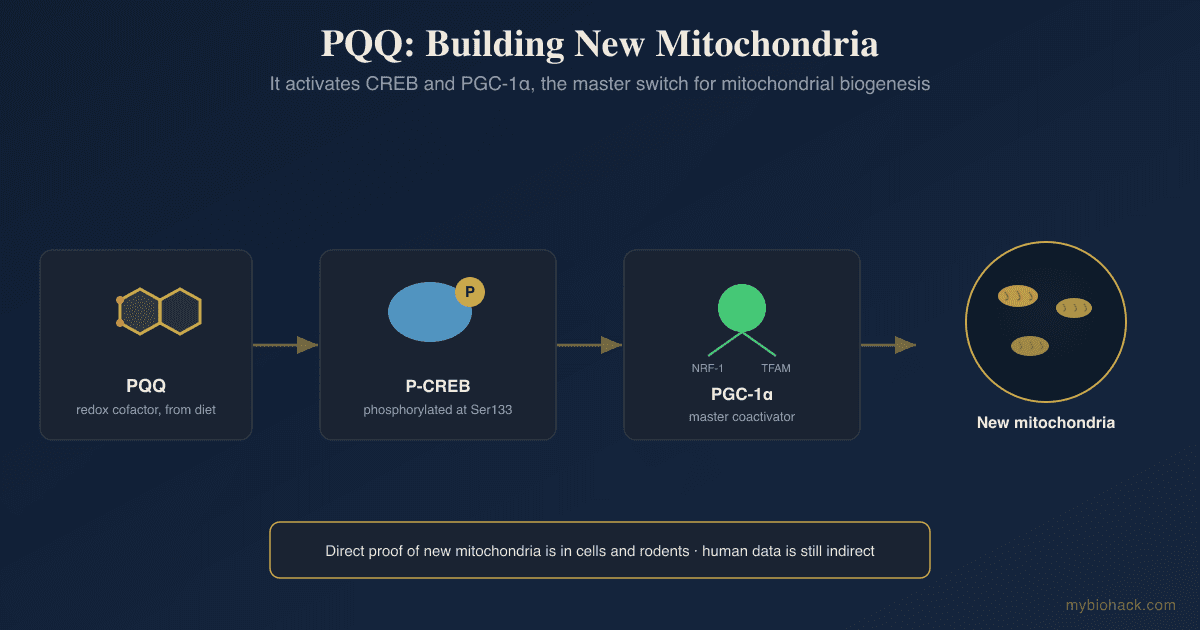
In cultured cells, PQQ phosphorylates cAMP Response Element-Binding protein (CREB) and drives expression of Peroxisome Proliferator-Activated Receptor Gamma Coactivator 1-Alpha (PGC-1alpha), the master regulator that turns on programs for building mitochondria. R
PGC-1alpha is the same coactivator that exercise and several exercise-mimetic supplements push through the AMPK pathway, which is why PQQ gets marketed alongside them.
When researchers silenced either CREB or PGC-1alpha, PQQ lost its ability to stimulate biogenesis, which is strong evidence that this pathway is the actual mechanism and not a coincidence. R
The honest limit is that no human study has directly shown an increase in mitochondrial number from taking PQQ.
The human evidence for biogenesis is indirect, inferred from downstream metabolic markers, while the direct measurements come from cell culture and rodents. R
2. Acts As A Recyclable Antioxidant
PQQ is an exceptionally stable ortho-quinone, and this is what separates it from most dietary antioxidants.
It readily accepts electrons to become PQQH2 and then gives them back, and it can run this cycle thousands of times without breaking down. R
It has particular affinity for the superoxide anion and the hydroxyl radical, two of the more damaging reactive oxygen species. R
In a small human crossover study, a single oral dose lowered blood levels of lipid peroxidation products (measured as TBARS) in a time-dependent way, and the drop tracked with peak plasma PQQ. R

3. Lowers Inflammatory Markers In Humans
This is one of the few benefits measured directly in people rather than inferred.
In ten young adults given roughly 20 mg of PQQ per day, plasma C-Reactive Protein (CRP) and Interleukin-6 (IL-6) both dropped, alongside shifts in markers of mitochondrial-related metabolism. R
The study was small and short, so treat this as a promising signal rather than a settled anti-inflammatory effect.
4. Stimulates Nerve Growth Factor
PQQ is a potent enhancer of Nerve Growth Factor (NGF) production in cultured cells, and NGF is a neurotrophin that supports the survival and growth of neurons. R
In a randomized trial in older adults, a reduced form of PQQ significantly raised serum Brain-Derived Neurotrophic Factor (BDNF) over six weeks, while placebo did not. R
The NGF work is largely in vitro and in animals, so the leap from a dish to a durable human effect on neuron growth is not yet made.
5. Supports Cognition And Memory
Several small human trials point in a favorable direction for cognition.
In 41 older adults, 20 mg per day of PQQ disodium salt for 12 weeks improved selective attention and visual-spatial function, with the largest gains in people who started with lower scores. R
A larger double-blind trial across ages 20 to 65 found 20 mg per day improved composite and verbal memory by 12 weeks, with different cognitive domains responding in younger versus older participants. R
In rats, PQQ prevented the learning and memory deficits caused by oxidative stress, and the combination of PQQ plus CoQ10 outperformed either alone. R
6. Improves Sleep And Reduces Fatigue
The sleep and fatigue data come from one small, uncontrolled study, so weight it accordingly.
Seventeen adults took 20 mg of PQQ daily for eight weeks, and scores for vigor, fatigue, tension-anxiety, and confusion all improved on a standardized mood inventory. R
Sleep quality improved as well, with better scores for sleepiness on waking, sleep onset, and sleep maintenance. R
There was no placebo group, so some of this is likely expectation and regression to the mean, but the direction is consistent with the biogenesis and antioxidant mechanisms.
This is the benefit that draws interest from the post-viral and fatigue community, though no controlled trial has tested PQQ specifically in ME/CFS or in the mitochondrial dysfunction seen in long COVID.
7. Increases Cerebral Blood Flow And Oxygenation
PQQ appears to change how the brain is perfused and how it uses oxygen.
In a controlled study, PQQ supplementation increased cerebral blood flow and oxygen metabolism in the prefrontal cortex. R
In the six-week trial in older adults with mild cognitive impairment, cerebral oxygenation saturation rose significantly on PQQ but not on placebo. R
8. Pairs With CoQ10 For Additive Mitochondrial Support
The PQQ and CoQ10 pairing is the most common way it is sold, and the rationale is mechanistically clean.
PQQ signals the cell to build new mitochondria, while Coenzyme Q10 (CoQ10) is the electron carrier that shuttles electrons within the mitochondria you already have, so the two act at different points in the same system.

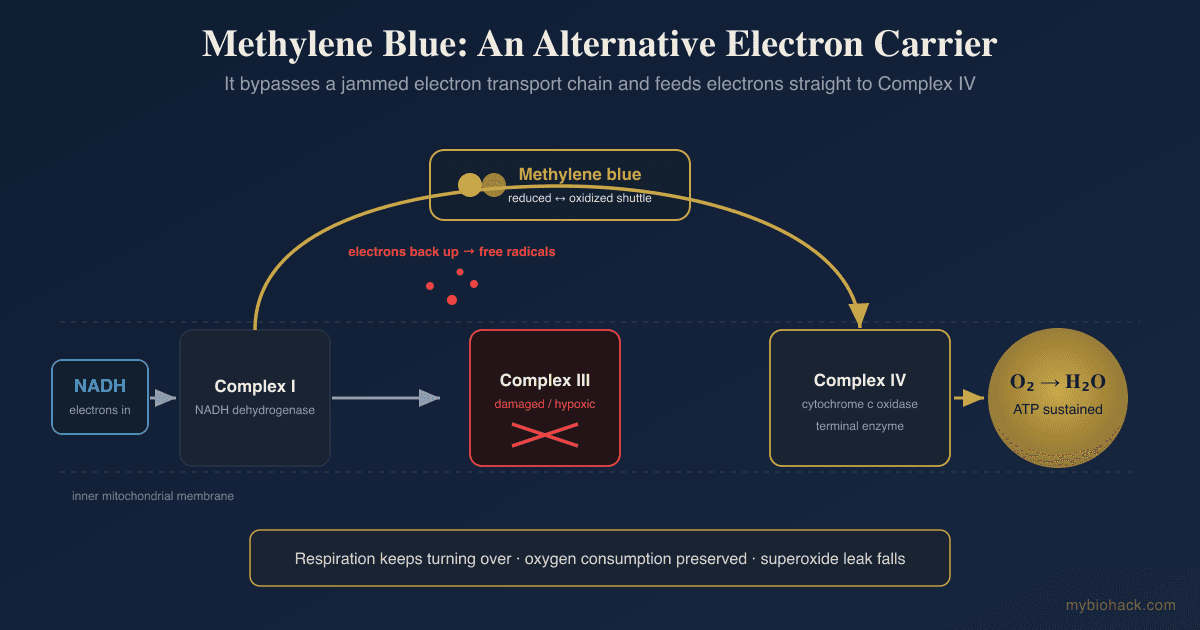
CoQ10 works at a similar stage of the electron transport chain to compounds like methylene blue, which acts as an alternative electron carrier.
In the rat cognition work, PQQ plus CoQ10 beat PQQ alone, and human combination trials using 20 mg PQQ with 100 to 300 mg CoQ10 have reported cognitive benefits in older adults. R
The combination trials are small and industry-adjacent, so the synergy is biologically plausible and modestly supported rather than proven.
Natural Sources
PQQ is widespread in plant foods and fermented foods, but at trace levels measured in nanograms per gram, not milligrams.
The richest measured sources, in analyses using gas chromatography and LC-MS/MS, cluster around fermented soy, certain herbs, and green vegetables. R R
The best food sources, alphabetically: (not an exclusive list)
- Fermented soy (natto and related products, among the highest at up to roughly 61 ng/g) R
- Green peppers
- Green tea (roughly per 100 mL brewed)
- Kiwi
- Papaya
- Parsley (one of the richest herb sources)
- Tofu
The number that matters is the gap between food and supplement.
Even the richest foods deliver PQQ in micrograms, while supplement doses are 10 to 20 mg, which is a thousandfold higher, so you cannot eat your way to a supplemental dose. R
Food-level PQQ still matters for baseline mitochondrial and reproductive function in animal models, but the effects people are chasing from supplements are a different order of exposure.
Dosage And Safety
Every published human trial that showed a benefit used 20 mg per day, and most sold products are 10 to 20 mg.
Common forms include the oxidized disodium salt (the form used in nearly all human trials, often branded BioPQQ) and a reduced form marketed as dihydro-PQQ or PQQH2. R
For a starting protocol, PQQ at 10 to 20 mg taken in the morning is reasonable, since a subset of people find it stimulating and report lighter sleep if they take it late.
For the mitochondrial pairing, CoQ10 at 100 to 300 mg (ubiquinol is the better-absorbed form) is the combination used in the cognition trials.
On safety, PQQ disodium salt has a good short-term profile.
It carries GRAS (Generally Recognized As Safe) status in the United States, showed no genetic toxicity in animal tests at doses far above what humans take, and was well tolerated at 20 mg per day across the 8-to-12-week trials. R R
The honest caveats:
- Long-term human safety beyond about 12 weeks has not been studied.
- Pregnancy and lactation safety is unknown, so avoid it in those cases.
- Some users report headache or insomnia, likely from the stimulating, pro-metabolic effect, which is why morning dosing helps.
Mechanisms Of Action
Simple:
- PQQ tells cells to build more mitochondria, and separately it soaks up damaging free radicals over and over without wearing out.
Advanced:
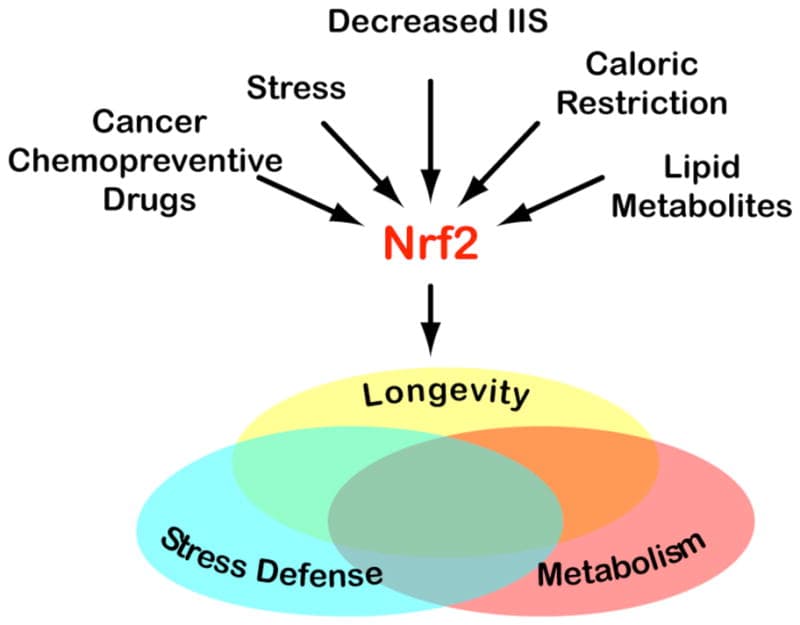
- Mitochondrial biogenesis via CREB and PGC-1alpha: PQQ phosphorylates CREB at serine 133, which activates the promoter for PGC-1alpha and raises its mRNA and protein. PGC-1alpha then coactivates nuclear respiratory factor 1 (NRF-1) and nuclear respiratory factor 2 (GABPA), which in turn drive mitochondrial transcription factor A (TFAM) and the TFB1M and TFB2M genes needed to replicate and transcribe mitochondrial DNA. Note that these nuclear respiratory factors are distinct from the KEAP1-regulated antioxidant factor Nrf2, despite the confusingly similar naming. R
- Recyclable redox cofactor: The ortho-quinone structure lets PQQ accept electrons to form PQQH2 and re-oxidize back to PQQ with unusual stability, allowing thousands of catalytic cycles versus roughly four for ascorbate. This is why it scavenges superoxide and hydroxyl radicals persistently rather than being consumed on first contact. R
- Neurotrophic signaling: PQQ enhances NGF synthesis and secretion in cultured cells and raises BDNF in humans, and in rodent models it protects neurons from NMDA-mediated excitotoxicity by suppressing peroxynitrite. R R
- Metabolic remodeling: In rats, altering PQQ status changed total energy expenditure, respiratory quotient, plasma lipids, and relative mitochondrial content in liver and heart, consistent with a shift toward mitochondrial fat oxidation. R
Genetics
There is no published human pharmacogenomic data on PQQ, so nothing below predicts individual response to the supplement.
These are the genes in the pathways PQQ engages, and the variants that reduce baseline function in those pathways, which is where a biogenesis or antioxidant nudge is at least theoretically most relevant.
PPARGC1A
This gene encodes PGC-1alpha, the coactivator PQQ works through to trigger mitochondrial biogenesis.
Variants that lower PGC-1alpha activity are associated with reduced mitochondrial capacity and higher metabolic disease risk.
rs8192678 (Gly482Ser): the Ser allele is linked to lower PGC-1alpha function and has been associated with reduced mitochondrial biogenesis and insulin resistance. R
NRF1
This gene encodes nuclear respiratory factor 1, one of the transcription factors PGC-1alpha activates downstream of PQQ to switch on mitochondrial genes.
Variants here influence how strongly the biogenesis program can be transcribed, so reduced-function carriers have a smaller ceiling for the response PQQ is trying to drive. R
SOD2
This gene encodes manganese superoxide dismutase, the enzyme that clears superoxide inside the mitochondria, the same radical PQQ scavenges.
rs4880 (Ala16Val): the Val allele can reduce efficient targeting of the enzyme into mitochondria, leaving more mitochondrial superoxide, which is the exact species PQQ's recyclable antioxidant activity addresses. R
More Research
Alphabetical, and weighted toward the honest limits.
- Combination framing dominates the marketing, and the PQQ plus CoQ10 pairing is mechanistically sound (biogenesis plus electron transport) but the human synergy data is small and industry-adjacent. R
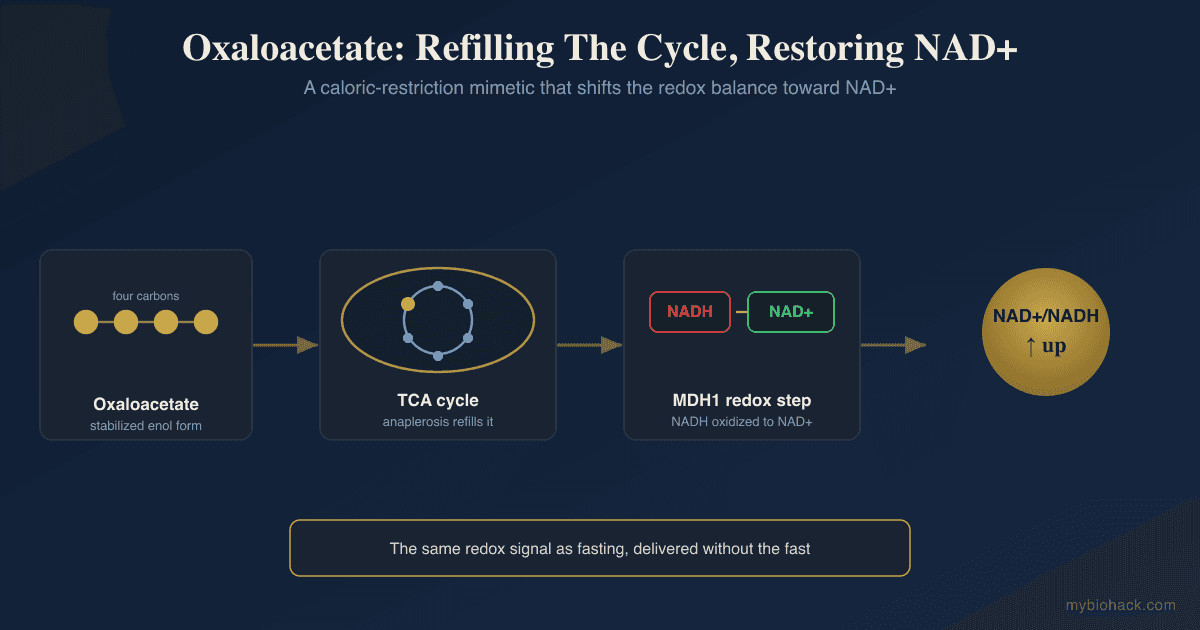
- Fatigue and post-viral use is popular but untested in controlled trials, so anyone using PQQ for ME/CFS or long COVID mitochondrial support should track their own energy, sleep, and symptom response rather than assume the effect, and compounds like oxaloacetate sit in the same speculative category for fatigue.
- Funding is a recurring caveat, since most of the flagship human cognition and cerebral blood flow trials used a single manufacturer's branded PQQ, which does not invalidate them but warrants independent replication. R R
- Human biogenesis evidence remains indirect, because the direct proof that PQQ raises mitochondrial number is in cells and rodents, while human studies infer it from metabolic and cognitive downstream markers. R R
- Reduced versus oxidized forms are being compared, with newer trials testing dihydro-PQQ (PQQH2), though the bulk of the evidence base still rests on the oxidized disodium salt. R
For tracking whether PQQ actually moves anything for you, the fatigue, sleep, and cognition outcomes in these trials are all self-reported or performance-based, which are exactly the kinds of subjective and functional markers worth logging over a defined trial period before deciding it is worth keeping.
Jacob Gordon
INHC, FMT-C
Integrative Nutrition Health Coach
I cover mold illness, post-viral recovery, methylation, and complex chronic disease, drawing on ten years of clinical research, work inside a functional medicine clinic, and my own recovery from all of it. Every claim here is cited.
Book a ConsultationRelated Protocols & Supplements
Deep-dive chapters and recommended supplements for this topic
Quercetin
500mg 2x/day
Vitamin D3 + K2
5000 IU + 200mcg/day
Magnesium Glycinate
400mg at bedtime