Resveratrol: Sirtuins, Cardiovascular, And The Bioavailability Problem
By Jacob Gordon, INHC, FMT-CThis article contains affiliate links. As an Amazon Associate, MyBioHack earns from qualifying purchases at no extra cost to you. We only link products we research and stand behind.
Resveratrol became famous as the molecule that let mice on a high-calorie diet live longer, and the sirtuin story behind that headline turned out to be far messier than the marketing ever let on.
In this post, we will discuss the sirtuin activation controversy in full, why AMPK (AMP-Activated Protein Kinase) and mild mitochondrial stress are the more defensible mechanisms today, why bioavailability is resveratrol's central practical problem, and what the honest cardiovascular and metabolic trial record actually shows.
---
- What Is Resveratrol
- The Sirtuin Activation Controversy
- AMPK And The Mitohormesis Alternative
- The Bioavailability Problem
- The French Paradox Reconsidered
- The Cardiovascular Trial Record
- Beyond The Heart
- Forms And Dosing
- Pterostilbene And Adjacent Compounds
- Testing
- Mechanisms Of Action
- Genetics
- More Research
What Is Resveratrol
Resveratrol is a stilbene-type polyphenol that plants produce as a stress response, mostly to fungal infection and UV exposure.
It shows up in grape skins, red wine, peanuts, and Japanese knotweed (*Polygonum cuspidatum*, also classified as *Fallopia japonica*), which is the plant most supplement manufacturers actually extract it from. R
The amount in red wine is small and inconsistent, typically well under a few milligrams per liter depending on grape variety, region, and fermentation time. R
Resveratrol went from an obscure phytoalexin to a household name in 2003, when David Sinclair's lab reported that it directly activated SIRT1 and extended the lifespan of yeast. R
That single finding launched a supplement category, a Pfizer acquisition, and two decades of contested science that I think most resveratrol marketing still has not caught up with.
It sits in a loose category with other stress-response and geroprotective compounds I have written about separately, including spermidine, fisetin, and urolithin A, all of which share the same basic problem this post is really about: a compelling cell-culture story that does not always survive contact with human pharmacokinetics.
The Sirtuin Activation Controversy
This is the single most important thing to understand about resveratrol, and most consumer-facing articles skip it entirely.
Sinclair's 2003 paper reported that resveratrol directly activated SIRT1, a NAD+-dependent deacetylase in the sirtuin family that was already linked to calorie-restriction biology and longevity. R
Follow-up mouse studies extended the story: resveratrol improved survival and metabolic health in mice on a high-calorie diet, alongside increased AMPK and PGC-1alpha activity. R
A companion paper showed resveratrol improved mitochondrial function and protected against diet-induced metabolic disease in a manner the authors attributed to SIRT1 and PGC-1alpha activation. R
Then came the correction that the supplement industry mostly ignored.
In 2010, a Pfizer research team reported that resveratrol, along with several synthetic sirtuin-activating compounds (STACs), only appeared to activate SIRT1 in the original biochemical assays because those assays used a peptide substrate with a covalently attached fluorophore, and resveratrol was binding the fluorophore-modified substrate rather than activating the enzyme on native, untagged protein substrates. R
That is a real and serious finding, not a semantic quibble: it meant a decade of "resveratrol activates SIRT1" data rested partly on an assay artifact.
The field did not stay settled there either.
A 2013 rebuttal identified a genuine allosteric activation mechanism, showing that resveratrol and other STACs can activate SIRT1 through a conserved hydrophobic motif present in some of SIRT1's native substrates, including PGC-1alpha and FOXO3a, mediated by a specific glutamate residue (Glu230) in SIRT1's N-terminal domain. R
So the honest current position is not "resveratrol activates SIRT1" or "resveratrol does not activate SIRT1."
It is that direct activation appears to be real for a subset of native substrates through a specific allosteric mechanism, the original assays that built the whole hype cycle were flawed, and resveratrol's biological effects in animals and humans very likely involve pathways beyond SIRT1 entirely, which is the subject of the next section.
I treat any resveratrol claim that leans exclusively on "activates your longevity genes" as a sign the writer has not read past the 2003 paper.
AMPK And The Mitohormesis Alternative
If resveratrol's benefits in animal models are not purely a SIRT1 story, AMPK is the mechanism with the strongest independent support.
One elegant 2012 study found that inhibiting a specific phosphodiesterase (PDE4) with an unrelated drug reproduced essentially all of resveratrol's metabolic benefits in mice, by raising intracellular cAMP, activating Epac1, and triggering AMPK activation downstream, which suggests resveratrol's core effect may run through phosphodiesterase inhibition rather than sirtuins at all. R
A separate mouse study found the relationship between SIRT1 and AMPK is dose-dependent and bidirectional: at moderate resveratrol doses, SIRT1 was required for AMPK phosphorylation and the resulting mitochondrial biogenesis, while at high doses AMPK activation occurred independently of SIRT1. R
AMPK, SIRT1, and PGC-1alpha function as an interconnected energy-sensing network rather than a single linear pathway, which is why isolating "the" mechanism has been so difficult. R
This connects directly to a concept called mitohormesis: mild mitochondrial stress, the kind produced by exercise, caloric restriction, or a polyphenol like resveratrol, triggers an adaptive stress response that produces a net benefit, rather than resveratrol acting as a clean, targeted "activator" of anything. R
In my experience this framing matters clinically, because it reclassifies resveratrol from "a sirtuin switch" to "a mild hormetic stressor," and mild hormetic stressors are dose-sensitive in a way that a simple on/off switch is not.
I cover this same hormetic logic in more depth in my post on mitochondrial psychobiology and in my breakdown of AMPK, mTOR, and autophagy signaling, which is worth reading alongside this section if the mechanism is what you actually care about.
The Bioavailability Problem
Even if every mechanistic claim above were airtight, resveratrol has a practical problem that undermines most of the human translation: almost none of an oral dose reaches your bloodstream as intact, free resveratrol.
The classic human pharmacokinetic study found that absorption of a 25 mg oral dose was actually good, at least 70 percent, but peak plasma concentrations of unmetabolized resveratrol were only trace amounts, under 5 ng/mL, because intestinal and hepatic sulfation and glucuronidation are extremely fast and essentially first-pass the compound into inactive conjugates. R
A phase I dose-escalation study confirmed the same pattern at much higher doses, up to 5 grams, where peak plasma levels of resveratrol and its metabolites still only reached the range of a few hundred ng/mL. R
A 29-day repeat-dosing study at 0.5 to 5 grams per day found the compound was generally tolerated but produced dose-dependent gastrointestinal side effects, and it also lowered circulating IGF-1 and IGFBP-3, which overlaps with the exercise and longevity signaling territory I cover in my humanin and IGF-1 post. R
This is the root of resveratrol's replication problem: most of the striking cell-culture results use concentrations in the 10 to 100 micromolar range, and free resveratrol concentrations achievable in human plasma are a small fraction of that, meaning a large share of the in vitro literature describes a scenario your body cannot actually reproduce. R
Proposed workarounds, including micronized particle formulations, piperine co-administration to inhibit glucuronidation the way it does for curcumin, phospholipid complexes, and nanoparticle delivery, are mechanistically plausible, but a 2014 review of the field was blunt that human bioavailability data validating most of these strategies is still thin. R
I do not think this makes resveratrol worthless, but I do think it means a large fraction of "resveratrol does X" claims trace back to a concentration you will never reach by mouth.
The French Paradox Reconsidered
Resveratrol's public image is inseparable from the French paradox, the observation that France had comparatively low coronary heart disease mortality despite a diet high in saturated fat.
The original 1992 hypothesis proposed that moderate wine consumption explained the discrepancy, largely through alcohol's effect on platelet aggregation rather than through any single wine polyphenol. R
Resveratrol got attached to that story later, and the attachment does not hold up on dose alone.
Red wine contains resveratrol at low milligram-per-liter concentrations, so a standard glass delivers a fraction of a milligram to a few milligrams. R
Every clinical trial that has shown a measurable cardiovascular or metabolic effect used doses of 150 mg per day or more, often gram-level doses, which is a gap of two to three orders of magnitude between "the French paradox" and any trial that actually moved a biomarker. R
The French paradox is a real epidemiological observation and a genuinely interesting one, but as a resveratrol origin story it does not survive basic arithmetic, and I think it is worth saying that plainly instead of letting the red wine framing carry more weight than the dose data supports.
The Cardiovascular Trial Record
The honest cardiovascular record is mixed, and I want to represent both directions rather than pick the side that sells better.
On the positive side, a review of the cardiovascular literature found that high-dose resveratrol (at or above 150 mg per day) improved acetylcholine-evoked vasorelaxation and reduced blood pressure, with effects more pronounced in hypertensive and dyslipidemic subjects than in healthy controls. R
A meta-analysis of six randomized controlled trials (247 participants) found that resveratrol at 150 mg per day or higher reduced systolic blood pressure by close to 12 mmHg, with no significant effect on diastolic pressure and no benefit at lower doses. R
A separate meta-analysis of 17 RCTs (736 participants) found resveratrol supplementation significantly reduced TNF-alpha and hs-CRP, though it did not move IL-6. R
Mechanistically, this plausibly runs through SIRT1-mediated deacetylation of endothelial nitric oxide synthase (eNOS), which increases nitric oxide production and promotes vasodilation. R
On the negative side, and I think this is the single most important cardiovascular finding this post can give you, an 8-week randomized, double-blind, placebo-controlled trial in aged, inactive men found that 250 mg per day of resveratrol blunted the cardiovascular benefits of exercise training itself: the placebo-plus-exercise group saw substantially larger improvements in VO2 max, blood pressure, and cholesterol than the resveratrol-plus-exercise group, and resveratrol shifted the balance of vasoactive signaling toward vasoconstriction by blunting the exercise-induced rise in the vasodilator prostacyclin. R
That is not a null result, it is a genuinely negative interaction, and it is the study I bring up whenever someone tells me they are stacking resveratrol with a serious training block.
There is a big MAYBE here that I do not think gets said often enough: resveratrol may help a sedentary, metabolically unhealthy person and simultaneously blunt the adaptive response of a person who is already training hard, which are two different audiences getting the same generic advice.
Beyond The Heart
The pattern of "strong preclinical signal, disappointing or mixed human trial" repeats across resveratrol's other proposed uses.
In non-alcoholic fatty liver disease (NAFLD), a placebo-controlled trial found that resveratrol supplementation did not improve liver fat, insulin sensitivity, or inflammatory markers in patients with confirmed NAFLD, despite a large preclinical literature suggesting it should. R
Glycemic control is one of the few areas with a genuinely positive signal, but it is conditional: a meta-analysis of 11 randomized controlled trials found resveratrol significantly improved fasting glucose, insulin, HbA1c, and insulin resistance specifically in people with diabetes, with no significant effect in non-diabetic subjects. R
That pattern, benefit concentrated in people who already have dysfunction to correct and little effect in healthy people, comes up often enough in this literature that I think it deserves its own mental category rather than being folded into "resveratrol works" or "resveratrol doesn't work."
Alzheimer's disease research produced one of the more rigorous resveratrol trials to date: a 52-week phase 2 randomized, double-blind, placebo-controlled trial in people with mild to moderate Alzheimer's found resveratrol was safe and well-tolerated, and that it and its metabolites crossed the blood-brain barrier and produced measurable CNS effects. R
A secondary analysis of that same trial cohort found resveratrol modulated neuroinflammatory markers, consistent with an immune-modulating effect, without translating into a clear cognitive benefit over the trial period. R
I think that trial is a fair template for how to read resveratrol research generally: safety and target engagement are usually there, a clean clinical win usually is not.
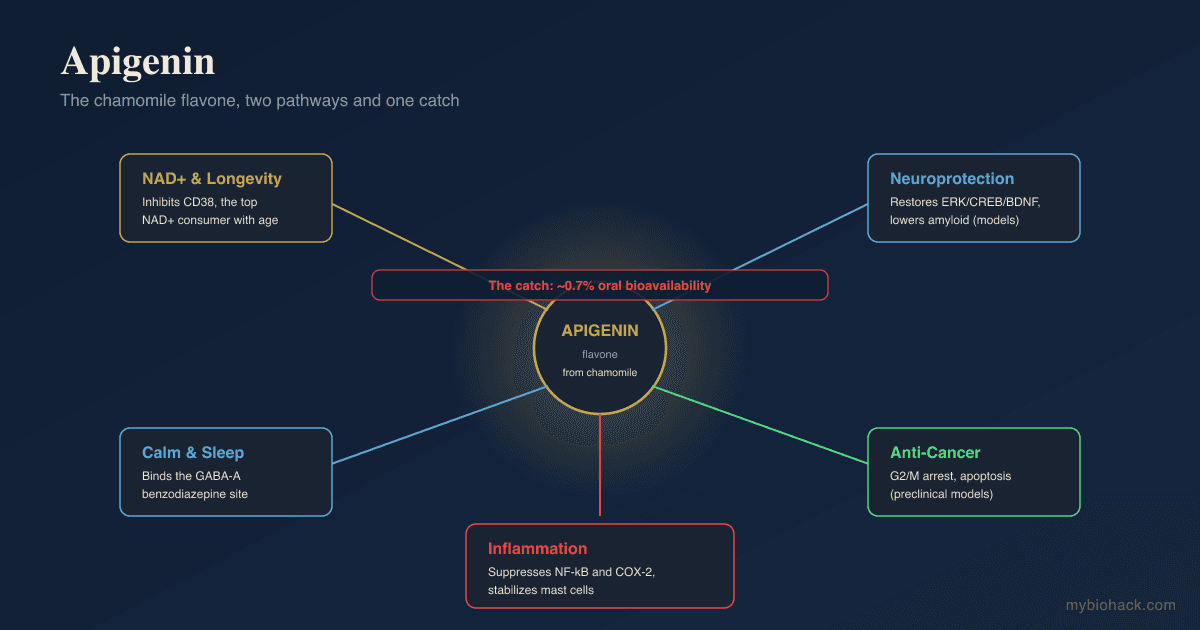
Other polyphenols in my library face the same translation gap between promising cell data and thinner human outcomes, including apigenin and quercetin, both of which I have written about with the same caveat.
Forms And Dosing
Virtually every clinical trial cited in this post used trans-resveratrol, the biologically active isomer, rather than the cis form, which is a distinction worth checking on a supplement label when buying trans-resveratrol.
Doses across the human trial literature ranged from roughly 20 mg per day up to 5 grams per day, with most positive cardiovascular and metabolic signals concentrated at 150 mg per day or higher. R
Doses up to about 1 gram per day are generally well tolerated, while doses in the multi-gram range produced dose-dependent gastrointestinal symptoms, including nausea and diarrhea, in formal safety trials. R
Resveratrol is also a mechanism-based inactivator of cytochrome P450 3A4 (CYP3A4), meaning it can permanently disable the enzyme rather than just competing for it, which raises real drug interaction potential for anyone on CYP3A4-metabolized medications. R
I bring this interaction up because it gets almost no attention in consumer marketing, and it is exactly the kind of thing worth flagging to a prescriber before starting a gram-level resveratrol protocol.
Some people add Piperine (as BioPerine) to inhibit glucuronidation and improve absorption, the same logic used for curcumin, but I want to be direct that controlled human data specifically validating this combination for resveratrol is still limited. R
Pterostilbene And Adjacent Compounds
Pterostilbene is resveratrol's dimethylated analog, meaning two of resveratrol's hydroxyl groups are replaced with methoxy groups, which increases metabolic stability and gives it meaningfully better oral bioavailability. R
A randomized, double-blind, placebo-controlled human trial in patients with elevated cholesterol established that Pterostilbene is generally safe up to 250 mg per day over 6 to 8 weeks, with no significant adverse effects on liver, kidney, or glucose markers. R
I consider pterostilbene the more pharmacologically sensible choice for anyone specifically chasing resveratrol's proposed mechanisms, precisely because it sidesteps the bioavailability problem that dominates section four of this post.
NAD+ precursors sit in an adjacent but mechanistically distinct category, since sirtuins require NAD+ as a cofactor regardless of how they get activated.
I have written separately about NMN as one option in that category, and it is worth being honest that the human data for its NAD-boosting cousin nicotinamide riboside is also mixed: a randomized, placebo-controlled trial in obese men found NR supplementation was safe and raised NAD+ levels but did not improve insulin sensitivity over the trial period. R
I also keep methylene blue in the same mental folder as resveratrol and pterostilbene, not because the mechanisms overlap directly, but because all three get marketed as mitochondrial optimizers on the strength of preclinical data that outruns the human trial record.
Testing
I do not think anyone should start a gram-level resveratrol or pterostilbene protocol without a baseline read on the systems these compounds actually touch: lipids, insulin sensitivity, liver conjugation capacity, and oxidative stress.
Cardiovascular And Metabolic Baseline
Given how concentrated the positive cardiovascular signal is in the 150 mg and up dose range, I use the Cardio Zoomer (Vibrant Wellness) to get a full lipid and lipoprotein picture, including ApoB and inflammatory markers, before and during a resveratrol protocol.
The Cardio IQ Advanced Lipid Panel With Inflammation (Quest, via Fullscript) or the simpler Lipid Panel (Quest) are reasonable alternatives if you want a lighter option.
Because the diabetic-specific glycemic benefit is the most reproducible finding in the entire resveratrol literature, I use Fasting Insulin (Quest) or the more complete Insulin Resistance Panel With Score (Quest) to figure out whether you are actually in the population that trial data supports.
Liver And Detox Capacity
Since resveratrol is cleared almost entirely through hepatic glucuronidation and sulfation, and since it is a mechanism-based CYP3A4 inactivator, I use the Hepatic Function Panel (Quest) to confirm baseline liver enzyme status before higher-dose protocols.
The Comprehensive Metabolic Panel (Quest) is a reasonable broader alternative if you want kidney and electrolyte markers included in the same draw.
Oxidative Stress And Mitochondrial Markers
Because the mitohormesis model treats resveratrol as a mild mitochondrial stressor rather than a clean antioxidant, I use the Oxidative Stress Profile (Genova Diagnostics) to see whether that stress is landing as adaptive signal or net oxidative burden in a given person.
The Cellular Zoomer (Vibrant Wellness) covers organic acids and mitochondrial function markers in more depth if you want to track the AMPK and mitochondrial biogenesis side of the mechanism directly.
For a broader baseline that includes liver, thyroid, and CBC markers in one draw before starting any longevity-compound stack, the Foundation Zoomer (Vibrant Wellness) is what I use most often with new clients.
Mechanisms Of Action
Simple:
- Resveratrol probably does not directly "switch on" your longevity genes the way it was originally marketed; the assay that produced that claim had a flaw.
- Its more defensible effects run through AMPK, a cellular energy sensor, and through mild, adaptive mitochondrial stress rather than a single clean target.
- It may support blood vessel lining function by increasing nitric oxide production, which is the leading candidate mechanism for its blood pressure effects.
- Almost none of an oral dose reaches your bloodstream intact, which is why so many promising cell-culture findings have not translated to humans.
Advanced:
- Allosteric SIRT1 activation. Resveratrol and related sirtuin-activating compounds can activate SIRT1 through a conserved hydrophobic motif present in specific native substrates, including PGC-1alpha and FOXO3a, mediated by the Glu230 residue in SIRT1's N-terminal domain, a mechanism distinct from the original, artifact-driven activation claims. R
- AMPK activation via phosphodiesterase inhibition. Resveratrol inhibits cAMP-degrading phosphodiesterases (notably PDE4), raising intracellular cAMP and activating Epac1, which triggers a Ca2+/CaMKKbeta-dependent activation of AMPK independent of any direct sirtuin interaction. R
- Dose-dependent SIRT1/AMPK crosstalk. At moderate resveratrol doses, SIRT1 is required upstream for AMPK phosphorylation and the resulting mitochondrial biogenesis, while high doses activate AMPK through a SIRT1-independent route, indicating at least two distinct dose-dependent mechanisms are active in the same tissue. R
- Mitohormesis. Mild mitochondrial stress from resveratrol triggers a retrograde signaling response from mitochondria to the nucleus that upregulates antioxidant and stress-resistance gene programs, the same adaptive logic that underlies benefits from exercise and caloric restriction. R
- NQO2 binding. Resveratrol is a high-affinity ligand for quinone reductase 2 (NQO2), binding the enzyme's active site with a dissociation constant in the low nanomolar range, and NQO2 inhibition is now considered a plausible off-target contributor to some of resveratrol's cellular effects, separate from sirtuins entirely. R
- eNOS deacetylation. SIRT1 deacetylates endothelial nitric oxide synthase (eNOS) directly, increasing its enzymatic activity and nitric oxide output, which is the leading mechanistic explanation for resveratrol's blood-pressure-lowering effect in trials at 150 mg per day and above. R
- Inflammatory signaling. Across pooled randomized trial data, resveratrol supplementation reduces circulating TNF-alpha and hs-CRP without a consistent effect on IL-6, suggesting it modulates specific arms of the inflammatory cascade rather than acting as a broad anti-inflammatory agent. R
Genetics
SIRT1 (rs7069102)
SIRT1 encodes the sirtuin most directly implicated, correctly or not, in resveratrol's proposed longevity mechanism.
A case-control study of over 1,000 obese patients and lean controls found the variant C-allele of rs7069102 was associated with reduced overall obesity risk, though the same variant was associated with increased visceral and abdominal fat specifically in obese men, illustrating that even a well-studied SIRT1 variant does not behave uniformly across populations. R
NQO2 (rs1143684)
NQO2 (NRH:Quinone Oxidoreductase 2) is a high-affinity off-target binding site for resveratrol, distinct from any sirtuin pathway. R
The common rs1143684 polymorphism produces two biochemically distinct enzyme variants, phenylalanine or leucine at position 47, with different catalytic stability and different responses to inhibition, which means NQO2 genotype could plausibly shift how much of resveratrol's off-target effect an individual actually experiences. R
UGT1A1
UGT1A1 (UDP-Glucuronosyltransferase 1A1) is one of the two enzyme families responsible for clearing resveratrol into inactive glucuronide conjugates within minutes of absorption.
The well-characterized TA-repeat promoter polymorphism that causes Gilbert's syndrome reduces UGT1A1 expression to roughly 30 percent of normal, and while that variant is best known for mild unconjugated hyperbilirubinemia, the same reduced glucuronidation capacity plausibly slows resveratrol clearance in carriers. R
SULT1A1
SULT1A1 (Sulfotransferase 1A1) handles the sulfation pathway that, alongside glucuronidation, is responsible for resveratrol's near-complete first-pass metabolism.
Copy number variation in SULT1A1 is significantly associated with enzymatic activity, meaning gene dosage alone can meaningfully change how fast a person's gut and liver inactivate resveratrol before it ever reaches systemic circulation. R
COMT (Val158Met)
COMT (Catechol-O-Methyltransferase) methylates catechol-containing compounds, and the well-known Val158Met functional variant produces a several-fold difference in enzymatic activity between genotypes. R
Resveratrol is not a catechol itself, but its metabolic byproducts and the broader dietary polyphenol class COMT normally processes overlap enough that I check this variant alongside UGT1A1 and SULT1A1 when I am building out someone's full detoxification and conjugation picture, a workup I discuss further in the context of oxidative load in my Nrf2 and sensitivities post.
More Research
- Alzheimer's biomarkers. A secondary analysis of the 2015 phase 2 Alzheimer's trial found resveratrol modulated peripheral and CNS inflammatory markers, including reductions in matrix metalloproteinase-9, suggesting an immune-modulating effect even where clinical cognitive outcomes were unclear. R
- Conflicts of interest. David Sinclair's original sirtuin work led to the founding of Sirtris Pharmaceuticals, which GlaxoSmithKline acquired for roughly $720 million in 2008 before quietly winding down its STAC drug program years later after disappointing trial results, a history worth knowing before taking any resveratrol claim from an interested party at face value.
- Exercise interaction. The Gliemann 2013 finding that resveratrol blunted training-induced cardiovascular adaptations in older men has not been widely replicated, and a subsequent commentary argued the broader evidence does not support "mainly negative" effects on exercise adaptation across the literature as a whole, so I treat this as an open, genuinely unresolved question rather than settled either way. R
- Isomer stability. Trans-resveratrol converts to the far less studied cis form under light and heat exposure, which is a real-world storage and formulation concern that has nothing to do with dose and everything to do with how a product was packaged and shipped.
- Nanoformulation delivery. Newer nanoparticle and phospholipid-complex delivery systems aim to solve the bioavailability problem directly rather than relying on absorption enhancers like piperine, though controlled human outcome data for these formulations is still early. R
- Sulforaphane comparison. Resveratrol is frequently grouped with other hormetic dietary compounds that activate adaptive stress-response pathways, including sulforaphane, and I think the parallel is instructive because sulforaphane's Nrf2 mechanism has held up to human trial scrutiny noticeably better than resveratrol's SIRT1 story has.
- Testing. For the full baseline workup I actually use before recommending a resveratrol or pterostilbene protocol, see the Testing section above, built around the Cardio Zoomer and Cellular Zoomer (Vibrant Wellness).
Jacob Gordon
INHC, FMT-C
Integrative Nutrition Health Coach
I cover mold illness, post-viral recovery, methylation, and complex chronic disease, drawing on ten years of clinical research, work inside a functional medicine clinic, and my own recovery from all of it. Every claim here is cited.
Book a ConsultationRelated Protocols & Supplements
Deep-dive chapters and recommended supplements for this topic
Quercetin
500mg 2x/day
Vitamin D3 + K2
5000 IU + 200mcg/day
Magnesium Glycinate
400mg at bedtime