Apigenin: Benefits, CD38/NAD+, Sleep, And The Chamomile Connection
By Jacob Gordon, INHC, FMT-CThis article contains affiliate links. As an Amazon Associate, MyBioHack earns from qualifying purchases at no extra cost to you. We only link products we research and stand behind.
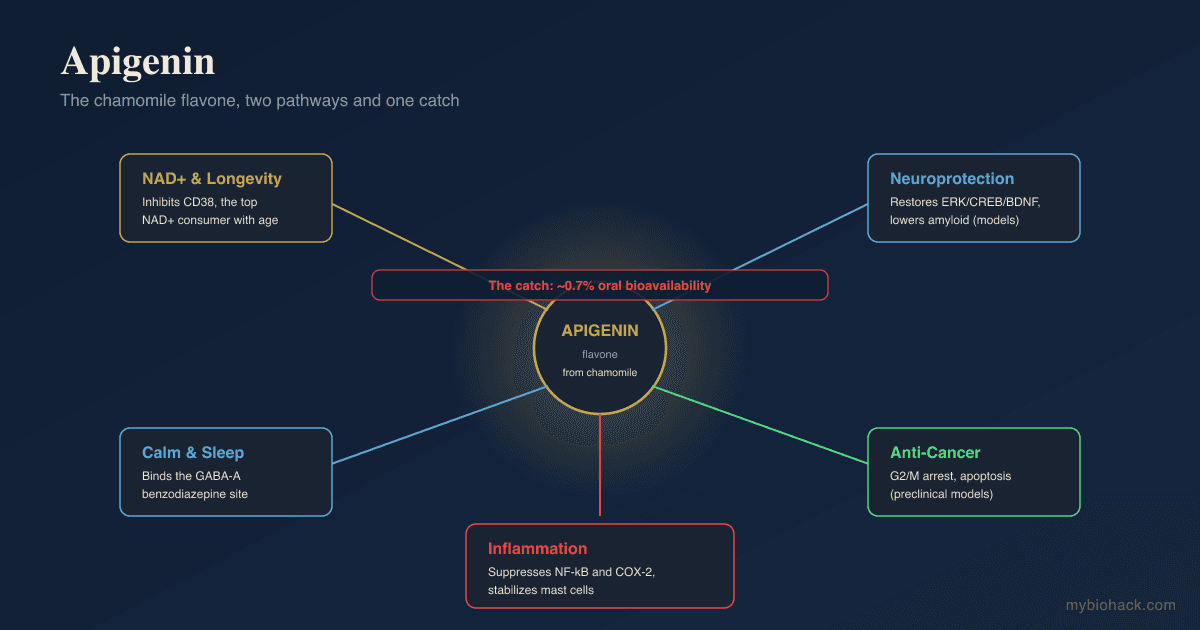
Apigenin is the flavone behind chamomile tea's calming reputation, and the same molecule that quietly raises NAD+ by shutting down an enzyme that destroys it.
In this post, we will discuss what apigenin is, how it inhibits CD38 to preserve NAD+, how it binds the GABA-A receptor to drive its anxiolytic and sleep effects, its anti-inflammatory and anti-cancer signaling, its serious bioavailability problem, where to find it, how to dose it, and the genetics that change how you respond.
What Is Apigenin
Apigenin (4',5,7-trihydroxyflavone) is a dietary flavone, a subclass of flavonoid found in chamomile, parsley, celery, and many other plants.
In food it almost never appears as free apigenin.
It is bound to sugars as glycosides like apiin and apigenin-7-O-glucoside, which have to be cleaved by gut bacteria before the aglycone (the active free form) can be absorbed.
The molecule has become popular for two very different reasons that most people never connect.
The longevity crowd takes it to raise NAD+ by inhibiting the enzyme CD38.
The sleep and anxiety crowd takes it because it is the active calming compound in chamomile, binding the same receptor site that benzodiazepines target.
Both effects are real, both are mechanistically distinct, and both are limited by the same problem of poor absorption.
The Benefits Of Apigenin

1. It Raises NAD+ By Inhibiting CD38
CD38 is the single largest consumer of NAD+ in mammalian tissue, and its expression climbs steadily with age.
Apigenin is a direct inhibitor of CD38, with a half-maximal inhibitory concentration of about 10.3 micromolar against the enzyme's NADase activity. R
In obese mice, apigenin administration raised NAD+ levels, lowered global protein acetylation, and improved glucose and lipid handling. R
This matters because rising CD38 is now considered a primary driver of the age-related NAD+ decline, acting through a SIRT3-dependent mechanism, and CD38 knockout mice are protected from that decline entirely. R
In a neuroinflammation model, a week of apigenin pre-treatment significantly raised hippocampal NAD+ and blunted the inflammatory response to an immune challenge, performing comparably to the NAD+ precursor nicotinamide riboside. R
Worth noting (this is the honest caveat): apigenin is a relatively weak CD38 inhibitor compared to designed pharmaceutical inhibitors like 78c, so the in-vivo NAD+ effect at realistic oral doses is plausible but not large.
2. It Calms The Brain Through The GABA-A Receptor
This is the chamomile connection.
Apigenin displaces the radioligand flunitrazepam from the central benzodiazepine binding site on the GABA-A receptor, which is the same molecular pocket diazepam and alprazolam act on. R
In a randomized, double-blind, placebo-controlled trial, standardized chamomile extract produced a significantly greater reduction in Hamilton Anxiety scores than placebo in people with generalized anxiety disorder. R
There is a big MAYBE in the mechanism, though, and it deserves to be stated plainly.
In patch-clamp work, apigenin actually reduced GABA-evoked currents rather than potentiating them the way classic benzodiazepines do, and at higher concentrations it behaved more like a partial negative modulator while also inhibiting NMDA currents with an IC50 around 10 micromolar. R
In the original Matricaria chamomilla characterization, apigenin given systemically reduced locomotor activity but did not show clean anxiolytic, muscle-relaxant, or anticonvulsant activity at the doses tested. R
So the practical anxiolytic and sleep benefit is well supported clinically through chamomile, but the receptor story is more nuanced than the popular "natural Valium" framing suggests, and part of the calming effect likely comes from NMDA and glutamate dampening rather than GABA potentiation alone.
For sleep specifically, apigenin and melatonin do different jobs.
Melatonin is a clock signal that tells the brain what time it is, while apigenin is a fast neuronal brake, which is why some people respond to one and not the other.
A 2026 study found that magnesium and apigenin together produced a synergistic sleep-promoting effect in normal and insomnia mouse models, which fits the way both quiet excitatory tone through different doors. R
3. It Lowers Inflammation Through NF-kB And COX-2
Apigenin is one of the better-characterized natural inhibitors of Nuclear Factor Kappa B (NF-kB), the master transcription factor for inflammatory gene expression.
It blocks phosphorylation and degradation of IkB-alpha by inhibiting IKK activation, which keeps NF-kB out of the nucleus and shuts down the genes it would otherwise switch on. R
In an acute lung injury model, apigenin suppressed both COX-2 and the NF-kB pathway, lowering downstream inflammatory cytokines. R
This dual NF-kB and COX-2 action is why apigenin shows up so often in inflammation and chronic-illness contexts, and it pairs mechanistically with other flavones like luteolin.
4. It Stabilizes Mast Cells
For anyone dealing with histamine and mast cell issues, apigenin is one of the more interesting flavones.
In human mast cells, apigenin blocked the release of inflammatory mediators by inhibiting NF-kB activation pathways, an effect tied to lowering intracellular calcium and suppressing TNF-alpha, IL-6, and IL-8. R
This puts it in the same functional category as quercetin and luteolin for people working on histamine intolerance, though apigenin has been studied less than quercetin in this specific role.
5. It Has Broad Anti-Cancer Signaling
Apigenin has been studied across pancreatic, breast, colorectal, prostate, and bladder cancer models, with a consistent pattern.
It induces cell-cycle arrest at the G2/M phase and triggers apoptosis while showing low toxicity to normal cells. R
A 2023 review mapped the main pathways it modulates in colorectal cancer, including Wnt/beta-catenin, PI3K/AKT/mTOR, MAPK/ERK, STAT3, and NF-kB. R
These are preclinical findings in cells and animals, not human cancer-treatment trials, so this is a signal worth knowing rather than a claim of clinical effect.
6. It Is Neuroprotective
In an Alzheimer's mouse model, apigenin lowered insoluble amyloid-beta and reduced BACE1 while restoring the neurotrophic ERK/CREB/BDNF pathway in the cerebral cortex. R
In cell models of Alzheimer's-associated neuroinflammation, apigenin preserved neuron and astrocyte integrity, reduced microglial activation, and lowered the M1 inflammatory marker CD68. R
Some of this neuroprotection likely overlaps with the NAD+ and CD38 story, since neuroinflammation and NAD+ depletion travel together.
7. It Improves Mitochondrial And Metabolic Function
By inhibiting CD38 and raising the NAD+/NADH ratio, apigenin activates SIRT3, the mitochondrial sirtuin that drives antioxidant enzyme activity.
In diabetic rats, apigenin downregulated CD38, raised the intracellular NAD+/NADH ratio, and restored Sirt3-mediated mitochondrial antioxidant defense in renal tubular cells. R
This is the same axis that connects apigenin to longevity, energy, and metabolic health rather than just calm.
The Bioavailability Problem
Here is the part most apigenin marketing leaves out.
Apigenin has very poor oral bioavailability, with an absolute oral bioavailability measured around 0.7 percent in rats. R
It is a BCS class II compound, meaning low solubility and poor dissolution, and it is chemically unstable in intestinal fluid.
On top of that, it is heavily metabolized by phase II conjugation in the gut wall and liver, primarily glucuronidation by UGT enzymes and some sulfation, so most of what you swallow leaves as apigenin-7-O-glucuronide before it ever reaches systemic circulation. R
This is the central tension with apigenin.
The mechanisms are impressive in a dish at micromolar concentrations, but reaching those concentrations in blood or brain from an oral dose is the actual challenge.
Practically, this is why delivery matters, and why formulations using phospholipid complexes, nanoparticles, or co-ingestion with fats are being studied, and why whole chamomile extract (with its matrix of co-factors) sometimes outperforms isolated apigenin in human outcomes.
Natural Sources Of Apigenin
Apigenin is concentrated in a small number of foods and herbs, mostly as glycosides.
Listed roughly from highest practical content:
- Celery (leaves and hearts, a major dietary source) R
- Chamomile (dried flowers are extremely rich in apigenin glycosides, which is why chamomile tea is the classic delivery vehicle) R
- Parsley (fresh and dried parsley are among the highest flavone sources by weight) R
Other contributors include artichoke, oregano, thyme, and spinach.
A practical note: dried herbs concentrate apigenin relative to fresh, and chamomile tea remains the most studied real-world source, since the clinical anxiety and sleep data come from standardized chamomile extract rather than isolated apigenin.
Chamomile extract standardized to apigenin is the closest thing to the form used in human trials.
Dosage And Safety
There is no validated isolated-apigenin dose for sleep or anxiety from a human randomized trial.
The popular nightly dose of 50 mg of isolated apigenin comes from the supplement market, not from a clinical trial on that compound and dose.
The human clinical evidence is for chamomile extract, typically standardized for apigenin content, at roughly 220 to 1500 mg per day. R
Apigenin is generally well tolerated, but there are real interaction concerns worth respecting.
- Anti-CD38 cancer therapy (apigenin inhibits CD38, the target of drugs like daratumumab, so this is a theoretical interaction worth flagging with an oncologist)
- Anticoagulants (chamomile has case reports of bleeding interaction with warfarin, partly through coumarin content and CYP effects)
- CYP-metabolized drugs (apigenin inhibits CYP1A2, CYP2C9, and CYP3A4 in vitro, which can raise levels of drugs cleared by those enzymes)
- Estrogen-sensitive conditions (apigenin has shown weak estrogen-receptor and aromatase activity in some models, so it sits in the be-thoughtful category rather than the clearly-safe one)
- Sedatives (combining with benzodiazepines, alcohol, or other GABAergic agents could be additive)
People with ragweed or Asteraceae allergy can react to chamomile specifically.
For sleep stacking, apigenin pairs logically with magnesium glycinate and theanine, which calm through different mechanisms.
Mechanisms Of Action
Simple:
- Apigenin blocks an enzyme called CD38 that chews up NAD+, so cells keep more of the fuel they need to run and repair.
- It plugs into the same calming receptor in the brain that anti-anxiety drugs use, which is why chamomile makes you sleepy.
- It turns down the body's master inflammation switch, so fewer inflammatory signals get made.
Advanced:
- CD38 inhibition and the NAD+/SIRT axis Apigenin directly inhibits the NADase and ADP-ribosyl-cyclase activities of CD38, the dominant NAD+-consuming ectoenzyme, raising the intracellular NAD+/NADH ratio and restoring SIRT1 and SIRT3 deacetylase activity, which improves mitochondrial antioxidant capacity and glucose and lipid homeostasis. R R
- GABA-A and glutamatergic modulation Apigenin binds the central benzodiazepine site and displaces flunitrazepam, but electrophysiology shows it reduces GABA-evoked chloride currents rather than potentiating them, and it inhibits NMDA-mediated currents with an IC50 near 10 micromolar, so its net calming effect appears to combine partial GABA-A modulation with suppression of glutamatergic excitation. R R
- NF-kB and COX-2 suppression Apigenin inhibits IKK activation, preventing IkB-alpha phosphorylation and degradation, which keeps NF-kB sequestered in the cytoplasm and downregulates NF-kB-dependent genes including COX-2, cyclin D1, Bcl-2, Bcl-xL, and VEGF. R R
- Mast cell stabilization In human mast cells apigenin lowers intracellular calcium and blocks NF-kB activation, suppressing TNF-alpha, IL-6, IL-8, and GM-CSF release. R
- Neurotrophic and anti-amyloid signaling Apigenin restores the ERK/CREB/BDNF pathway and lowers BACE1 and insoluble amyloid-beta in Alzheimer's models, while reducing microglial M1 activation and CD68 expression. R R
Genetics
CD38
CD38 encodes the NAD+-consuming ectoenzyme that apigenin inhibits.
Higher CD38 expression and activity drive faster NAD+ decline and worse mitochondrial function with age. R
People with higher constitutive CD38 activity, whether from inflammation or genetics, are the ones with the most theoretical room to benefit from CD38 inhibition.
UGT1A1
UGT1A1 encodes the primary UDP-glucuronosyltransferase that conjugates apigenin in the gut and liver.
Reduced-function variants (such as the UGT1A1*28 allele associated with Gilbert's syndrome) slow glucuronidation broadly.
rs8175347 (the *28 promoter variant) lowers UGT1A1 activity, which in theory could leave more free apigenin available, though this has not been directly studied for apigenin pharmacokinetics. R
CYP1A2
CYP1A2 encodes a major hepatic cytochrome that apigenin inhibits in vitro.
Inhibition of CYP1A2 slows clearance of substrates like caffeine and certain medications.
rs762551 (the CYP1A2*1F variant) determines fast versus slow metabolizer status, so slow metabolizers stacking apigenin with caffeine may notice a stronger and longer caffeine effect. R
More Research
Apigenin is one of the clearest examples of a compound whose laboratory potency outruns its oral bioavailability, so delivery form may matter more than dose. R
For anxiety and sleep, the strongest human evidence is for standardized chamomile extract rather than isolated apigenin, and the receptor mechanism is more complex than simple benzodiazepine-site potentiation. R R
For NAD+ goals, apigenin is best understood as a CD38 brake that pairs with, rather than replaces, NAD+ precursors, since lowering NAD+ consumption and raising NAD+ supply attack the problem from opposite ends. R
If you want to track the downstream of the NAD+ and mitochondrial axis, I use the Cellular Zoomer (Vibrant Wellness) to assess organic acids, mitochondrial function, oxidative stress, and methylation status, which is where CD38 and NAD+ effects show up indirectly.
The anti-cancer data is consistent across many tumor models but remains preclinical, so it belongs in the mechanism-of-interest column, not the treatment column. R
The synergy between magnesium and apigenin for sleep is an early but mechanistically sensible finding, since the two calm excitatory tone through separate channels. R
Jacob Gordon
INHC, FMT-C
Integrative Nutrition Health Coach
I cover mold illness, post-viral recovery, methylation, and complex chronic disease, drawing on ten years of clinical research, work inside a functional medicine clinic, and my own recovery from all of it. Every claim here is cited.
Book a ConsultationRelated Protocols & Supplements
Deep-dive chapters and recommended supplements for this topic
Lion's Mane
1000mg/day
Omega-3 (DHA)
2g/day
Phosphatidylserine
100mg 3x/day