Iodine: Thyroid, Breast Tissue, And The Hashimoto's Caution
By Jacob Gordon, INHC, FMT-CIodine is one of the most polarizing nutrients in thyroid and breast health discussions, with some groups advocating high doses and others warning against them.
In this post, we will discuss what iodine actually does, why both deficiency and excess can cause problems, and how to think about dosing if you have Hashimoto's or other autoimmune thyroid disease.

What Is Iodine
Iodine is an essential trace element required for the synthesis of thyroid hormones, which regulate metabolism, development, and cellular energy production. RIt is found in seawater, soil, and certain foods, but iodine content in food varies widely depending on soil and farming practices. R
The thyroid gland is the primary site of iodine storage and utilization in the body. R
Thyroid Hormone Synthesis
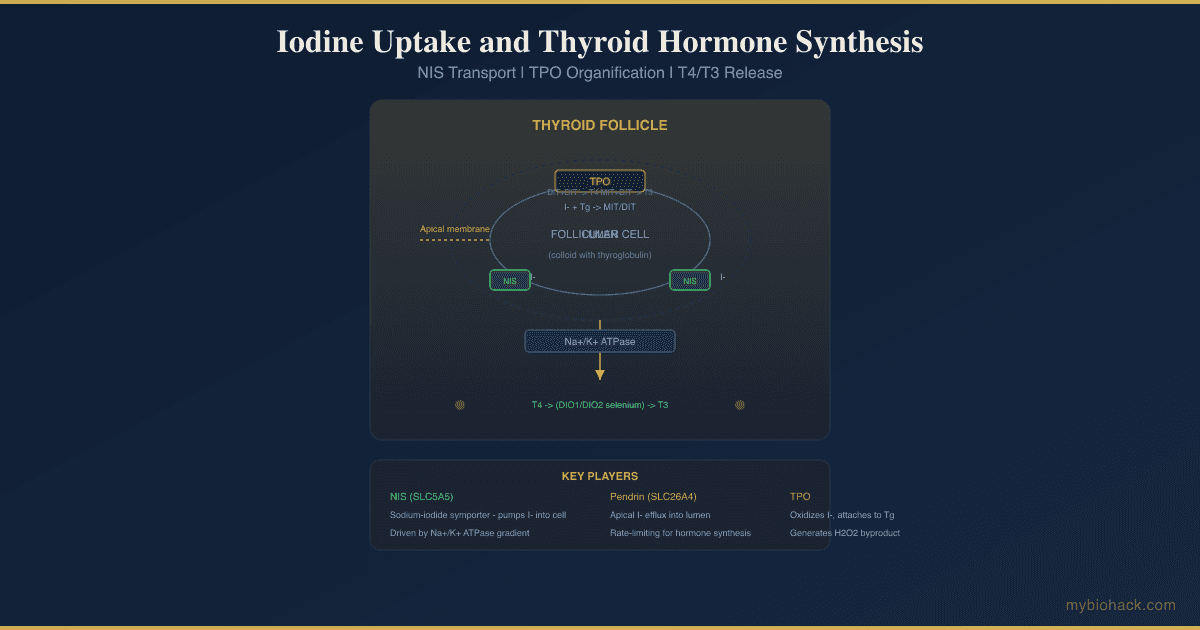
Thyroid hormone synthesis occurs in five main steps. R
1. Iodide uptake. Iodide is transported from the blood into thyroid follicular cells via the sodium-iodide symporter (NIS).
2. Thyroglobulin synthesis. Thyrocytes produce thyroglobulin, a precursor protein stored in the follicular lumen.
3. Oxidation. Thyroid peroxidase (TPO) oxidizes iodide into active iodine.
4. Organification. TPO attaches iodine to tyrosine residues on thyroglobulin, creating monoiodotyrosine (MIT) and diiodotyrosine (DIT).
5. Coupling. TPO combines MIT and DIT to form T3 and T4.
Without adequate iodine, the thyroid cannot produce enough thyroid hormone, leading to hypothyroidism and goiter. R
Iodine And Breast Tissue
Iodine is also concentrated in breast tissue, where it may act as an antioxidant and influence estrogen metabolism. R
Some researchers have proposed that iodine deficiency is associated with fibrocystic breast disease and benign breast pain. R
Older studies suggested that iodine supplementation improved breast pain and fibrosis in some women. R
However, the evidence is limited and controversial, and high-dose iodine is not without risks. R
Deficiency Vs Excess
Deficiency
Iodine deficiency is the most common preventable cause of intellectual disability worldwide. R
It causes:
Goiter Hypothyroidism Developmental impairment in fetuses and infants Increased thyroid nodule risk in some populationsExcess
Too much iodine can also cause thyroid dysfunction. R
The two main effects are:
Wolff-Chaikoff effect. An acute, transient reduction in thyroid hormone synthesis after a large iodine load. Most people escape this effect within 24-48 hours. R Jod-Basedow effect. Hyperthyroidism triggered by iodine exposure in people with autonomous thyroid nodules or latent Graves' disease. RThe tolerable upper intake level for adults is 1100 mcg per day. R
The Hashimoto's Caution
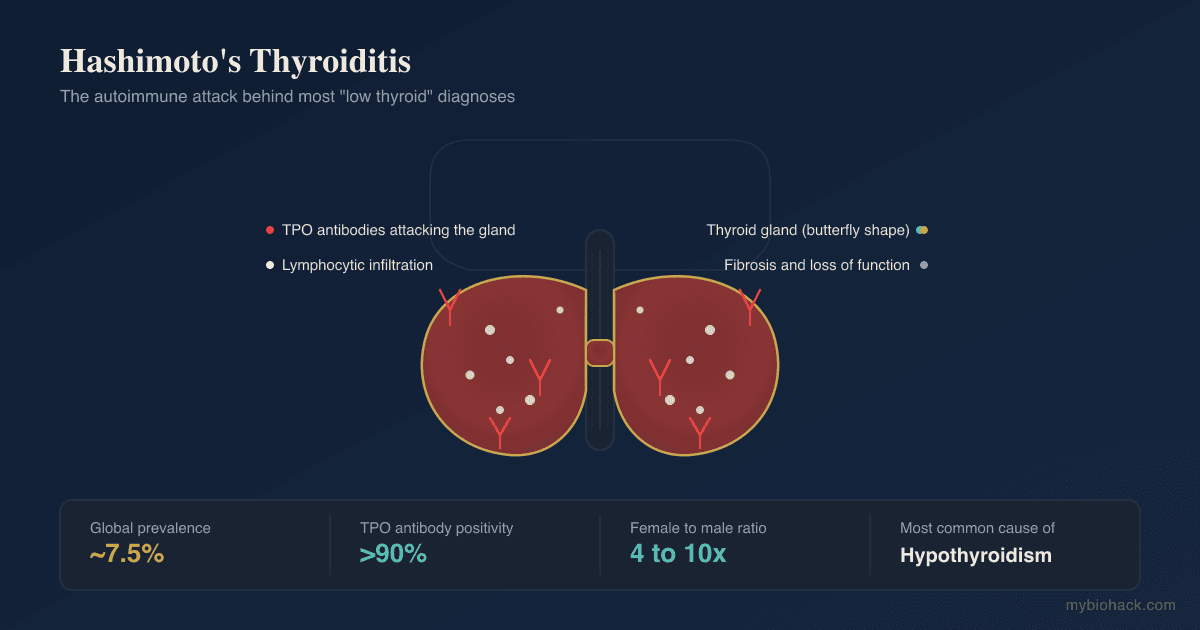
People with Hashimoto's thyroiditis are particularly sensitive to iodine fluctuations. R
Excess iodine can exacerbate the autoimmune process and worsen hypothyroidism in susceptible individuals. R
This does not mean all iodine is dangerous for Hashimoto's patients. R
It means that high-dose iodine, kelp supplements, and unsupervised iodine loading protocols should be approached with caution. R
The American Thyroid Association advises against non-monitored high-dose iodine and kelp supplements. R
Forms And Dosing
Potassium Iodide
Potassium iodide is the most common supplemental form and is used in prenatal vitamins and nuclear emergency preparedness. RStandard prenatal doses are around 150 mcg per day. R
Lugol's Solution
Lugol's solution contains elemental iodine and potassium iodide and is used medically for short-term, supervised treatment. RIt is not appropriate for casual self-supplementation due to the risk of iodine excess. R
Kelp
Kelp supplements are highly variable in iodine content and can contain amounts far exceeding the daily limit. RThey are a common source of iodine-induced thyroid dysfunction. R
Pregnancy Needs
Iodine requirements increase during pregnancy from 150 mcg per day to 220-250 mcg per day. R
The fetus depends entirely on maternal thyroid hormone during the first trimester. R
Excess iodine during pregnancy can cause fetal hypothyroidism and goiter. R
Mechanisms Of Action
Simple:
Iodine is required to make thyroid hormones T3 and T4. The thyroid actively concentrates iodide using the NIS transporter. Both too little and too much iodine disrupt thyroid function.Advanced:
Sodium-iodide symporter (NIS). NIS is a transmembrane glycoprotein that actively pumps iodide into thyroid follicular cells against a concentration gradient, driven by the sodium gradient. R Thyroid peroxidase (TPO). TPO oxidizes iodide and catalyzes both the organification of tyrosine residues and the coupling reaction that forms T3 and T4. R Wolff-Chaikoff escape. After an iodine load, the thyroid transiently reduces hormone synthesis, then escapes this inhibition through downregulation of NIS, allowing hormone production to resume. R Autoimmune modulation. Iodine excess may increase thyroid antigenicity and oxidative stress in genetically susceptible individuals, potentially triggering or worsening Hashimoto's. RGenetics
NIS / SLC5A5
SLC5A5 encodes the sodium-iodide symporter (NIS). RMutations cause congenital hypothyroidism due to impaired iodide uptake. R
TPO
TPO encodes thyroid peroxidase, the enzyme that oxidizes iodide and couples iodotyrosines. RTPO mutations and autoantibodies are central to Hashimoto's and congenital hypothyroidism. R
TG
TG encodes thyroglobulin, the protein scaffold for thyroid hormone synthesis. RMutations can cause goiter and hypothyroidism. R
More Research
Breast cancer. Some epidemiological studies suggest iodine status may influence breast cancer risk, but causality is unclear and high-dose iodine is not established as preventive. R Iodinated contrast. Medical imaging with iodinated contrast can induce thyroid dysfunction in susceptible patients, particularly those with autonomous nodules. R Autoimmune thyroid disease. The relationship between iodine intake and autoimmune thyroid disease is complex and varies by genetic susceptibility, selenium status, and baseline thyroid health. R- Testing. For biomarker testing I use the Thyroid Panel and Comprehensive Metabolic Panel to assess iodine-related thyroid function.
Jacob Gordon
INHC, FMT-C
Board Certified Health Coach
I spent years battling unexplained chronic illness before discovering biohacking, epigenetics, and functional medicine. Now I share that research at MyBioHack to help others find their own answers.
Book a ConsultationRelated Protocols & Supplements
Deep-dive chapters and recommended supplements for this topic
Ashwagandha (KSM-66)
600mg/day
Vitamin D3 + K2
5000 IU + 200mcg/day
Zinc
30mg/day with food