The Integrated Stress Response (ISR) and eIF2alpha: The Cell's Master Stress Switch
By Jacob Gordon, INHC, FMT-CThis article contains affiliate links. As an Amazon Associate, MyBioHack earns from qualifying purchases at no extra cost to you. We only link products we research and stand behind.
The Integrated Stress Response (ISR) is the single pathway your cells use to triage almost every kind of stress, and when it gets stuck in the "on" position it quietly drives fatigue, brain fog, and neurodegeneration.
In this post, we will discuss what the ISR is, the four kinases that switch it on, how phosphorylation of eIF2-alpha shuts down translation while raising ATF4, why a response built to save cells turns destructive when it never resolves, and what can be done to modulate it.

Basics Of The Integrated Stress Response
The Integrated Stress Response (ISR) is an evolutionarily conserved signaling network that lets eukaryotic cells respond to a wide range of internal and external threats through one shared bottleneck. R
That bottleneck is the phosphorylation of a single serine on a single protein. R
The protein is eukaryotic translation initiation factor 2 alpha (eIF2-alpha), and the serine is Ser51. R
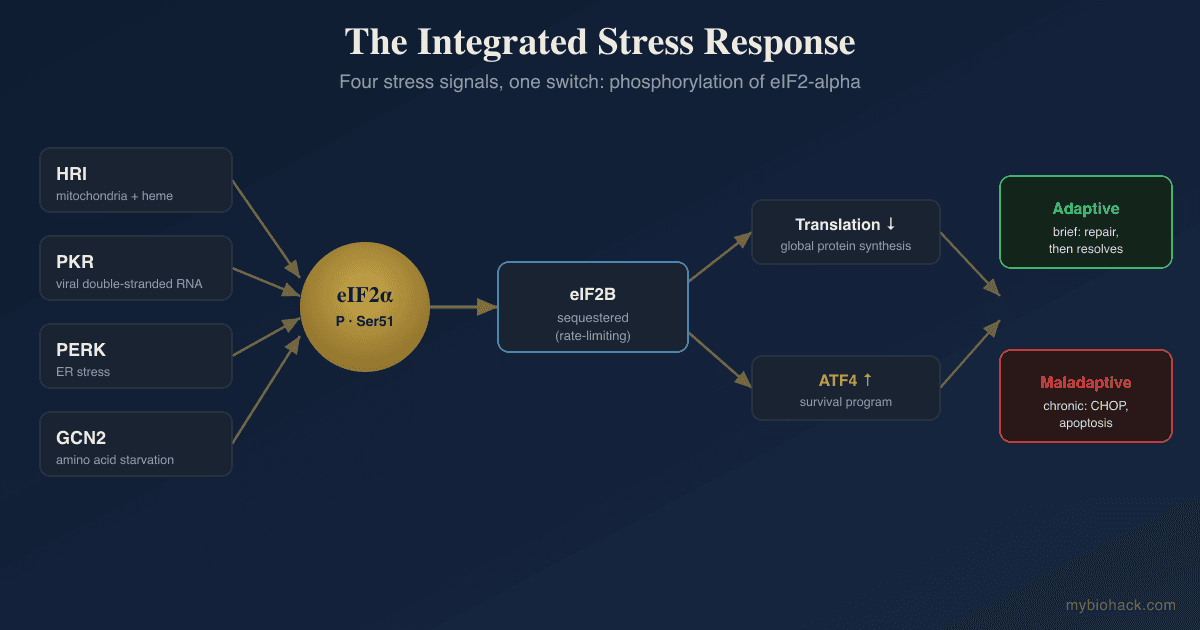
When a cell senses stress, it phosphorylates eIF2-alpha at Ser51, which does two things at once. R
It throttles down global protein synthesis to conserve energy and stop making proteins that may misfold. R
At the same time it paradoxically increases the translation of a small set of stress-adaptive messages, the most important of which is Activating Transcription Factor 4 (ATF4). R
The name "integrated" is the key idea.
Four different sensors, each watching a different kind of danger, all converge on the exact same event (Ser51 phosphorylation), so the cell integrates many distinct stress signals into one unified output. R
In Jacob's Junction Dysfunction framework this matters because the ISR sits downstream of nearly every cascade described in the guide.
Mitochondrial failure, viral persistence, endoplasmic reticulum overload, and amino acid depletion all feed into this one switch, which is why so many post-viral and chronic illness presentations share the same metabolic signature.
The Four Kinases That Sense Stress
Four kinases phosphorylate eIF2-alpha, and each one is tuned to a different category of stress. R
They are heme-regulated inhibitor (HRI), protein kinase R (PKR), PKR-like endoplasmic reticulum kinase (PERK), and general control nonderepressible 2 (GCN2). R
PERK (ER Stress)
PERK is the endoplasmic reticulum sensor, encoded by the EIF2AK3 gene. R
When misfolded proteins accumulate in the ER, the chaperone BiP releases from PERK's luminal domain, PERK dimerizes, and it phosphorylates eIF2-alpha. R
PERK is part of the broader unfolded protein response and is the branch most people mean when they talk about ER stress. R
GCN2 (Amino Acid Starvation)
GCN2 is the amino acid sensor, encoded by EIF2AK4. R It detects uncharged transfer RNA that accumulates when a specific amino acid runs low, then activates the ISR to ration translation. R
This is the most interesting kinase from a Junction Dysfunction angle.
When chronic interferon signaling drives IDO1 to shunt tryptophan into the kynurenine pathway, local tryptophan depletion is exactly the kind of amino acid scarcity GCN2 is built to detect, which is Jacob's hypothesis for one way the kynurenine shunt and the ISR reinforce each other.
HRI (Heme Deficiency And Mitochondrial Stress)
HRI is the heme sensor, encoded by EIF2AK1, and it was classically known for matching globin production to iron and heme availability in red blood cell precursors. R
The bigger discovery is that HRI is also the relay for mitochondrial stress. R
When mitochondria are damaged, the protease OMA1 cleaves the protein DELE1, cleaved DELE1 moves into the cytosol, and it binds and activates HRI, which then triggers the ISR. R
This OMA1-DELE1-HRI axis is how a struggling mitochondrion tells the rest of the cell to slow down, and it is the molecular bridge between the cell danger response and the ISR. R
PKR (Viral Double-Stranded RNA)
PKR is the antiviral sensor, encoded by EIF2AK2. R It binds double-stranded RNA produced during viral replication, dimerizes, autophosphorylates, and shuts down translation to starve the virus of the ribosomes it needs. R
Many viruses fight back, and SARS-CoV-2 is a good example.
Its nucleocapsid protein sequesters double-stranded RNA and blocks PKR-mediated ISR activation, which is one way the virus suppresses the host shutdown that would otherwise contain it. R
How eIF2-alpha Phosphorylation Works
To understand why one phosphorylation event has such large consequences, you have to understand what eIF2 normally does.
eIF2 is a three-part protein that carries the initiator methionine transfer RNA to the ribosome to start translation, and it can only do this when bound to GTP. R
After each round of initiation, eIF2 is left bound to GDP and must be recharged back to the GTP form by its guanine nucleotide exchange factor, eIF2B. R eIF2B is the rate-limiting catalyst for the entire process, and it is present in much smaller amounts than eIF2 itself. R
Here is the trick.
When eIF2-alpha is phosphorylated at Ser51, eIF2 stops being a substrate for eIF2B and becomes a tight inhibitor of it instead. R
Because eIF2B is scarce, a small amount of phosphorylated eIF2 is enough to sequester most of the available eIF2B, which collapses the recharging cycle and shuts down general translation. R

The ATF4 paradox is the other half of the system.
Most messenger RNAs slow down when translation initiation falls, but ATF4 carries small upstream open reading frames in its 5-prime region that normally suppress its own translation. R
When ternary complex is scarce, ribosomes skip the inhibitory upstream reading frames and instead initiate at the true ATF4 start codon, so ATF4 protein actually rises while everything else falls. R
ATF4 then drives a transcriptional program for survival.
It turns on genes for amino acid transport and synthesis, one-carbon metabolism, and glutathione production to restore redox balance. R
ATF4 is also the master transcription factor of the mitochondrial branch of the response, coordinating metabolic remodeling when mitochondria are under strain. R
Finally there is a built-in off switch.
One of ATF4's downstream targets is GADD34 (the product of the PPP1R15A gene), a regulatory subunit that directs protein phosphatase 1 to dephosphorylate eIF2-alpha. R
This negative feedback loop is what allows translation to recover once the stress is resolved, and its failure is central to several diseases discussed below. R
Adaptive Versus Maladaptive ISR
The ISR is fundamentally protective.
A short, sharp activation buys the cell time to clear misfolded proteins, restore amino acids, repair mitochondria, and rebuild antioxidant defenses, then GADD34 resets the system and translation resumes. R
The problem is duration.
When stress is severe or never resolves, sustained ATF4 stops being adaptive and starts driving the pro-apoptotic transcription factor CHOP, tipping the cell from survival toward programmed death. R
The same response that saves a cell over hours can destroy it over weeks. R
This is the central tension of the whole pathway, and it explains why simply blocking the ISR is not automatically good and simply boosting it is not automatically bad.
The ISR can output two opposite fates, survival or apoptosis, and the determinant is largely how long and how strongly it stays on. R
There is even a pharmacological line drawn through this distinction.
The small molecule ISRIB suppresses low-grade chronic ISR signaling but leaves a strong acute ISR intact, which means the destructive chronic tail can in principle be trimmed without disabling the protective acute burst. R
In Junction Dysfunction terms this maps cleanly onto Jacob's framing of the Wound Healing Cycles (WHC).
A healthy cell completes the ISR and moves on, the same way a healthy body completes hemostasis and inflammation and progresses to proliferation and remodeling.
People stuck in chronic post-viral illness look, at the cellular level, like cells stuck in a low-grade ISR that never clears, which is Jacob's framing of why translation, repair, and energy production all stall together.
The ISR And Overlapping Conditions
Because the ISR sits at the convergence of so many stressors, a stuck ISR shows up across the conditions Jacob works with most.
Neurodegeneration
Phosphorylated eIF2-alpha attributed to chronic PERK activation has been found in the postmortem brains of patients with Alzheimer's disease, Parkinson's disease, ALS, Huntington's disease, progressive supranuclear palsy, and HIV-associated neurocognitive disorders. R
Sustained ATF4 chronically suppresses the synthesis of new synaptic proteins, which is one mechanistic link between a stuck ISR and the loss of plasticity seen in these diseases. R
In Parkinson's models, inhibiting the PERK-ATF4 arm preserves dopaminergic neurons, which is why this pathway is now a major drug target. R
Cognitive Impairment And Memory
The ISR is woven directly into how memories form.
Phosphorylation of eIF2-alpha and the resulting ATF4 act as a molecular brake on the conversion of short-term to long-term memory, and learning itself triggers eIF2-alpha dephosphorylation to release that brake. R
Releasing the brake pharmacologically with ISRIB reverses age-related memory decline in mice and restores spatial and working memory. R
In a model of vascular cognitive impairment, ISR inhibition restored CREB and BDNF signaling and reduced cognitive deficits, tying the ISR to the same growth-factor machinery Jacob targets for neuroplasticity. R
Mitochondrial Disease
When mitochondria fail, the OMA1-DELE1-HRI axis fires a dedicated branch sometimes called the mitochondrial ISR. R
ATF4 then drives secretion of the cytokines FGF21 and GDF15, which is why these two proteins are now used as blood biomarkers of mitochondrial dysfunction. R
This is the cell trying to adapt, but chronic activation of this branch contributes to the muscle weakness and exercise intolerance of mitochondrial disease. R
Long COVID And Post-Viral Illness
Acute SARS-CoV-2 infection is a direct ISR battleground, with the virus actively suppressing PKR-driven shutdown to keep replicating. R
In Jacob's framing, the relevance to long COVID is that persistent viral remnants, ongoing glycocalyx damage, and the mitochondrial dysfunction that follows microcapillary leak would all keep nudging PKR, PERK, and HRI, holding the ISR in the low-grade chronic state that produces post-exertional crashes and brain fog.
This is Jacob's hypothesis, not settled science, but it unifies the fatigue, cognitive, and metabolic features of post-viral illness under one cellular mechanism.
How To Modulate The ISR
This is the contested part, and honesty matters here.
There is a big MAYBE around whether you want to activate or inhibit the ISR, because the answer depends entirely on context, dose, and duration.
A systematic review of directional ISR modulation in neurodegeneration found that both eIF2B activators that suppress the response and agents that prolong it have shown benefit in different models, which tells you the field itself has not settled this. R
The cleanest way to think about it is this.
You generally do not want to add more chronic stress signaling on top of an already stuck ISR, and you do want to remove the upstream drivers that keep the kinases firing.
Removing drivers means the same Junction Dysfunction work Jacob always emphasizes: lowering viral and endotoxin load, repairing mitochondria, restoring the glycocalyx, and refilling the amino acid and redox pools that ATF4 is desperately trying to rebuild.
Support Mitochondria To Quiet The HRI Branch
Because the HRI branch fires from mitochondrial failure, mitochondrial support is upstream ISR support.
Pharmacologic activation of ISR kinases has been shown to block pathologic mitochondrial fragmentation, which is one reason crude "shut it all off" approaches can backfire. R
CoQ10 (ubiquinol): supports the electron transport chain that, when it fails, triggers the OMA1-DELE1-HRI relay. R
Nicotinamide riboside: replenishes NAD, which is depleted both by mitochondrial strain and by the kynurenine shunt that competes for tryptophan.
Refill What ATF4 Is Trying To Build
ATF4 spends its entire program trying to restore amino acids, one-carbon flux, and glutathione, so giving the cell those substrates removes the reason to keep straining. R
N-acetylcysteine: a direct glutathione precursor that takes redox pressure off the ATF4 program.
Glycine: a rate-limiting amino acid for glutathione synthesis and a substrate ATF4 actively upregulates transport for. R
Modulate The ER Stress Branch
Several food-derived compounds tune the PERK-eIF2-alpha-ATF4 arm, though they are hormetic and dose matters.
Sulforaphane: modulates the unfolded protein response and ATF4, and at low doses promotes protective autophagy while high doses push the response toward cell death (so more is not better). R
Curcumin: can either attenuate or sensitize ER-stress signaling depending on context, which fits the broader theme that ISR modulators are bidirectional. R
The Fasting And Ketosis Window
Fasting and ketosis open a repair window in Jacob's glycocalyx model, and beta-hydroxybutyrate appears to take metabolic pressure off stressed mitochondria, which would indirectly quiet the HRI branch.
The evidence here is mechanistic and indirect rather than ISR-specific in humans, so frame it as plausible support, not a proven ISR therapy.
The Pharmacology (For Context, Not Recommendation)
These are prescription or research compounds, included so you understand the landscape, not as a protocol.
ISRIB acts as a molecular staple that holds eIF2B in its fully active form, restoring translation even when eIF2-alpha is phosphorylated, and it preferentially trims chronic low-grade ISR. R
Salubrinal does the opposite, blocking eIF2-alpha dephosphorylation to prolong the ISR, which is protective in some ER-stress and neuronal injury models. R
Guanabenz and its derivative Sephin1 were proposed to selectively inhibit the GADD34 phosphatase complex to prolong the ISR, although later work questioned whether they actually have that mechanism, so treat the GADD34-targeting story with caution. R
What To Stay Away From
Indiscriminate ISR suppression (qualifier note): a strong acute ISR is protective, and blunting it can leave cells unable to handle misfolded proteins or viral load.
- Blind L-arginine or nitric oxide boosters while mitochondria are failing, because adding oxidative and viral-reactivation pressure feeds the very stress that keeps the ISR on
- Chronic overtraining, which loads mitochondria and the ER with stress and, in the Junction Dysfunction population, prolongs the stuck low-grade ISR rather than producing hormetic benefit
- High sustained doses of hormetic ISR modulators, since compounds like sulforaphane flip from protective autophagy to pro-apoptotic CHOP signaling as the dose climbs R
- Resveratrol in the post-viral context, which Jacob avoids because it induces IDO1 and would deepen the tryptophan depletion that GCN2 senses
Testing
There is no single direct clinical assay for "ISR activity," so testing focuses on the upstream drivers and the downstream biomarkers the ISR produces.
Blood And Urine Markers
FGF21 and GDF15 are the most useful ISR-linked markers, since both are secreted under ATF4 control during mitochondrial stress and FGF21 in particular discriminates mitochondrial disease well. R
Homocysteine, B12, and folate reflect the one-carbon metabolism that ATF4 leans on, and you can assess them with the Homocysteine + B12 + Folate panel (Quest Diagnostics).
High-sensitivity CRP and IL-6 track the inflammatory load that keeps PKR and PERK firing, available through the Cardio IQ Advanced Lipid Panel with Inflammation (Quest Diagnostics).
Functional Lab Panels
I use the Cellular Zoomer (Vibrant Wellness) to assess mitochondrial function, oxidative stress, and methylation markers, which together reveal whether the HRI and ATF4 branches are likely engaged.
For organic-acid evidence of mitochondrial and microbial strain, the Organic Acids Test (Mosaic Diagnostics) is the alternative I reach for.
To check the amino acid status that GCN2 senses, the Nutrient Zoomer (Vibrant Wellness) covers amino acids alongside the vitamins and minerals that feed redox recovery.
When viral persistence is the suspected ISR driver, the Viral Infections Panel (Vibrant Wellness) helps map reactivated latent infections.
Genetics
A Methylation Genetics panel, or analysis of 23andMe raw data, lets you check the variants below that set your personal ISR sensitivity.
Mechanisms Of Action
Simple:
- Your cells have one master "pause" button for stress, and pressing it slows down making most proteins while turning up a few survival proteins.
- Four different alarms (low iron and broken mitochondria, viruses, ER overload, and missing amino acids) all press the same button.
- Pressing it briefly is healing, but holding it down for weeks starts killing cells, which is what happens in chronic illness and brain disease.
Advanced:
- eIF2B sequestration is the core switch, where Ser51-phosphorylated eIF2 converts from a substrate into an allosteric inhibitor of the scarce guanine nucleotide exchange factor eIF2B, collapsing ternary complex regeneration and global cap-dependent initiation. R
- uORF-mediated ATF4 translation reroutes scanning ribosomes past inhibitory upstream open reading frames to the ATF4 coding sequence specifically when ternary complex is limiting, producing the counterintuitive rise in ATF4 during global translational arrest. R
- The OMA1-DELE1-HRI relay transduces inner-membrane mitochondrial stress into cytosolic ISR activation, with OMA1 cleaving DELE1, cytosolic DELE1 oligomerizing with and activating HRI, and HRI phosphorylating eIF2-alpha. R
- The ATF4-GADD34 negative feedback loop restores homeostasis by inducing PPP1R15A, which targets protein phosphatase 1 to dephosphorylate eIF2-alpha, and loss of this loop produces the prolonged translational hyperrepression seen in vanishing white matter disease. R
- CHOP-driven commitment to apoptosis occurs when ATF4 induction is sustained, shifting the transcriptional program from cytoprotective amino acid and redox genes toward pro-death effectors. R
Genetics
EIF2AK1
EIF2AK1 encodes HRI, the heme-regulated eIF2-alpha kinase. R
Loss of function impairs the matching of globin synthesis to heme availability and disrupts the mitochondrial ISR relay, since HRI is the kinase that receives the DELE1 signal. R
Variants that alter HRI sensitivity are most relevant in the context of iron handling and mitochondrial stress.
EIF2AK2
EIF2AK2 encodes PKR, the double-stranded-RNA-activated kinase. R
It is the antiviral arm, and its activity is directly antagonized by viral proteins including the SARS-CoV-2 nucleocapsid. R
EIF2AK3 (Highest Population Relevance For ER Stress)
EIF2AK3 encodes PERK, the ER-stress kinase highly expressed in pancreatic beta cells and bone. R
Biallelic loss-of-function mutations cause Wolcott-Rallison syndrome, with permanent neonatal diabetes, skeletal fragility, and liver dysfunction. R
These rare mutations prove how essential PERK signaling is for cells with heavy secretory loads. R
EIF2AK4
EIF2AK4 encodes GCN2, the amino-acid-starvation kinase. R
Recessive loss-of-function mutations cause pulmonary veno-occlusive disease, an aggressive form of pulmonary hypertension, showing that GCN2 signaling protects the pulmonary vasculature. R
ATF4
ATF4 encodes the master transcription factor of the ISR. R
Its program governs amino acid metabolism, one-carbon flux, and glutathione synthesis, so ATF4 activity sets how well a cell recovers from stress versus tips toward CHOP-driven death. R
PPP1R15A And PPP1R15B
PPP1R15A encodes GADD34, the stress-inducible phosphatase subunit that switches the ISR off, while PPP1R15B encodes CReP, its constitutive counterpart. R
Together they set the speed of eIF2-alpha dephosphorylation, and impaired GADD34 feedback prolongs the maladaptive ISR. R
EIF2B1 Through EIF2B5
These five genes encode the subunits of eIF2B, the target of the entire switch. R
Mutations cause vanishing white matter disease, in which cells hypersuppress translation during the ISR and fail to recover, a direct human example of a permanently stuck stress response. R
More Research
ATF4 is regulated by more than just eIF2-alpha, with the mTORC1 pathway independently driving ATF4 to support glutathione and amino acid synthesis during growth, which means nutrient signaling and stress signaling share this transcription factor. R
O-GlcNAc modification has emerged as another layer of control over ATF4 and the mitochondrial ISR, linking nutrient sensing through the hexosamine pathway to how strongly the response fires. R
Stress granules, the cytoplasmic condensates that form when translation stalls during the ISR, appear to be protective in neurodegeneration by sequestering stalled messages, adding nuance to the idea that ISR activation is purely harmful. R
The ISR is also a live cancer target, since tumor cells exploit ATF4 to survive the amino acid scarcity and hypoxia of the tumor microenvironment, and ISR inhibitors are being explored to remove that survival crutch. R
The directional question of when to activate versus inhibit the ISR remains the central unresolved problem in translating this biology, with eIF2B activators advancing for cognitive and neurodegenerative indications while prolonging agents are tested elsewhere. R
For biomarker testing I use the Cellular Zoomer (Vibrant Wellness) to assess the mitochondrial and oxidative-stress signature that tends to accompany a chronically engaged ISR, and pair it with FGF21 and GDF15 when mitochondrial disease is on the differential.
Jacob Gordon
INHC, FMT-C
Integrative Nutrition Health Coach
I cover mold illness, post-viral recovery, methylation, and complex chronic disease, drawing on ten years of clinical research, work inside a functional medicine clinic, and my own recovery from all of it. Every claim here is cited.
Book a ConsultationRelated Protocols & Supplements
Deep-dive chapters and recommended supplements for this topic
Quercetin
500mg 2x/day
SPM Active (Pro-resolving Mediators)
2 softgels/day
Curcumin (Liposomal)
500mg 2x/day