Ergothioneine: The Longevity Vitamin Hiding In Mushrooms (Benefits And Sources)
By Jacob Gordon, INHC, FMT-CThis article contains affiliate links. As an Amazon Associate, MyBioHack earns from qualifying purchases at no extra cost to you. We only link products we research and stand behind.
Ergothioneine is the strongest existing case for a nutrient that should be classified as a vitamin but currently is not, and the entire argument hinges on a transporter your body built specifically to hoard it.
In this post, we will discuss what ergothioneine actually is, why a dedicated transporter changes how seriously you should take a nutrient, what the human evidence does and does not show, where to get it from food, and how to dose it safely.
What Is Ergothioneine
Ergothioneine (EGT) is a betaine of 2-thio-L-histidine, a sulfur-containing derivative of the amino acid histidine.
It exists almost entirely as its thione tautomer rather than as a free thiol, and that single structural fact explains most of what is interesting about the molecule. R
Ordinary thiol antioxidants like glutathione are reactive by design, they donate electrons and get oxidized in the process, which is why they need constant enzymatic regeneration.
Ergothioneine's thione form is chemically stable and resistant to autoxidation under physiological conditions, so it does not burn out the way a classic thiol does. R
That stability is the whole point.
A nutrient your body can park inside a cell without it degrading or reacting away on contact is a fundamentally different kind of antioxidant than one that has to be recycled hour to hour, and it is why ergothioneine behaves more like a stored defense system than a consumable one.
Humans cannot make ergothioneine.
Neither can plants or other animals.
Only fungi and a subset of bacteria, specifically actinobacteria, carry the biosynthetic pathway for it. R
Everything in your body came from your diet, and mushrooms are by far the dominant source. R
If you want the compound in your tissues, you either eat it or you do not have it, which is a different situation from something like vitamin D that your skin can also synthesize on its own.
The OCTN1 Transporter And The Longevity Vitamin Hypothesis
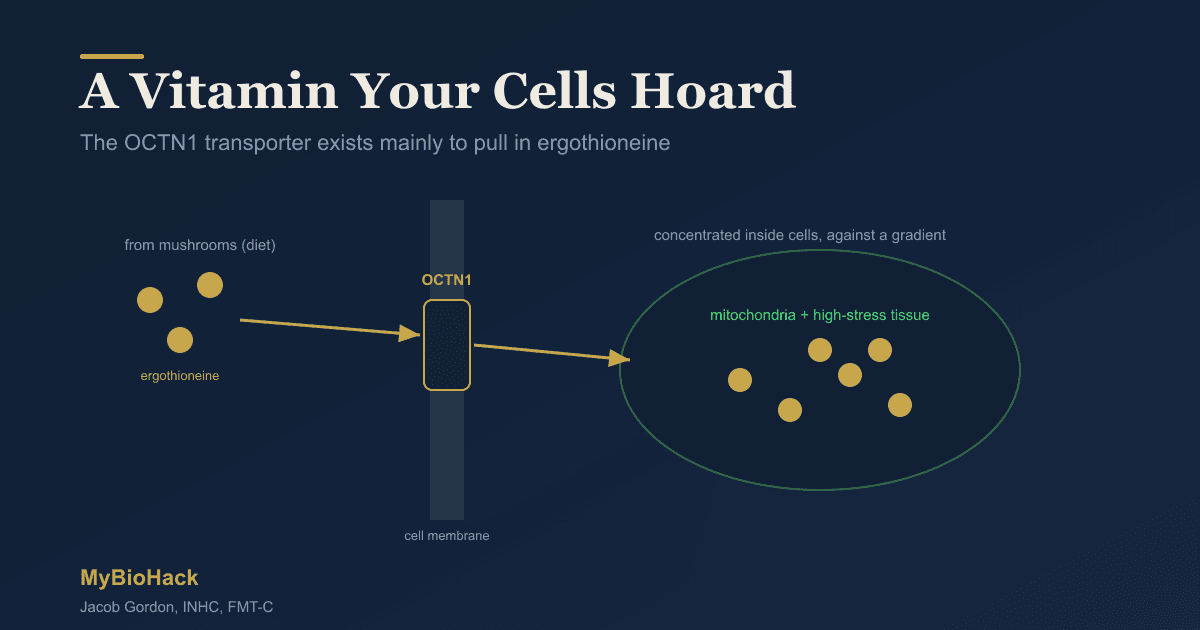
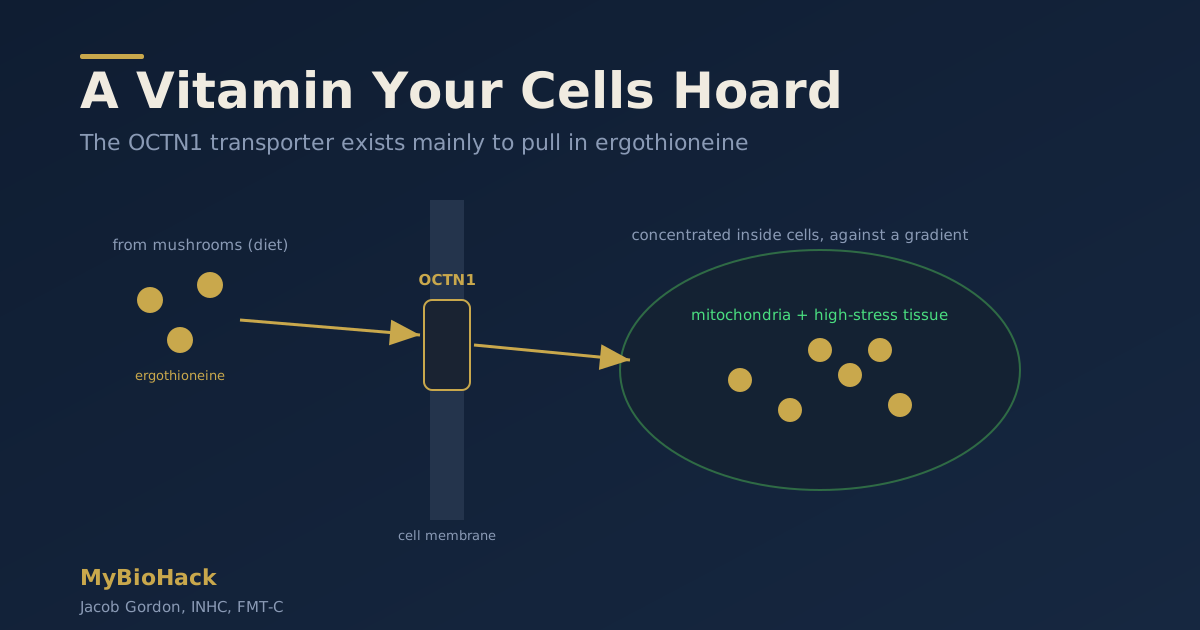
In 2005, a research group set out to characterize a poorly understood transporter called OCTN1, encoded by the gene SLC22A4, that was assumed to move organic cations like carnitine.
What they found instead was that OCTN1 transports ergothioneine roughly 100 times more efficiently than it transports carnitine or tetraethylammonium, the substrates it was originally thought to handle. R
They proposed renaming it the ergothioneine transporter, ETT, because ergothioneine was clearly what the protein evolved to move. R
A later inventory of the transporter's substrates and tissue locations confirmed it is a highly specific, dedicated route for a single dietary compound, which is unusual. R
Most nutrients diffuse passively or share generic transporters with other molecules.
Ergothioneine gets its own.
This is the observation Bruce Ames built his "longevity vitamin" argument around.
Ames's triage theory holds that when a protective micronutrient is scarce, the body rations it toward short-term survival functions and away from long-term maintenance and repair, which accelerates the diseases of aging without producing an acute deficiency syndrome. R
His underlying argument is that evolution does not build a dedicated, high-affinity, metabolically costly transporter for a compound the organism does not need. R
Jacob's read on this: the transporter argument is the most convincing part of the ergothioneine story, more convincing than any single health outcome study, because it does not depend on one cohort or one trial holding up over time.
OCTN1 is not expressed evenly across the body.
It shows strong expression in bone marrow, granulocytes, monocytes, and nucleated red blood cell precursors, in intestinal tissue where the compound is absorbed, in the kidney's proximal tubules where it is reabsorbed rather than lost in urine, and in ocular tissue. R
Mature erythrocytes do not express OCTN1 themselves, but they still carry high ergothioneine concentrations, two to nine times higher than the surrounding plasma, because they load up on it while they are still nucleated precursors in the bone marrow and keep it after they shed their nucleus. R R
The liver accumulates it too, and in a guinea pig model of fatty liver disease, damaged liver tissue upregulated OCTN1 and packed in even more ergothioneine, which the study authors interpreted as a defensive stress response. R
Animal data on reproductive tissue shows the same accumulation pattern, ergothioneine concentrates in seminal plasma in stallions, though I have not found a human study confirming this specific tissue distribution, so I am flagging it as animal evidence only. R
The compound is also unusually well retained once it is inside you.
Human pharmacokinetic data shows large increases in plasma ergothioneine after intake with only minimal urinary loss, under 4 percent, meaning the body is not flushing it out, it is keeping it. R
Benefits Of Ergothioneine
I want to separate two different kinds of evidence here, because the post is more honest if I do.
The mechanistic case for ergothioneine as an antioxidant is strong and largely built on cell and animal work.
The human outcome case is observational and gets its own section next.
1. Scavenges Hydroxyl Radicals And Singlet Oxygen
Ergothioneine scavenges hydroxyl radicals at very high rates and physically quenches singlet oxygen, while also reacting specifically with hypervalent ferryl species, halogenated oxidants, and peroxynitrite-derived nitrating species. R
In UV-irradiated human dermal fibroblasts, it scavenges superoxide and singlet oxygen directly and suppresses the UV-induced rise in TNF-alpha and MMP-1, the enzyme that breaks down collagen. R
2. Chelates Redox-Active Metals
Free iron and copper drive Fenton chemistry, generating hydroxyl radicals from hydrogen peroxide.
Ergothioneine binds these metals and pulls them out of circulation before they can react. R
3. Protects Mitochondria Specifically
Ergothioneine concentrates inside mitochondria, the organelle most exposed to the reactive oxygen species it produces as a byproduct of energy generation. R
Cells engineered to lack the ergothioneine transporter accumulate more mitochondrial DNA damage under oxidative stress than cells that can take the compound up normally, which is about as direct a demonstration of its cytoprotective role as exists. R
4. Activates NRF2 And Suppresses Inflammatory Signaling
Beyond direct radical scavenging, ergothioneine activates the NRF2 pathway, the master switch for the body's own antioxidant enzyme production, and suppresses proinflammatory cytokines including TNF-alpha, IL-1 beta, and IL-6. R
This puts it in the same functional category as other NRF2 activators I write about often, like sulforaphane, though the activation mechanism differs.
5. Extends Healthspan In Animal Models
The newest and, in my opinion, most important mechanistic data came out in 2025.
Ergothioneine extended lifespan and improved mobility and stress resistance in *C. elegans*, and in aged rats it increased NAD+ in muscle tissue, improved exercise capacity, and preserved muscle mass, through a pathway involving hydrogen sulfide signaling and persulfidation of more than 300 proteins. R
This is animal data, not human data, and I want to be direct about that.
But it is the closest thing to a genuine interventional longevity signal that exists for this compound, and it came out of a top-tier journal, not a supplement company press release.
6. Skin-Specific Antioxidant Defense
Human skin cells and tissue use ergothioneine as an integral part of their own antioxidant defense system. R
Head-to-head, its antioxidant potency in skin models compares favorably to idebenone, a synthetic antioxidant marketed specifically for that purpose. R
The honest summary of this section is that almost everything above is mechanistic, in vitro, or animal work.
That does not make it weak evidence, mitochondrial cytoprotection is a real and important finding, but it is not the same as proving ergothioneine prevents disease in people, which is what the next section addresses.
What The Human Evidence Actually Shows
This is where I have to slow down, because popular coverage of ergothioneine tends to blur mechanism and outcome together, and I do not want to do that here.
Levels Decline With Age
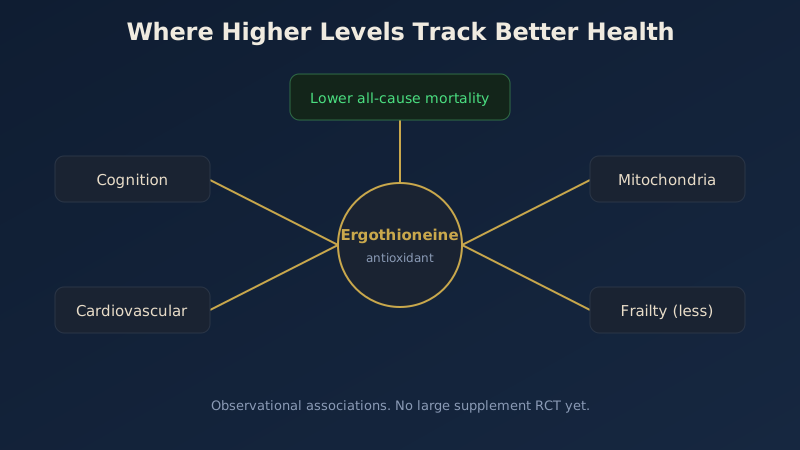
Plasma ergothioneine falls as people get older, and lower levels track with a higher incidence of cognitive decline in elderly cohorts. R
Whole-blood metabolomics work has independently found ergothioneine significantly lower in dementia patients compared to age-matched healthy controls. R
Levels also drop with frailty, alongside other metabolites involved in antioxidation, cognition, and mobility. R R
Kidney patients on dialysis lose ergothioneine directly, hemodialysis patients run at roughly 10 percent of control erythrocyte levels and peritoneal dialysis patients at roughly 34 percent, and the researchers who found this were careful to note that whether repleting it actually helps has not been tested. R
Associated With Lower Mortality And Cardiovascular Disease
In a Swedish cohort of 3,236 people followed for a median of 21.4 years, higher plasma ergothioneine was associated with significantly lower coronary disease, cardiovascular mortality, and all-cause mortality. R
I track this kind of cardiovascular risk signal alongside markers like homocysteine, which sits on the same methylation and redox axis.
Predicts Cognitive And Functional Decline
In a Singapore memory-clinic cohort of 470 older adults followed for up to five years, lower baseline ergothioneine predicted faster decline across global cognition, memory, language, attention, executive function, and visuomotor speed in participants who were not yet demented. R
White matter hyperintensities and brain atrophy substantially explained the relationship, which points toward a cerebrovascular and neurodegenerative mechanism rather than coincidence. R
The Correlation Problem
None of the studies above prove that low ergothioneine causes worse outcomes.
People with poor diets, more inflammation, and more comorbidities plausibly eat fewer mushrooms and also age worse for reasons that have nothing to do with ergothioneine itself.
This is association, not causation, and I am not going to pretend otherwise.
The Interventional Gap Is The Honest Problem
Here is the big MAYBE.
Actual randomized trials testing whether ergothioneine supplementation changes hard outcomes, mortality, cardiovascular events, dementia incidence, essentially do not exist yet.
The one pilot study I could find that even approaches this question is a feasibility trial in people with metabolic syndrome, testing 5 mg or 30 mg per day against placebo for 12 weeks, and its own authors describe it as the first study to even ask whether ergothioneine supplementation has health benefits in that population. R
A separate 12-week trial using 25 mg per day of ergothioneine-rich mushroom extract did show a measurable benefit, but for skin hydration and wrinkle scores, not longevity or disease outcomes. R
So the honest state of the field is this.
The transporter argument is compelling, the mechanistic antioxidant data is solid, the observational human data is consistent and points the same direction across multiple independent cohorts, and the interventional trial base that would actually confirm any of it is close to nonexistent.
The excitement around ergothioneine is currently ahead of the trials that would justify it.
I still eat mushrooms regularly and think the mechanism is worth taking seriously, but I am not going to tell you a supplement bottle is proven to extend your life, because nobody has run that trial yet.
Natural Sources
Mushrooms supply roughly 95 percent of dietary ergothioneine in most diets that contain any at all. R
Content varies enormously by species and by which study measured it, which is why different sources give you different numbers for the same mushroom.
Compiled across multiple analyses, dry-weight content runs from under 1 mg per kg in some white button samples up to over 2,500 mg per kg in oyster mushrooms, with porcini, shiitake, and maitake all capable of reaching four figures depending on growing conditions and measurement method. R
Ergothioneine content also correlates strongly with glutathione content across mushroom species, so the mushrooms richest in one antioxidant tend to be richest in the other. R
One controlled comparison found oyster mushrooms at 1,310 mg per kg dry weight against 630 mg per kg for standard white button mushrooms, roughly double. R
Ranked from typically highest to typically lowest ergothioneine content (not an exclusive list, and individual samples vary a great deal):
- King oyster and porcini mushrooms (among the top performers in most comparisons, though less consistently measured than the species below) R
- Maitake mushrooms R
- Oyster mushrooms (one of the most consistently high sources across studies) R
- Shiitake mushrooms R
- White button mushrooms (the lowest of the common culinary mushrooms, but still meaningful, and by far the most consumed mushroom in the United States) R
Non-mushroom sources exist but contribute far less.
Tempeh, made by fermenting soybeans with fungus, contains a moderate 201 mg per kg dry weight, a real amount thanks to the fungal fermentation step. R
Black beans and oat bran contain small but nonzero amounts, on the order of 13 and 4 mg per kg wet weight respectively, not enough to matter much unless mushrooms are absent from the diet entirely. R
The typical American gets about 1.1 mg of ergothioneine per day, compared to roughly 4.6 mg per day in Italy, where mushroom consumption is culturally higher. R
That gap alone is a reasonable argument for eating more mushrooms if you are not already.
Cooking does not meaningfully destroy it.
Ergothioneine's thione-form stability holds up under heat and across a range of pH, to the point that hot water extraction methods do not cause substantial degradation, so sauteing, roasting, or simmering your mushrooms keeps the compound intact. R
A human feeding study using button mushrooms confirmed the compound is absorbed and produces measurable acute changes in antioxidant capacity and inflammatory biomarkers after ingestion. R
If you want a rotation that covers the highest-content species, Dried Shiitake Mushrooms and a King Oyster Mushroom Powder or mushroom blend are the most direct way to get meaningful, consistent intake without relying on whatever happens to be at the grocery store.
Oat Bran is a minor contributor but reasonable to include if you already eat it for fiber.
Lion's Mane deserves a specific mention here.
Extracts standardized to include its full compound profile, erinacine A, hericenones, and ergothioneine together, improved locomotor and cerebellar function in aged mice. R
A follow-up study using an ergothioneine-rich primordium extract of the same mushroom improved memory in mice, an effect the researchers attributed in part to its ergothioneine content. R
I cover Lion's Mane and its NGF-driving compounds in more depth in its own post, and Chaga is another mushroom worth knowing about for a different antioxidant profile, though I flag the oxalate caution there for a reason.
Dosage And Safety
Human trials to date have used doses in the 5 to 30 mg per day range.
A 12-week pilot at 5 or 30 mg daily was designed as a feasibility and dose-finding study, not a confirmed effective dose. R
A separate 12-week trial at 25 mg per day of ergothioneine-rich extract raised plasma ergothioneine roughly 4.7-fold, from about 3.4 to 15.9 micromolar, and produced measurable changes in skin hydration. R
Preclinical safety data is reassuring.
A 90-day repeated-dose study in rats found no adverse effects at 1,600 mg per kg of body weight per day, the highest dose tested, and no evidence of mutagenicity in bacterial assays up to 5,000 micrograms per mL. R
I have not found a published human trial pushing doses anywhere near that high, so I would treat the 5 to 30 mg range used in actual human research as the practical ceiling for now, not the animal no-adverse-effect level.
Ergothioneine: a standardized option if you are not eating mushrooms regularly enough to close the gap through food.
Because uptake runs through a single high-affinity transporter rather than passive diffusion, blood levels rise gradually with regular intake rather than spiking after one dose, which fits a daily, food-first approach better than an occasional large one. R
Mechanisms Of Action
Simple:
- Your cells cannot make this antioxidant, so you have to eat it, almost entirely from mushrooms.
- A dedicated pump grabs it from your gut and stores it inside cells, especially where oxidative stress runs highest.
- Once it is stored, it barely leaves your body, and your kidneys hang onto it instead of flushing it out.
- It soaks up damaging free radicals and protects your mitochondria, and it does this without burning out the way other antioxidants do.
- People who have less of it in their blood tend to age faster, decline cognitively sooner, and die younger, though that does not yet prove ergothioneine itself is the reason.
Advanced:
- Thione tautomer stability Ergothioneine exists predominantly in its thione tautomeric form at physiological pH rather than as a reactive thiol, which confers exceptional resistance to autoxidation and degradation and distinguishes its redox behavior from thiol antioxidants like glutathione that require continuous enzymatic regeneration. R
- OCTN1-mediated concentrative uptake SLC22A4 (OCTN1) transports ergothioneine roughly 100 times more efficiently than its originally assumed substrates, carnitine and tetraethylammonium, concentrating the compound intracellularly against a gradient in tissues including bone marrow, intestinal epithelium, renal proximal tubules, and ocular tissue. R R
- Direct radical scavenging and metal chelation The thiol/thione structure scavenges hydroxyl radicals and singlet oxygen at high rates, reacts specifically with hypervalent ferryl complexes and peroxynitrite-derived species, and chelates redox-active iron and copper before they can drive Fenton chemistry. R
- Mitochondrial cytoprotection Ergothioneine accumulates preferentially in mitochondria, and cells lacking the ergothioneine transporter accumulate more mitochondrial DNA damage under oxidative challenge, indicating a targeted protective role at the organelle most exposed to reactive oxygen species. R
- NRF2 activation and cytokine suppression Beyond direct scavenging, ergothioneine activates the NRF2 antioxidant response pathway and downregulates TNF-alpha, IL-1 beta, and IL-6, adding an anti-inflammatory signaling layer on top of its chemical antioxidant activity. R
- CSE-dependent persulfidation In a 2025 mechanistic study, ergothioneine served as an alternative substrate for cystathionine gamma-lyase, driving hydrogen sulfide production and persulfidation of over 300 protein targets, including activation of cGPDH, which raised muscle NAD+ and improved healthspan measures in aged animals. R
- Ames triage theory Under this framework, a scarce protective micronutrient with a dedicated high-affinity transporter is preferentially diverted toward acute survival functions during periods of low intake, accelerating long-term degenerative changes without producing a classic deficiency syndrome. R
Genetics
SLC22A4 (OCTN1)
SLC22A4 encodes OCTN1, the transporter that moves ergothioneine from your gut into your bloodstream and from your bloodstream into cells. R
Polymorphisms in this gene affect transporter expression and function, which changes how efficiently a given person absorbs and retains dietary ergothioneine at the same intake level. R
SLC22A4 Variants And Autoimmune Disease Risk
The same gene sits inside the IBD5 risk locus on chromosome 5, and OCTN1/OCTN2 variants within that locus contribute to susceptibility and severity in Crohn's disease. R
An intronic single nucleotide polymorphism in a RUNX1 binding site of SLC22A4 is independently associated with rheumatoid arthritis risk. R
Jacob's clinical observation: I see SLC22A4 variants more often in clients who already carry other transporter or redox-related variants, and I would not be surprised if reduced-function OCTN1 turns out to be one more piece of why some people run chronically low on endogenous antioxidant capacity, similar to what I see clinically with SOD2 rs4880 carriers, myself included.
This is an observation from my practice, not a published finding, and I want to be clear about that distinction.
People carrying lower-function OCTN1 variants likely need more dietary ergothioneine to reach the same tissue concentration as someone with fully functional transporters, though this has not been directly quantified in a human trial to my knowledge.
More Research
- A 2025 Cell Metabolism paper found ergothioneine extends lifespan in *C. elegans* and improves NAD+ levels, muscle mass, and exercise capacity in aged rats through hydrogen sulfide signaling, the strongest interventional longevity signal for this compound so far, though still animal data. R
- A comprehensive review lays out ergothioneine's biology end to end, including that only fungi and actinobacteria synthesize it and that neither plants nor animals can. R
- Dialysis patients lose ergothioneine directly through treatment, hemodialysis more severely than peritoneal dialysis, and whether repletion helps this population has not been studied. R
- Old erythrocyte uptake data complicates the antioxidant story somewhat, one study found erythrocytes concentrate ergothioneine well above plasma levels but did not find evidence it protected glutathione from depletion under peroxide stress in that specific system, a reminder that not every mechanistic claim generalizes cleanly across tissue types. R
- The pilot feasibility trial in metabolic syndrome, testing 5 and 30 mg daily doses, is explicitly framed by its own authors as the first study asking whether ergothioneine supplementation has any measurable health benefit in that population, which tells you how early this field still is. R
Where To Go From Here
Ergothioneine is one piece of a larger redox and mitochondrial picture that also includes glutathione, its precursor NAC, and your overall NRF2 activation status.
If you are interested in the longevity angle specifically, I have separate posts on NMN, resveratrol, and spermidine, all of which sit in the same mechanistically promising, thin on hard human trials category that ergothioneine occupies right now.
For mitochondrial support specifically, CoQ10 works through a different mechanism but complements the same underlying goal.
If you want to actually measure whether your own oxidative stress load is trending in the right direction over time, biomarkers like 8-OHdG, homocysteine, and epigenetic age testing are more useful than any single supplement's marketing claims, and the Health Hub tracks these alongside your symptoms over time, which comes with the Pro plan at $180 a year.
The Biohacking Bot can help you figure out where ergothioneine actually fits in your own stack given what else you are already taking.
The simplest starting point costs nothing extra.
Eat more mushrooms, and if you eat mostly white button because that is what your grocery store stocks, branch out toward oyster and shiitake when you can.
Jacob Gordon
INHC, FMT-C
Integrative Nutrition Health Coach
I cover mold illness, post-viral recovery, methylation, and complex chronic disease, drawing on ten years of clinical research, work inside a functional medicine clinic, and my own recovery from all of it. Every claim here is cited.
Book a ConsultationRelated Protocols & Supplements
Deep-dive chapters and recommended supplements for this topic
Lion's Mane
1000mg/day
Omega-3 (DHA)
2g/day
Phosphatidylserine
100mg 3x/day