The 13+ Benefits Of Chokeberries (Aronia)
By Jacob Gordon, INHC, FMT-CThis article contains affiliate links. As an Amazon Associate, MyBioHack earns from qualifying purchases at no extra cost to you. We only link products we research and stand behind.

Basics Of Aronia

Chokeberries have more polyphenols (such as flavanoids) than other remarkable berries, such as blueberries (4x more), raspberries (3-8x more), currant (0.6x more) strawberries (10x more) and blackberries (2-4x more). R R
Black Chokeberry (Aronia Melanocarpa) is high in the flavonoid of anthocyandins (the component that gives the fruit a very dark color) which may prevent many age-related diseases and chronic illnesses. R R
Purple Chokeberry (Aronia prunifolia) and Red Chokeberry (Aronia arbutifolia) are richer in in flavonoids of phenolic acid and proanthocyanins. R
Chokeberry (aronia) should not be confused with a similar-sounding berry, Chokecherries (Prunus).

Benefits Of Aronia
1. May Increase Longevity
Chokeberry can increase Klotho and PON1 (two powerful aging-suppressing factors). R
DNA damage causes increased aging as well as senescent cells (non-cancerous cells that refuse to die or replicate). R
Chokeberry can decrease the chance of this DNA damage. R
2. May Prevent Cancer
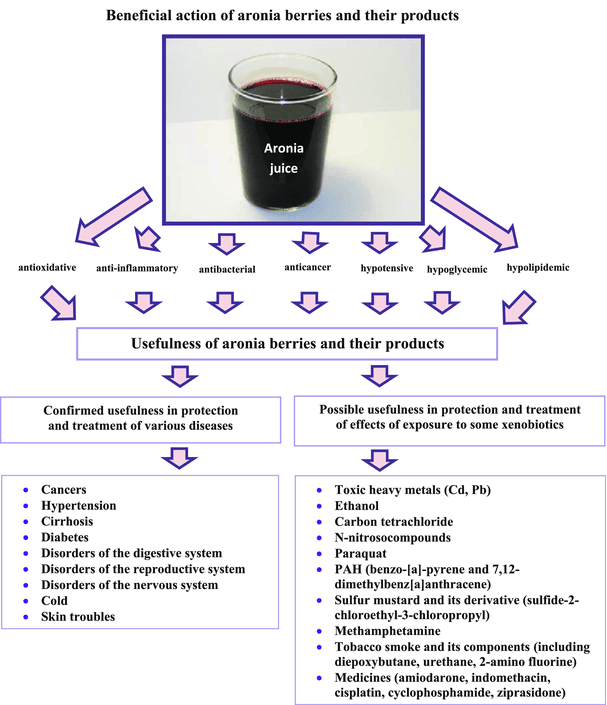
By protecting DNA from damage, chokeberry has been successfully used to prevent and/or fight cancers: R R
Chokeberry can stop cancerous cells from replicating (via regulation of p53 and p73) and increase the immune systems defense to fight cancerous cells. R R R
3. Protects The Brain
Unrepaired DNA damage can lead to a loss of brain function. R
Chokeberry can prevent this. R
As previously discussed above, chokeberry may increase the protein klotho. R
Klotho is powerful in increasing cognitive function. R
Chokeberry can also protect the brain against glutamate-induced excitotoxicity. R
Low doses of chokeberry can protect the brain against the toxic effects of the herbicidal toxin, paraquat, and may prevent toxin-induced Parkinson's Disease (PD). R
Chokeberry may also improve memory and cognitive function in neurodegenerative diseases like Alzheimer's Disease (AD) and Dementia. R R R
One way it does this is by its ability to increase the neurotransmitter acetylcholine and Brain Derived Neurotrophic Factor (BDNF) in the hippocampus. R
In aged mice, chokeberry can help maintain spacial memory. R
This effect is even greater when combined with EGCG (or green tea). R
4. Improves Exercise Performance
Chokeberry can improve mitochondrial function. R
For example, in triathletes, a Chokeberry/Cirtus Juice blend can decrease biomarkers of mitochondrial stress. R R R
It also improves exercise tolerance, by reducing fatigue in atheletes. R R R
5. Has Anti-Depressant And Anti-Anxiety Effects

In a study with aged mice, chokeberry significantly increases the neurotransmitters norepinephrine, dopamine, and serotonin. R
In another study, rats that were given unlimited availability to drink chokeberry juice for 2 months had decreased symptoms of anxiety and depression. R
Chokeberry may also help with social anxiety. R
For example, in animal studies, chokeberry had comparable anxiolytic effects as diazepam (Valium), a common anti-anxiety medication. R
6. Helps The Liver
Chokeberry can protect the liver. R R R R R
For example, in animal models of Non-Alcoholic Fatty Liver Disease (NAFLD), chokeberry can significantly reduce fat accumulation in the liver. R
Chokeberry also prevents oxidation of lipids in the liver and blood. R R
Chokeberry increases antioxidants (such as glutathione) and can also activate the major antioxidant promoting pathway NRF2. R R
Chokeberry may improve cholesterol metabolism in those with an APOE mutation. R
7. Protects The Gut
Chokeberry may also improve symptoms of Ulcerative Colitis (UC). R
It can also help with ulcers in the gut and improve gastric mucous secretion. R
For example, in studies where animals had ulcers, chokeberry helped protect the stomach lining and improved the condition of the ulcer. R
8. Helps With Diabetes
Chokeberry may help with metabolic syndromes as it can help with inflammation of the pancreas, restore beta-cells ability to secrete insulin, and prevent insulin resistance. R R R R
For example, in diabetic animal models, chokeberry can normalize the metabolism of carbohydrates, thus preventing insulin resistance. R
In a study with healthy women, chokeberry was able to reduce improper insulin responses to eating wheat and rye. R
It can also help with proper insulin secretion by inhibiting DPP IV. R R
Chokeberry can protect the body against the damaging effect of high glucose levels and may also help reduce glucose levels. R R
It can reduce HbA1C levels in diabetic patientes. R
It may also prevent weight gain in diabetic patients. R
9. Helps With Weight Loss

Chokeberry may help with weight loss.
For example, obese rats that were fed chokeberry were able to keep stable blood sugar and lose visceral fat. R
Chokeberry can increase levels of adiponectin and PPAR-gamma, thus promoting fat burning. R
Chokeberry can also inhibit α-glucosidase and α-amylase, which can inhibit the absorption of sugars. R R
Obese patients that were given chokeberry juice with glucomannan had a better omega 3:6 ratio and lower blood pressure. R
10. Has Anti-Microbial And Anti-Viral Effects
Chokeberry has anti-viral effects against influenza. R
It has anti-microbial action against:
Chokeberry can also inhibit biofilms. R
Chokeberry Juice may be a useful replacement for antibiotic treatment for Urinary Tract Infections (UTI). R
Chokeberry Juice may inhibit inflammation in pneumonia. R
11. Supports A Healthy Vascular System
Chokeberry protects the blood and vascular system. R R R
It may prevent heart disease. R R R
It can reduce C-Reactive Protein (CRP) levels. R
It can also reduce high homocysteine levels. R
Chokeberry can also protect the heart against some antibiotics, such as doxorubicin. R
Chokeberry is very effective at reducing high blood pressure. R R R R
It also can increase nitric oxide levels. R R
Chokeberry can reduce LDL and triglycyride levels and improve HDL cholesterol in the blood via regulation of PON1. R R R R R
It may also protect against the detrimental effects of oxidized LDL. R R
Chokeberry may also help with natural blood clot formation. R R
By mediating blood flow and norepinephrine levels, chokeberry may help balance body temperature levels in those sensitive to cold temperatures. R
12. Protects The Skin

Chokeberry may reduce inflammation in eczema. R
13. Protects Against Toxins
Chokeberry may also protect against:
My Experience And Where To Get Chokeberry
Eating the berries are very sour and so is the unsweetened juice, so I usually like to supplement it instead.
If I supplement this before exercise, I am able to work out for longer with less overall fatigue.
Forms Of Chokeberry
Aronia Chokeberry Supplement - I use this daily in the morning.
Chokeberry Powder - I will put this in smoothie.
Chokeberry Juice - I will drink this while working out (juice may be added to wine or alcohol when at social gatherings, but I don't drink).
It can also be used as an essential oil, but I have not tried that yet.
Chokeberry Goes Well With:
Physical Activity - increases the bioavailability of flavanones R
If you grow your own plants, EMFs (such as UVC and microwaves) can increase the anthocyanin content of chokeberries. R
Caveats
Chokeberries and chokeberry juice are safe in humans. R R
Metals in chokeberries are significantly lower than WHO's RDA should not be a concern and eating the berries may actually be a good source of Ca, Cu, Fe, K, Mg, Mn, Na, Ni, and Zn. R
Cokeberry does not interfere in iron absorption. R
Eating the berries may cause a reaction if you are sensitive to lectins. R
Chokeberry may interfere with drugs that are metabolized via Cytochrome 450. R
It may also reduce lactobacillus, enterobacteriaceae and enterococcus strains in the gut. R R
Mechanism Of Action
Simple:
Increases Adiponectin R
Increases CDC2/25 R
Increases CREB R
Increases DA R
Increases Glut1/4 R
Increases Gys1 R
Increases Klotho R
Increases HDL R
Increases HO-1 R
Increases HSP-70 R
Increases IL-4 R
Increases Irs1/2 R
Increases MCP-1 R
Increases PCI R
Increases Pi3k R
Increases PPAR-gamma (in fat) R
Increases 5-HT R
Reduces α-amylase R
Reduces ALT R
Reduces aP2 R
Reduces AST R
Reduces ATM R
Reduces ATR R
Reduces Chk1/2 R
Reduces CRP R
Reduces COX-2 R
Reduces DPP IV R
Reduces Glucose R
Reduces Gsk3-beta R
Reduces HbA1C R
Reduces Homocysteine R
Reduces H2AX R
Reduces IL-1b R
Reduces IL-6 R
Reduces IL-10 R
Reduces Leptin R
Reduces LPL R
Reduces MAO-A/B (possibly) R
Reduces MMP-2 R
Reduces MMP-14 R
Reduces MMP-16 R
Reduces MMP-17 R
Reduces MPO R
Reduces Prostaglandin E2 R
Reduces P450 R
Reduces PPARγ2 (in liver) R
Reduces TGF-b1 R
Advanced:
The bioactive components of Aronia are well absorbed, can cross the blood brain barrier (BBB) and have systemic beneficial effects. R R R
Anthocyanins (cyanidin 3-arabinoside, cyanidin 3-galactoside, cyanidin 3-xyloside, and cyanidin 3-glucoside) produce many of the benefits of chokeberry such as increasing klotho, increasing neurotransmitters norepinephrine, dopamine (dose-dependent manner), and 5-hydroxytryptamine, inflammatory cytokines (COX2, TGF-β1, and IL-1) transcription and preventing DNA damage. R
Black Chokeberry (Aronia) contains isoquercetin, kaempferol, ferulic acid, caffeic acid, ellagic acid, myricetin and hydroxybenzoic acids as well. R
In the brain Aronia increases BDNF, CREB and acetylcholine levels (via acetylcholinesterase inhibition) and contributes to long-term potentiation. R
Anthocyanins significantly raise GSH-PX and T-SOD. R
Anthocyanins from BC dose-dependently decrease H2AX and γ-H2AX (mediators of the DNA damage signaling pathway) and Chk1,p- Chk1, Chk2, p-Chk2 (Checkpoint kinase 1 and checkpoint kinase 2 which are effectors of DNA damage signaling pathway) by increasing anti-inflammatory IL-4yr cytok, HSP-70, NO, and PGE2 expressions. R
In the skin, chokeberry inhibits NF-KB/MAPK activation of TNF-alpha stimulation of ICAM-I pro-inflammatory cytokines. R
More Research
Aronia mitschurinii, that apparently originated in cultivation, is also known as Sorbaronia mitschurinii. R
Jacob Gordon
INHC, FMT-C
Integrative Nutrition Health Coach
I cover mold illness, post-viral recovery, methylation, and complex chronic disease, drawing on ten years of clinical research, work inside a functional medicine clinic, and my own recovery from all of it. Every claim here is cited.
Book a ConsultationRelated Protocols & Supplements
Deep-dive chapters and recommended supplements for this topic
Electrolyte Complex
1 scoop/day
CoQ10
200mg/day
Magnesium Glycinate
400mg at bedtime