Succinate: The TCA-Cycle Metabolite That Acts Like An Inflammatory Signal
By Jacob Gordon, INHC, FMT-CSuccinate is a normal tricarboxylic acid cycle metabolite that can also act as a signal when it accumulates inside cells or reaches the extracellular space.
In this post, we will discuss how succinate links mitochondrial metabolism to HIF-1alpha, reactive oxygen species, SUCNR1 signaling, and inflammation, while keeping the evidence separate from the idea that succinate is always harmful.

What Is Succinate
Succinate is an intermediate of the tricarboxylic acid cycle and a substrate for succinate dehydrogenase.
Succinate dehydrogenase is unusual because it participates in both the TCA cycle and respiratory complex II.
This places succinate at a direct junction between carbon metabolism, electron transport, and redox chemistry.
When production exceeds oxidation or export, succinate can accumulate and influence signaling beyond ATP production. R
Succinate is therefore not a waste product that the body simply needs to eliminate.
It is a normal metabolite whose effects depend on concentration, location, duration, and tissue context.
Succinate can be produced through the canonical TCA cycle, but it can also accumulate when cells change glutamine use, the GABA shunt, purine metabolism, or the direction of electron flow through complex II.
The source of the succinate matters because it changes what the metabolite is signaling about.
How Succinate Becomes A Signal
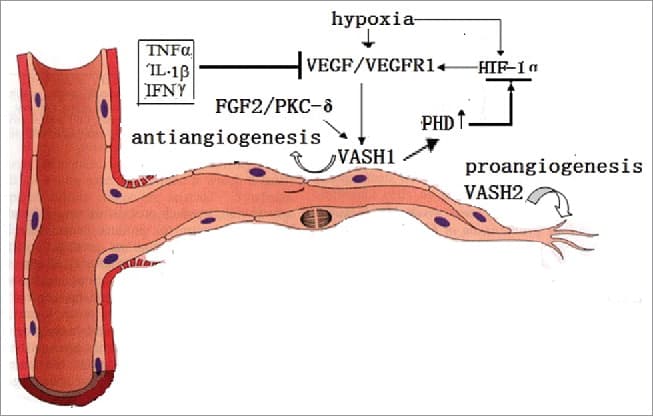
Intracellular succinate can inhibit prolyl hydroxylases that normally mark HIF-1alpha for degradation.
HIF-1alpha stabilization can change glycolytic and inflammatory gene expression in specific immune and stressed-cell contexts. R
Succinate can also increase reactive oxygen species through changes in complex II flux and reverse electron transport under certain conditions.
Extracellular succinate can bind succinate receptor 1, also called SUCNR1, on immune and other cells.
Succinate can additionally influence protein succinylation, creating a post-translational link between metabolism and gene regulation. R
These are parallel mechanisms, not one universal succinate pathway.
Succinate can also be exported from cells and later taken up by neighboring cells.
This creates a local communication system in which one cell's metabolic stress changes the behavior of another cell.
The extracellular concentration, receptor expression, and duration of exposure determine whether that signal is inflammatory, adaptive, or neutral.
Succinate In Immunity And Disease
Innate Immunity
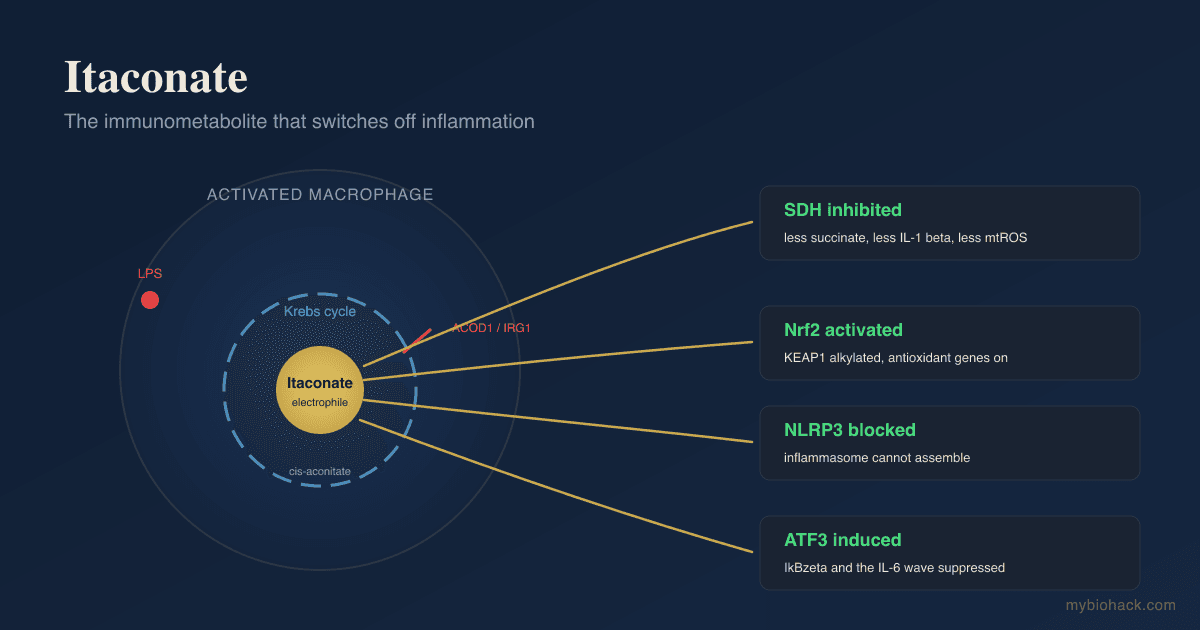
Activated macrophages can accumulate succinate during inflammatory metabolic reprogramming.
Succinate has been linked to HIF-1alpha-dependent interleukin-1beta production and other changes in innate immune function. R
Tissue Context
Succinate signaling can be pro-inflammatory in one tissue and adaptive or anti-inflammatory in another.
Recent reviews emphasize that its effects depend on the immune cell, receptor expression, oxygen availability, and metabolic state. R
Cancer And Chronic Disease
Succinate accumulation has been studied in tumor metabolism, inflammatory bowel disease, liver disease, obesity, and atherosclerosis.
These associations do not mean that lowering blood succinate will reverse every disease connected to mitochondrial stress.
JD Framing
Jacob's hypothesis is that persistent succinate accumulation could help connect impaired mitochondrial oxidation with inflammatory signaling in a Junction Dysfunction environment.
That is a model for investigation, not evidence that a person's symptoms are caused by excess succinate.
The hypothesis becomes more useful when it generates a measurable question.
For example, researchers could ask whether a tissue with impaired perfusion has altered succinate oxidation, HIF-1alpha activity, SUCNR1 expression, or inflammatory gene output.
A symptom label alone cannot answer those questions.
How To Think About Succinate
The first mistake is treating succinate as inherently toxic.
It is an essential metabolic intermediate and can support normal energy production.
The second mistake is interpreting a single succinate measurement without knowing whether it is intracellular, plasma, urine, or tissue-derived.
Those measurements answer different biological questions.
The third mistake is using a supplement or medication to force succinate lower without identifying why it accumulated.
The cause may involve hypoxia, altered TCA flux, inflammation, microbiome metabolism, substrate availability, or impaired electron transport.
Lowering succinate without correcting those causes could simply shift carbon into another metabolite or reduce the cell's ability to use the TCA cycle.
The safest interpretation is that succinate is a clue about metabolic state, not an isolated toxin that can be judged without context.

Mechanisms Of Action
Simple:
- Succinate helps make energy inside the TCA cycle and respiratory chain.
- When it accumulates, it can stabilize HIF-1alpha and change inflammatory gene expression.
- Outside the cell, succinate can signal through SUCNR1.
Advanced:
- SDH and complex II oxidize succinate to fumarate while transferring electrons into the respiratory chain, linking succinate levels to mitochondrial redox state. R
- Prolyl hydroxylase inhibition by accumulated succinate can stabilize HIF-1alpha and increase HIF-dependent inflammatory programs in selected contexts. R
- Reverse electron transport can increase mitochondrial reactive oxygen species when the membrane potential and electron supply favor backward flow through complex I.
- SUCNR1 signaling allows extracellular succinate to act as a paracrine or endocrine-like cue, but the result depends on receptor distribution and downstream cell state. R
- Protein succinylation can connect succinate availability to changes in enzyme activity and transcriptional regulation, although the physiological importance of individual succinylation events is still being defined. R
Genetics
SDHA, SDHB, SDHC, And SDHD
SDHA, SDHB, SDHC, and SDHD encode the core subunits of succinate dehydrogenase.
Pathogenic variants can disrupt complex II and are associated with mitochondrial disease or paraganglioma syndromes, depending on the gene and variant.
SUCNR1
SUCNR1 encodes the succinate receptor 1.
Expression of SUCNR1 differs across tissues, which helps explain why extracellular succinate can have different effects in immune, kidney, retinal, and metabolic biology. R
HIF1A
HIF1A encodes the alpha subunit of HIF-1.
Succinate can regulate HIF-1alpha stability through metabolism, but a HIF1A variant is not equivalent to a diagnosis of succinate-driven inflammation.
SDHAF2
SDHAF2 supports the assembly and maturation of succinate dehydrogenase.
Rare SDHAF2 variants can produce a succinate dehydrogenase deficiency or paraganglioma phenotype, illustrating how impaired succinate oxidation can have both metabolic and signaling consequences.
More Research
- Compartment matters. Intracellular and extracellular succinate can trigger different biology.
- The metabolite is bidirectional. Succinate can support normal metabolism while also acting as a danger or adaptation signal during stress.
- The causal sequence is not always clear. Succinate may initiate inflammation, amplify it, or simply mark a metabolic shift caused by another process.
- Clinical testing needs context. A single circulating value is unlikely to identify the relevant tissue source or pathway.
- The main open question is intervention. Researchers need ways to target pathological succinate signaling without disrupting complex II and normal energy metabolism.
- Human trials are still limited. Much of the intervention literature remains preclinical or focused on specific inflammatory diseases rather than general fatigue or wellness.
Jacob Gordon
INHC, FMT-C
Integrative Nutrition Health Coach
I cover mold illness, post-viral recovery, methylation, and complex chronic disease, drawing on ten years of clinical research, work inside a functional medicine clinic, and my own recovery from all of it. Every claim here is cited.
Book a ConsultationRelated Protocols & Supplements
Deep-dive chapters and recommended supplements for this topic
Quercetin
500mg 2x/day
SPM Active (Pro-resolving Mediators)
2 softgels/day
Curcumin (Liposomal)
500mg 2x/day