The Role of DARPP-32 In Addiction, Schizophrenia & Parkinson's Disease
By Jacob Gordon, INHC, FMT-CThis article contains affiliate links. As an Amazon Associate, MyBioHack earns from qualifying purchases at no extra cost to you. We only link products we research and stand behind.

In this post, we will discuss how protein phosphatase 1 regulatory subunit 1B (PPP1R1B), also known as dopamine- and cAMP-regulated neuronal phosphoprotein (DARPP-32) plays a large role addiction, Parkinson's Disease, schizophrenia, cognition, and cancer.
Basics
Dopamine- and cAMP-regulated phosphoprotein of 32 kDa (DARPP-32) has a pivotal role in dopamine, glutamate, and adenosine neurotransmission, especially in the caudate, putamen, nucleus accumbens, cerebral and cerebellar cortex. R R
DARPP-32 dysregulation plays a role in:
- Addiction R
- Alzheimer's Disease R
- Anhedonia R
- Anxiety R
- Bipolar Disorder R
- Cancer R
- Huntington's Disease R
- Infections R
- Insulin (pancreatic) Regulation R
- Parkinson's Disease R
- Schizophrenia R
It is expressed in low levels during development and gradually increases after birth. R
DARPP-32 And Disease
1. Addiction And Reinforcement
DARPP-32 activity changes with repeated/chronic exposure to specific dopaminergics and addictive substances. R
When first exposed to a substance, DARPP-32 enhances D1-like receptor (D1R) activity, whereas chronic exposure to substances can cause suppression of D1R activity. R
This means repeated exposure to addictive substances suppresses DARPP-32's actions on D1Rs (to be more specific see advanced section). R
Here are some common examples of DARPP-32 playing a big role in addictions:
This can be seen in Parkinson's Disease patients with L-DOPA-induced dyskinesia (LID). R
2. Parkinson's Disease
For Parkinson's Disease, in the striatum increasing DARPP-32 in D1Rs is better, while inhibiting DARPP-32 in D2Rs are better. R R
So for example, activating medium spiny neurons (MSN) D1Rs can improve locomotion, whereas D2R activation does the opposite. R
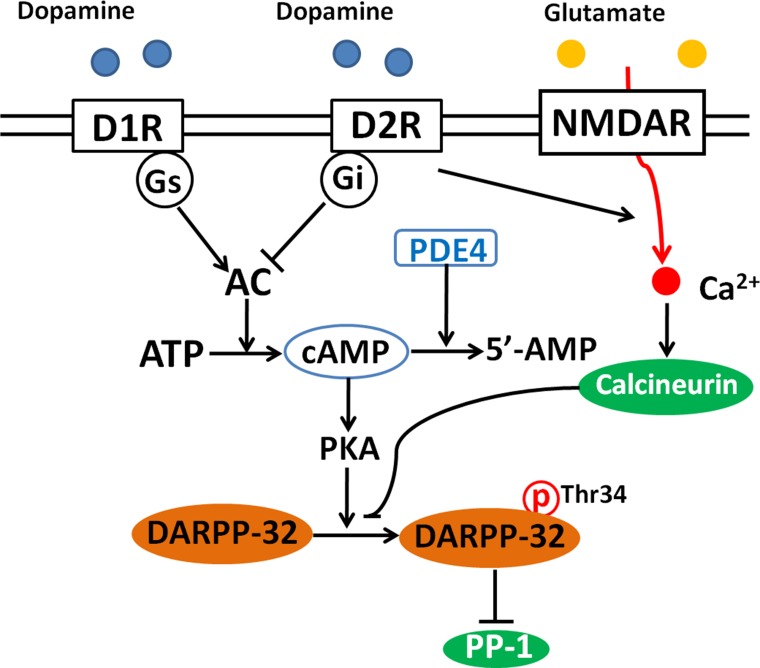
This is because D1Rs activate adenylyl cyclase and cAMP synthesis, whereas D2Rs inhibit them. R
3. Cognition, Memory, And Excitotoxicity
DARPP-32 plays a role in creating new brain cells (via neurogenesis and neuroplasticity) as Brain Derived Neurotrophic Factor (BDNF) can increase levels of DARPP-32. R R
DARPP-32 (along with adductins) is necessary for the induction of striatal LTD and LTP, which is important for memory acquisition and consolidation, as well as neuronal plasticity. R R R
It also plays a role on episodic memory (see genetics below). R
DARPP-32 acts as a regulator of homeostasis in the brain and may help prevent excitotoxicity (too much neuronal activity causing cell death). R
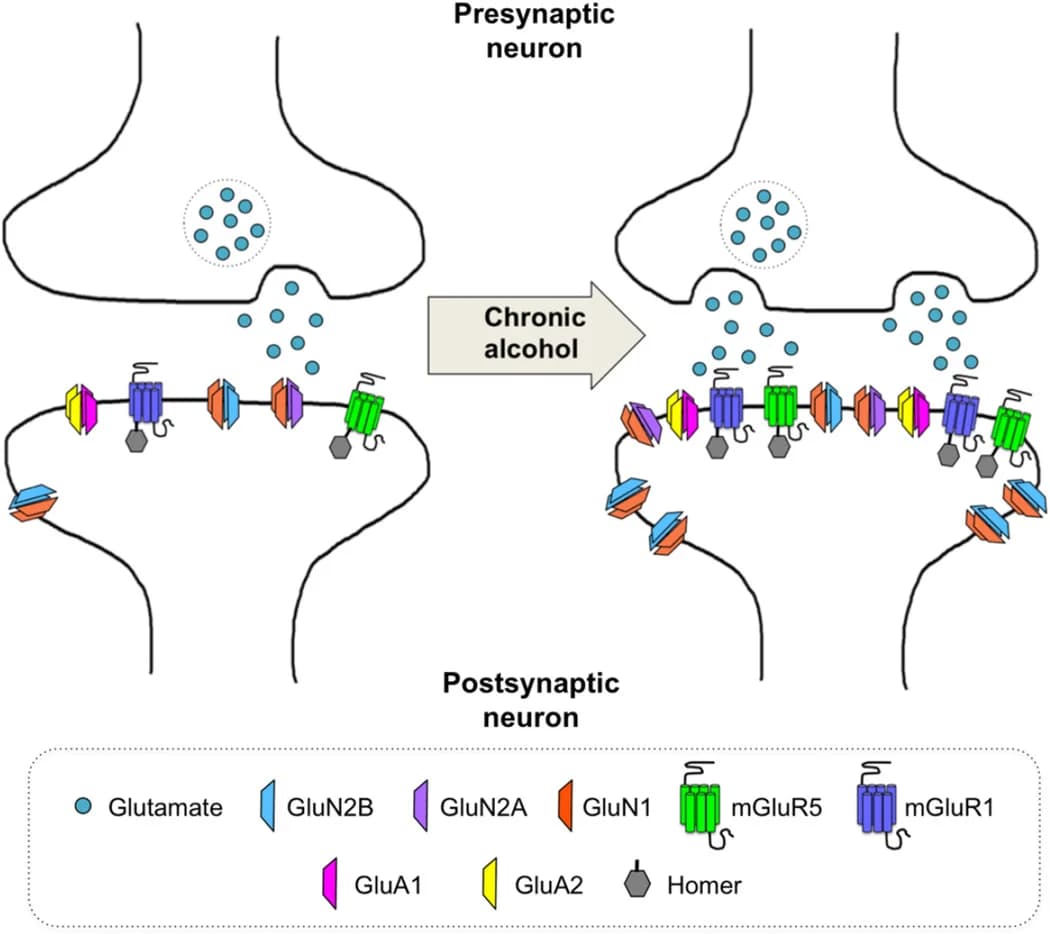
For example, glutamate is able to decrease the action of DARPP-32 (see advanced for more) and inhibiting glutamate receptors (NMDA or AMPA) may prevent glutamate-induced exictoxicity via DARPP-32 regulation. R
4. Hypoxia And Brain Injury
By regulating dopamine and glutamate, DARPP-32 expression may protect the brain during hypoxia and help with traumatic brain injuries (TBI). R
For example, DARPP-32 expression may be lowered after TBI, causing problems with dopamine-induced synaptic plasticity. R
5. Schizophrenia
In schizophrenia, antipsychotic drugs like haloperidol act on the striatum by inhibiting action of D2Rs (aslo leading to increase cAMP). R
This inhibition likely also plays a role on DARPP-32, as some drugs that work on DARPP-32 have also implicated in inducing schizophrenia: (see advanced for explanation)
- Amphetamines
- LSD
- PCP
DARPP-32 protein expression is usually reduced in the dorsolateral prefrontal cortex (PFC) of schizophrenic patients, as well as bipolar patients. R R R
6. Cancer
DARPP-32 may promote angiogenesis and tumorgenesis. R
DARPP-32 (as well as t-Darpp, the truncated form of DARPP-32) is overexpressed in some cancers:
- Breast Cancer R
- Colon Cancer R R
- Esophageal Cancer R
- Gastric Cancer (may be overexpression from H. Pylori) R R
- Prostate Cancer R
This overexpression may cause chemoresistance (such as Herceptin), as it shuts down the Her-2 signaling pathway. R R R
7. Antimicrobial
DARPP-32 may have antimicrobial or anti-inflammatory against H. Pylori. R
8. Motivation And Anhedonia

Low levels of DARPP-32 have been implicated with low motivation and anhedonia. R
Increasing DARPP-32 may help with these problems. R
For example, long-term use of aripiprazole was able restore DARPP-32 and improve anhedonia in a stress-induced model. R
9. Thyroid Function
DARPP-32 is necessary for IGF-1 and TSH (together) to induce thyroid cells to develop. R
What Increases DARPP-32?

Lifestyle/Diet:
- Caloric Restriction R
- Enriched Environment (increases adducin phosphorylation) R
- Fasting R
- High Fat Diet R
- Pain R
Supplements:
- Caffeine (increases adducin phosphorylation as well) R R
- Curcumin R
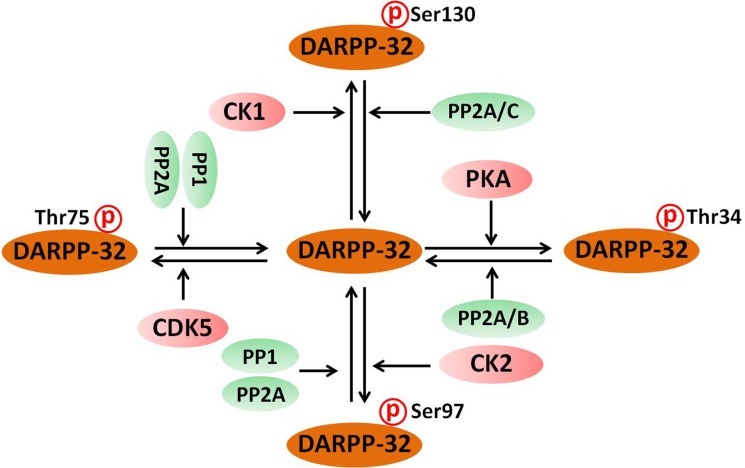
- Forskolin - increases DARPP-32 Thr34 phosphorylation by 8-fold, while decreasing Thr75 and Ser97 phosphorylation R
- Manganese (may be toxic) R
Hormones:
Drugs/Chemicals:
- Aripiprazole R
- Baclofen R
- Chlorbipram R
- Cyclosporine R
- Haloperidol - in D2R R
- L-DOPA - activate D1R R
- Purmorphamine R
- Rolipram R
Pathways:
What Decreases DARPP-32?
Mechanism Of Action
Simple:
Advanced:
- DARPP-32 may have to balance with ARPP-21 (cAMP-Regulated Phosphoprotein 21kDa) for calcium-and dopamine- dependent activation in the striatum. R
- In the striatum, activation of D1Rs in the direct MSNs leads to Golf-mediated stimulation of adenylyl cyclase, the enzyme responsible for the synthesis of cAMP, which then promotes transmission at AMPA NMDA glutamate receptors -> elevates the ability of sustained release of glutamate to produce depolarized up-states close to spike threshold, thereby promoting the excitability of striatonigral MSNs. R
- Activation of D2Rs in the indirect MSNs is coupled to Gi/o-mediated inhibition of adenylyl cyclase, which decreases cAMP synthesis, which decreases cell excitability via G-protein-mediated activation of inwardly rectifying K+ channels. R
- Several D2R antagonists, including antipsychotic drugs, to promote histone H3 phosphorylation at Ser10 depends exclusively on activation of the cAMP/DARPP-32 cascade. R
- DARPP-32 is phosphorylated at Thr34 by PKA -> inhibits protein phosphatase 1 (PP1), so when PKA is activated in striatal neurons, PP1 inhibition increases the phosphorylation for PKA and PP1. R
- In addiction, DARPP-32 plays a bidirectional role in drug addiction depending on its phase - P-Thr34 (acted on acutely - activating D1R/PKA signaling) or P-Thr75 (acted on chronically - opposite effect of P-Thr34) as part of homeostasis. R
- Dopamine -> DARPP-32 at Thr34 -> D1R -> activation of PKA or Dopamine -> DARPP-32 at Thr75 -> cyclin-dependent kinase 5 (CDK5) -> inhibitor of PKA R
- In schizophrenia drugs, the ones listed above increas P-Thr34 and P-Ser130 and decrease in P-Thr75. R
- Glutamate decreases the phosphorylation states of DARPP-32 at Ser-97 as well as Thr-34, Thr-75, and Ser-130 by activating NMDA or AMPA receptors in both direct and indirect pathway striatal neurons, thus the effect of glutamate in decreasing Ser-97 phosphorylation was mediated by activation of PP2A. R
- The phosphatidylinositol 3-kinase (PI3K)/protein kinase B (Akt) /mammalian target of rapamycin (mTOR) and the CDK5/p35 signaling pathways are involved in the regulation of DARPP-32 protein levels by BDNF in MSNs. R
Genetics
PPP1R1B
rs879606 (I'm GG)
- G Allele - higher cortical expression of DARPP-32, higher dopamine receptor efficacy, and greater bias toward positive cues, had increased functional connectivity in cortical-subcortical circuits in response to happy faces, engaging the dorsal prefrontal cortex (DLPFC), fusiform gyrus (FG) and the midbrain (MB). R
- G allele - dorsolateral prefrontal cortex (DLPFC) volumes were larger compared to A alleles R
- G allele - performed better on a free recall test of EM compared to A-carriers R
- Unknown allele - strongly associated with schizophrenia and bipolar disorder R
- G alleles - alleles displayed increased intrinsic connectivity between the IFG and PHG, as well as increased excitability of the PHG for negative emotional stimuli R
rs907094
- T Allele - higher cortical expression of DARPP-32, higher dopamine receptor efficacy, and greater bias toward positive cues, had increased functional connectivity in cortical-subcortical circuits in response to happy faces, engaging the dorsal prefrontal cortex (DLPFC), fusiform gyrus (FG) and the midbrain (MB). R
- G allele - performed better on a free recall test of EM compared to A-carriers R
- T alleles - displayed increased intrinsic connectivity between the IFG and PHG, as well as increased excitability of the PHG for negative emotional stimuli R
rs3764352
- A Allele- higher cortical expression of DARPP-32, higher dopamine receptor efficacy, and greater bias toward positive cues, had increased functional connectivity in cortical-subcortical circuits in response to happy faces, engaging the dorsal prefrontal cortex (DLPFC), fusiform gyrus (FG) and the midbrain (MB). R
- Unknown allele - strongly associated with schizophrenia and bipolar disorder R
- A alleles - displayed increased intrinsic connectivity between the IFG and PHG, as well as increased excitability of the PHG for negative emotional stimuli R
rs90974
- Unknown allele - strongly associated with schizophrenia and bipolar disorder R
Associations Between PPP1R1B Gene Polymorphisms and Anxiety Levels in the Chinese Population (2018) R
More Research
- Brown fat may contain levels of DARPP-32. R
Jacob Gordon
INHC, FMT-C
Integrative Nutrition Health Coach
I cover mold illness, post-viral recovery, methylation, and complex chronic disease, drawing on ten years of clinical research, work inside a functional medicine clinic, and my own recovery from all of it. Every claim here is cited.
Book a ConsultationRelated Protocols & Supplements
Deep-dive chapters and recommended supplements for this topic
Lion's Mane
1000mg/day
Omega-3 (DHA)
2g/day
Phosphatidylserine
100mg 3x/day