What Is A Peptidein? Inside The Dark Proteome Discovery Reshaping Human Biology
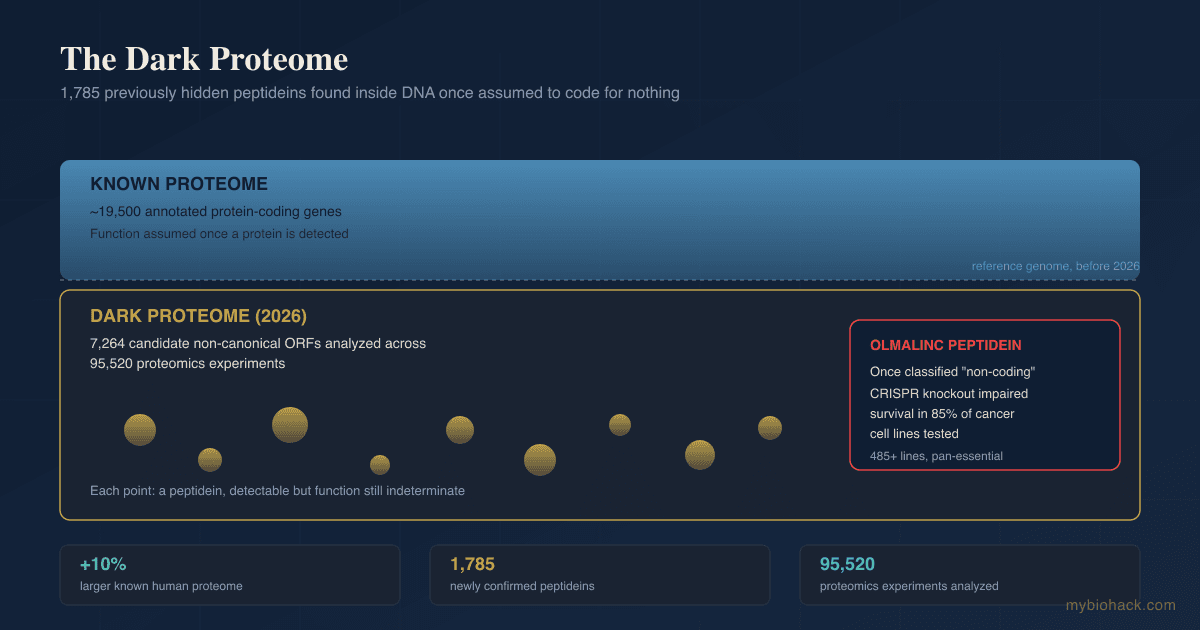
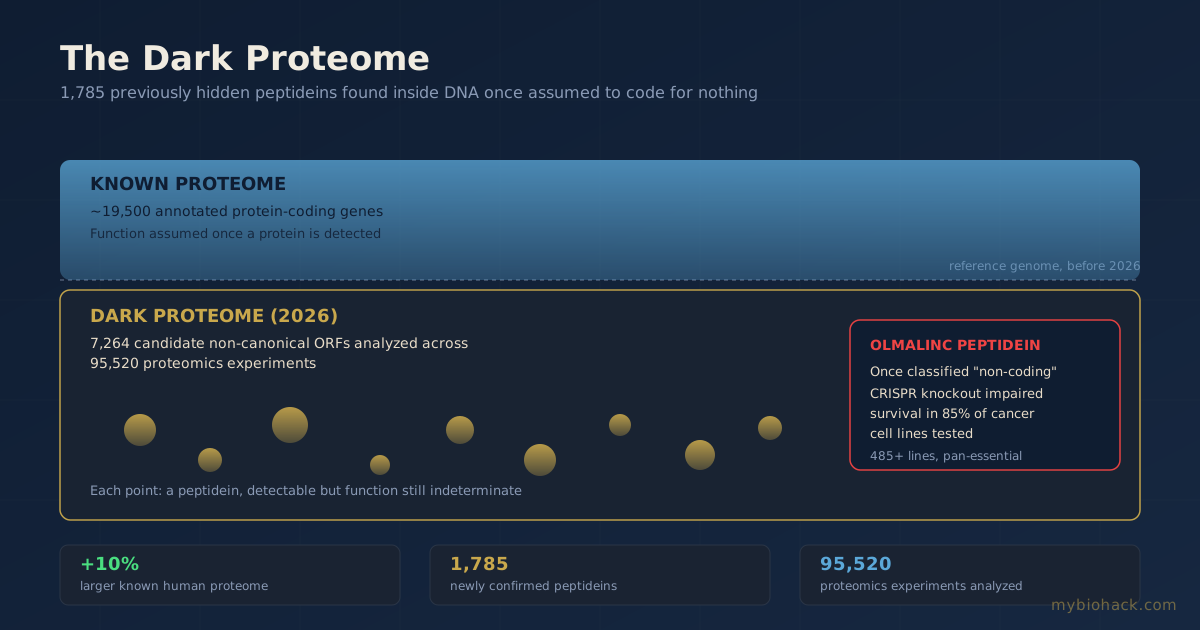
By Jacob Gordon, INHC, FMT-CA peptidein is a newly classified type of small protein-like molecule that scientists just proved your cells actually make, expanding the known human proteome by roughly 10% in a single 2026 study. R
In this post, we will discuss what a peptidein actually is, how it differs from the therapeutic peptides you already know, how the discovery was made, what these molecules appear to do in cancer and genetic disease, and where the research goes from here.
Basics Of Peptideins
Your genome is the full set of DNA instructions in a cell, and for decades the working assumption was that only about 19,500 stretches of it, called open reading frames (ORFs), actually code for proteins.
Everything else, roughly 98% of the genome, was treated as either regulatory scaffolding or non-coding DNA with no protein product.
A peptidein is a small protein-like molecule, usually under 100 amino acids, produced from one of these previously ignored stretches, called non-canonical open reading frames (ncORFs). R
The term was coined in 2026 by the TransCODE Consortium, an international collaboration led by Sebastiaan van Heesch of the Princess Máxima Center for Pediatric Oncology, in a Nature paper that systematically hunted for direct evidence that these overlooked sequences were actually being made into peptides, not just transcribed and discarded. R
A peptidein is deliberately defined as a molecule of indeterminate function: detectable, real, made of amino acids, but without an established biological job yet.
That is different from a conventional protein, where detection and function are usually assumed together.
Of the 1,785 peptideins identified in the initial analysis, 65% were under 50 amino acids, compared to less than 1% of conventional proteins that small, and only about 12 resembled a typical full-length protein in structure. R
Researchers and journalists have nicknamed this whole hidden layer of biology the dark proteome, a term that mirrors "dark matter" (present, measurable in its effects, but not yet understood).
Peptideins Are Not Peptide Therapies
The name similarity to "peptide" causes real confusion, so it is worth being blunt about the distinction.
A peptidein is an endogenous molecule your own cells are already producing from a stretch of your own DNA.
You cannot buy a peptidein, inject one, or take one as a supplement, and nothing in the current research suggests you should try.
This is a completely different category from the therapeutic peptides discussed elsewhere on this site, compounds like BPC-157, thymosin alpha-1, MOTS-c, tesamorelin, CJC-1295 and ipamorelin, or Semax, which are synthesized, purified, and administered from outside the body for a specific, studied effect.
Peptideins are a basic-science discovery about what your genome is already doing, not a new biohacking tool.
If a supplement company starts marketing "peptidein" products, that is a marketing appropriation of a term describing an undiscovered, endogenous, unpurified molecule, not a legitimate product category.
How Peptideins Were Discovered
The TransCODE Consortium was initiated in 2022 by researchers Sonia Chothani and Jorge Ruiz-Orera and grew into a collaboration spanning the Princess Máxima Center, Duke-NUS Medical School, the Max Delbrück Center, the University of Michigan Medical School, EMBL's European Bioinformatics Institute, and the Institute for Systems Biology in Seattle. R
The team started with 7,264 candidate ncORFs that had already been flagged by ribosome profiling (a technique that shows where ribosomes physically sit on RNA, implying translation is happening) as plausible protein-coding sequences.
Ribosome profiling can show a ribosome is present, but it cannot prove a stable peptide product actually exists afterward, so the consortium needed direct peptide-level evidence.
They mined 95,520 existing mass spectrometry proteomics experiments (a method that identifies proteins by their fragment masses), representing 3.7 billion raw data points, and ran roughly 20,000 hours of computation through the Trans-Proteomic Pipeline to search for matches. R
About 25% of the 7,264 candidate ncORFs, 1,785 of them, produced a peptide that was actually detectable in real human samples, not just theoretically possible. R
To figure out which of those 1,785 were more likely to be biologically meaningful rather than translational noise, the team built a new metric called ORF relative branch length (ORBL), which measures how much evolutionary selection pressure has acted on a sequence across species (a proxy for functional importance). R
Higher evolutionary constraint by ORBL correlated with a higher chance the ncORF's peptide would actually be detected in the proteomics data, which is one of the clearest signals that at least a subset of peptideins are functionally real rather than translational accidents. R
The consortium published the full framework and made it publicly searchable through GENCODE and PeptideAtlas, the two reference databases researchers use to look up gene and protein annotations. R
What Peptideins Do: Cancer, Genetic Disease, And OLMALINC
Most of the 1,785 peptideins identified have no established function yet, and the paper is explicit that this is the starting point of investigation, not the end. R
A subset already has direct disease relevance, and the clearest example involves OLMALINC, a gene previously classified as a long non-coding RNA (lncRNA), meaning it was assumed to act only through the RNA molecule itself, without ever being translated into protein.
Using CRISPR gene editing to knock out the OLMALINC-derived peptidein, researchers found it impaired survival in roughly 85% of the more than 485 cancer cell lines tested, a pan-essential result (meaning the gene is broadly required for cell survival across many cancer types, not just one). R
That is a striking finding for a gene that, until 2026, was not believed to make a protein product at all.
A second, earlier example is ASDURF (also annotated as the ASNSD1 upstream ORF), a microprotein encoded in the untranslated region ahead of the ASNSD1 gene.
ASDURF was first shown to be a structural subunit of the PAQosome, a large protein-folding chaperone complex, functioning as a previously unknown 12th subunit with homology to beta-prefoldins. R
A separate study then found ASDURF is upregulated in high-risk childhood medulloblastoma (a pediatric brain cancer), associates with MYC family oncogenes, and is required for medulloblastoma cell survival through its role in that chaperone complex. R
Because many peptideins appear to sit on the outside of the cell surface, researchers are also investigating whether some could serve as targets for cancer immunotherapies or vaccines, an approach that depends on a molecule being visible and distinct enough for the immune system to be trained against it. R
The honest caveat here is that the vast majority of peptideins remain functionally unmapped, and it will likely take years of follow-up CRISPR screens, structural studies, and disease-cohort analysis before most of them are understood, if they turn out to matter at all.
Testing: Can You Measure Peptideins Today?
There is currently no consumer or clinical lab test for peptideins, and that is worth stating plainly instead of implying otherwise.
The detection method used in the discovery paper, large-scale mass spectrometry proteomics run against a purpose-built reference database, is a research tool, not a clinical assay, and it is not offered by any commercial lab panel at this time.
The public resources that came out of this research, GENCODE and PeptideAtlas, are reference databases for researchers to look up whether a given gene or ORF has peptide-level evidence, not something an individual can use to test their own biology.
If you are trying to assess your own cancer risk or genetic disease risk today, the actionable path is still conventional genetic and biomarker testing rather than anything peptidein-specific.
For readers already tracking epigenetic age and methylation-based biomarkers, that testing category remains the practical option; peptidein-specific testing is not yet a real product category to look for.
Mechanisms Of Action
Simple:
- Your DNA has far more working parts than the roughly 19,500 genes textbooks describe, and some of those extra parts make small, real, physically detectable molecules.
- Scientists used to assume a stretch of DNA either made a full protein or made nothing; peptideins show there is a large, previously invisible middle category.
- Some of these small molecules turn out to be essential for cancer cells to survive, which makes them potential new drug targets.
Advanced:
- Non-canonical open reading frame translation. Ribosomes have long been observed initiating translation at start codons outside annotated protein-coding sequences, including in 5' UTRs (upstream ORFs), 3' UTRs, and RNAs previously classified as non-coding. The TransCODE paper confirms that a meaningful fraction of this ribosome activity produces stable, mass-spectrometry-detectable peptide products rather than being degraded immediately after synthesis. R
- ORF relative branch length (ORBL). This new evolutionary metric compares the substitution rate within an ORF to the substitution rate of its surrounding genomic context across species, distinguishing sequences under real purifying selection (implying function) from sequences drifting neutrally (implying no function). ORBL is one of the first tools built specifically to evolutionarily triage the huge backlog of candidate ncORFs. R
- PAQosome chaperone assembly. ASDURF physically integrates into the prefoldin-like module of the PAQosome, a co-chaperone complex that assists in folding several essential protein complexes, including RNA polymerase II and small nuclear ribonucleoproteins. Its structural homology to beta-prefoldins let it slot into a hexameric complex as a previously unrecognized 12th subunit. R
- MYC-associated translational dysregulation in medulloblastoma. High-risk medulloblastoma shows widespread non-canonical ORF translation on ribosome profiling, and ASDURF's upregulation tracks with MYC family oncogene activity, tying a specific peptidein to a known oncogenic transcriptional program rather than a generic stress response. R
Genetics
OLMALINC
OLMALINC is a gene locus originally annotated as a long non-coding RNA associated with oligodendrocyte maturation (the cells that produce myelin in the central nervous system).
The 2026 TransCODE analysis found it also encodes a peptidein, overturning its "non-coding" classification and identifying it as pan-essential across the majority of cancer cell lines tested via CRISPR knockout. R
This is one of the clearest demonstrations that "non-coding" annotations in current reference genomes may be provisional rather than final, since the classification depended on the detection methods available at the time each gene was annotated.
ASNSD1 / ASDURF
ASNSD1 is a protein-coding gene; its upstream open reading frame independently encodes the microprotein ASDURF, sitting in the 5' UTR ahead of the main ASNSD1 coding sequence.
Population variant data specific to ASDURF's cancer-relevant function is not yet established in the literature; the current findings are at the level of gene expression and CRISPR knockout phenotype rather than common single-nucleotide polymorphisms.
ASDURF upregulation associates with MYC family oncogene activity in high-risk childhood medulloblastoma and is required for survival of those cancer cells. R
More Research
- Immunotherapy targeting. Because a number of peptideins appear to be presented on the cell surface, several groups are now evaluating them as antigens for cancer vaccines and immunotherapy, though this work is still preclinical. R
- John Prensner's broader microprotein research. Prensner's lab at the University of Michigan characterized cancer-associated microproteins for several years before the TransCODE paper, including the original ASDURF/PAQosome work, and described peptideins as potentially among the most versatile and consequential regulatory molecules once their functions are mapped.
- Reference database access. Both GENCODE and PeptideAtlas are open to any researcher and now include peptidein-level annotations, which should accelerate independent replication and functional follow-up work.
- Scale of the unknown. Only 1,785 of the flagged 7,264 candidate ncORFs produced detectable peptides in this analysis, and the authors are explicit that thousands of additional ncORFs beyond the initial candidate set have not yet been systematically tested, meaning the true count of peptideins in the human genome is almost certainly higher than what has been confirmed so far. R
- What this does and does not mean for chronic illness. None of the current peptidein research is specific to conditions like long COVID, POTS, or CIRS; the confirmed disease links so far are cancer and rare genetic disease. The broader lesson, that a large fraction of the genome long assumed to be functionally silent is not, is a reasonable argument for humility about how much of chronic illness biology remains genuinely unmapped, but it is not itself evidence for any specific chronic illness mechanism.
If you want to go deeper on how much of the body still functions as a genuine black box in chronic illness, most of the Junction Dysfunction guide is built around exactly that kind of "the mechanism isn't in the textbook yet" territory, and the Biohacking Bot can walk through follow-up questions on this paper or on the difference between peptideins and any peptide protocol you are already using.
Jacob Gordon
INHC, FMT-C
Integrative Nutrition Health Coach
I cover mold illness, post-viral recovery, methylation, and complex chronic disease, drawing on ten years of clinical research, work inside a functional medicine clinic, and my own recovery from all of it. Every claim here is cited.
Book a ConsultationRelated Protocols & Supplements
Deep-dive chapters and recommended supplements for this topic
Methylated B Complex
1 cap/day with food
SAMe
400mg on empty stomach
Resveratrol
250mg/day