Akkermansia muciniphila: The Mucin-Eating Gut Bacterium That Strengthens the Barrier and Improves Metabolic Health
By Jacob Gordon, INHC, FMT-CThis article contains affiliate links. As an Amazon Associate, MyBioHack earns from qualifying purchases at no extra cost to you. We only link products we research and stand behind.
Akkermansia muciniphila is a mucin-eating bacterium that lives inside your gut mucus layer, and its abundance tracks closely with leanness, insulin sensitivity, and a resilient gut barrier.
In this post, we will discuss what A. muciniphila is, the paradox by which grazing on mucus makes the barrier thicker, its metabolic and immune benefits, how to raise it with diet and supplements, the live-versus-pasteurized debate, dosing and safety, mechanisms, and genetics.

What It Is
Akkermansia muciniphila (A. muciniphila) is a Gram-negative anaerobe that colonizes the mucus layer lining the gut, where it makes up 1 to 4 percent of the fecal microbiota in healthy adults.
Its entire lifestyle is built around one food source: mucin, the heavily glycosylated protein that forms the gut's protective mucus gel.
A. muciniphila carries a specialized enzymatic toolkit of sialidases and fucosidases that let it strip sugars off mucin and use them for carbon and nitrogen, which is why it lives closer to the epithelium than almost any other commensal.
It is now classified as a keystone species and one of the first true "next-generation probiotics," a category that describes gut natives with therapeutic potential rather than the traditional Lactobacillus and Bifidobacterium strains covered in the companion strain guide.
Low A. muciniphila is a recurring signature of metabolic and inflammatory disease, and its depletion is one of the more consistent features of dysbiosis.
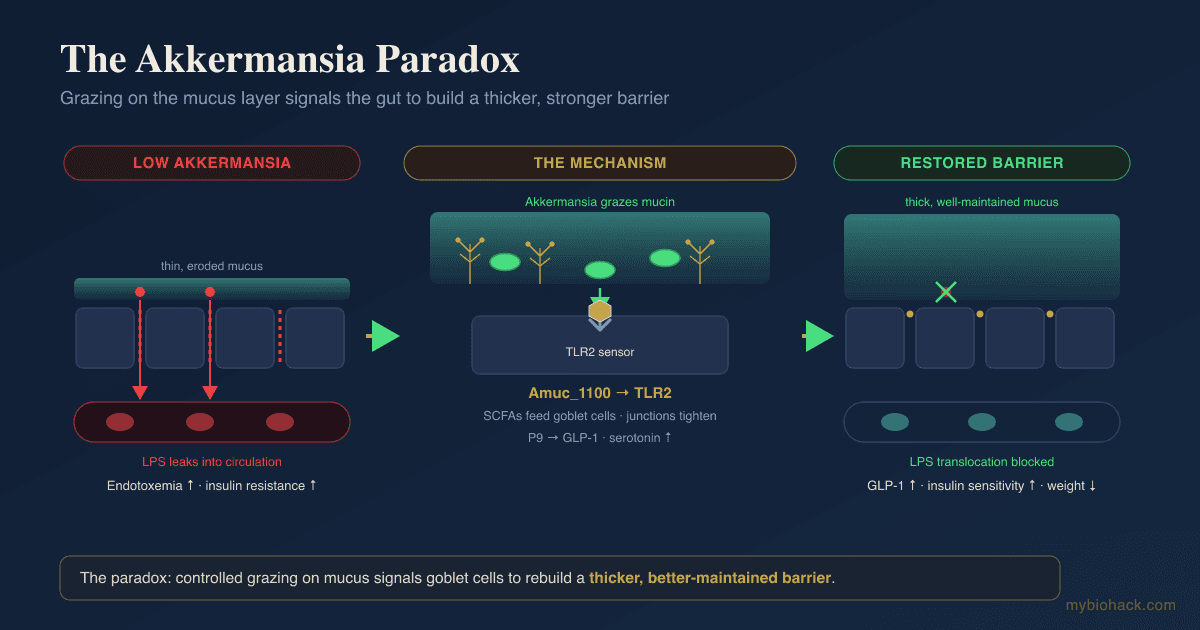
The Mucin Paradox
The obvious worry is that a bacterium eating your mucus lining would thin the barrier that keeps gut contents out of your bloodstream.
The opposite happens.
Colonizing mice with A. muciniphila restored the thickness of the mucus layer that a high-fat diet had thinned, rather than eroding it further. R
The reason is that controlled grazing on mucin is a growth signal.
Mucin degradation releases short-chain fatty acids (SCFAs) like acetate and propionate that feed colonocytes and stimulate goblet cells to secrete more mucus, so turnover drives regrowth. R
This shows up wherever Akkermansia rises: interventions that increase it also increase goblet-cell number and mucin output, so the net effect is a thicker, better-maintained barrier. R
There is an important honest caveat here, and it is the condition under which the paradox breaks.
When the host is starved of dietary fiber, mucin-foraging bacteria stop being groomers and start being erosive, degrading the colonic mucus barrier and increasing susceptibility to enteric pathogens. R
In other words, A. muciniphila thickens the barrier when the gut has enough substrate to regrow mucus faster than it is being grazed, and it becomes a liability when it does not.
Feeding the system matters as much as the bug itself.
Metabolic Benefits
A. muciniphila is inversely associated with obesity, type 2 diabetes (T2D), and metabolic endotoxemia across rodent and human studies.
The core observations:
- Body weight inversely correlates with A. muciniphila abundance in mice and humans, and supplementing it reverses high-fat-diet weight gain and fat mass. R
- Endotoxemia (circulating lipopolysaccharide, or LPS) falls when A. muciniphila is restored, along with adipose tissue inflammation and insulin resistance. R
- Insulin sensitivity improved by roughly 29 percent in insulin-resistant volunteers given the pasteurized bacterium for three months, with reductions in insulinemia and total cholesterol. R
- Metabolic health at baseline is better in people who already carry more A. muciniphila, and those people improve more during caloric restriction. R
The most important human signal is that A. muciniphila secretes a protein (P9) that induces glucagon-like peptide-1 (GLP-1), the same incretin hormone targeted by the drugs discussed in the GLP-1 and muscle preservation post. R
So part of Akkermansia's metabolic effect is endogenous incretin signaling, which is a gentler lever on the same pathway modern weight-loss pharmacology hits hard.
The honest limit is that human trials remain small, and benefit appears to depend on how much Akkermansia you start with, so it is not a guaranteed responder for everyone. R
Gut Barrier And Immunity
The metabolic wins trace back to what A. muciniphila does to the gut wall.
A stronger mucus layer and tighter epithelial junctions mean less LPS crosses into portal circulation, which lowers the low-grade inflammation that drives insulin resistance. R
Much of this is not the whole bacterium but a single protein.
Amuc_1100, a thermostable protein on the A. muciniphila outer membrane, signals through Toll-Like Receptor 2 (TLR2) to improve gut barrier function and reproduce most of the bacterium's metabolic benefits on its own. R
The same Amuc_1100 to TLR2 interaction also raises intestinal serotonin (5-HT) synthesis by upregulating the rate-limiting enzyme Tph1 and lowering the reuptake transporter, which is relevant to gut-brain and motility signaling. R
On the disease side, A. muciniphila is depleted in inflammatory bowel disease (IBD), and its abundance tracks the proportion of sulphated mucin in the colon, falling sharply in active ulcerative colitis. R
That sulphation detail is where this connects to Jacob's Junction Dysfunction framework.
In the JD model, the gut mucus layer and the epithelial glycocalyx are treated as one continuous, negatively charged, highly sulfated barrier, not two separate structures, and Jacob's hypothesis is that supporting the organisms that maintain sulfated mucin also supports the glycocalyx side of that barrier and reduces the endotoxin load that feeds systemic inflammation. R
You can read the deeper mechanistic argument in the glycocalyx chapter, keeping in mind this is Jacob's framing rather than settled consensus.
How To Increase It
You can raise A. muciniphila with diet, fasting, specific drugs, and direct supplementation.

1. Eat polyphenol-rich foods and extracts
Polyphenols are the single most reproducible dietary lever, because they are poorly absorbed in the small intestine and reach the colon where they feed mucin-producing goblet cells and selectively bloom Akkermansia.
Polyphenol sources with the strongest Akkermansia data (not an exclusive list):
- Concord grape polyphenols increased A. muciniphila and blunted high-fat-diet weight gain, inflammation, and glucose intolerance in mice. R
- Cranberry extract markedly raised the Akkermansia proportion while protecting against diet-induced obesity, insulin resistance, and intestinal inflammation. R
- Pomegranate ellagitannins stimulated A. muciniphila growth in vivo, and urolithin A producers carry far more Akkermansia than non-producers. R
For a concentrated dose, cranberry extract, pomegranate extract, and grape seed extract deliver the relevant proanthocyanidins and ellagitannins without the sugar load of the whole fruit.
2. Feed the mucus system with fiber, and mind the low-FODMAP trade-off
A. muciniphila does not ferment most dietary fiber directly, but fiber protects it indirectly.
Fermentable fibers feed cross-feeding bacteria that supply Akkermansia and keep the mucus barrier intact, which is exactly the substrate that goes missing in the fiber-deprivation experiments where mucin foragers turn erosive. R
The nuance worth flagging is that a strict low-FODMAP diet, used widely for IBS, removes many of these fermentable substrates and can lower beneficial taxa, so long-term FODMAP restriction may work against Akkermansia even as it calms symptoms.
Use low-FODMAP as a short diagnostic phase, not a permanent state.
3. Practice intermittent fasting
Time-restricted eating consistently raises A. muciniphila, and the effect has shown up in human fasting studies as well as rodent models. R
The likely reason is that fasting windows give the gut lining time to turn over mucus without a constant stream of incoming food, and Akkermansia is one of the taxa that benefits from that rhythm.
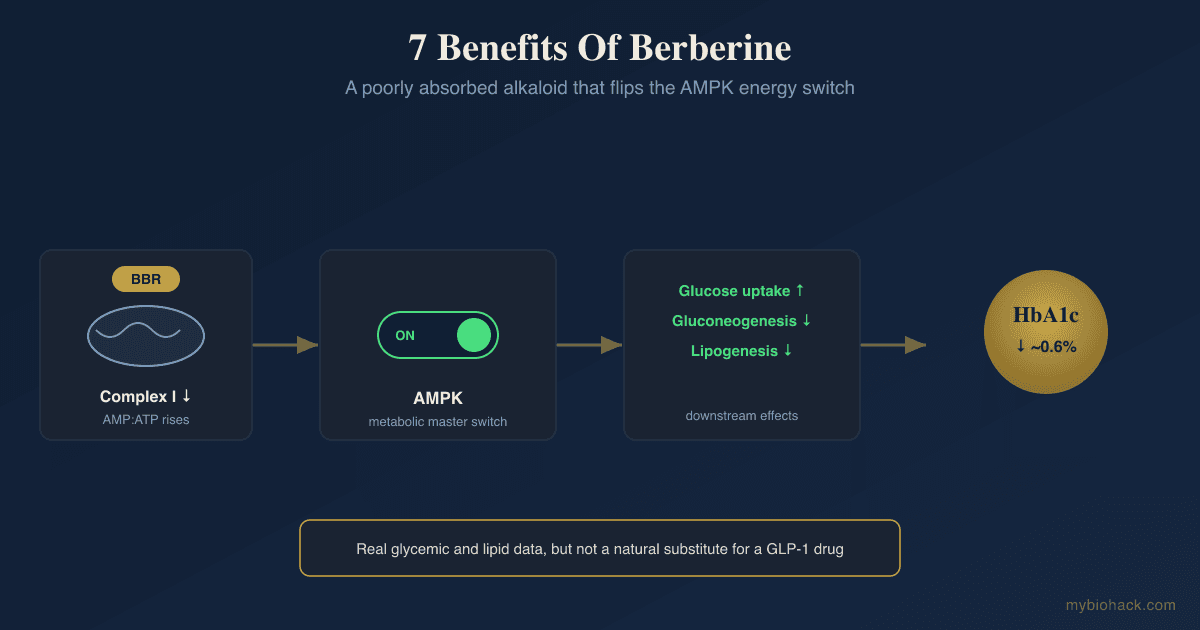
4. Consider metformin or berberine
Both drugs raise Akkermansia as a side effect of how they act on the gut.
Metformin increases A. muciniphila abundance alongside a rise in mucin-producing goblet cells, and this shift contributes to its glucose-lowering effect independent of the drug's action on the liver. R
Berberine similarly increases gut Akkermansia and lowered metabolic endotoxemia and atherosclerosis in high-fat-fed mice. R
Berberine is available over the counter as berberine, which makes it the more accessible of the two for people not on a metformin prescription.
5. Supplement the bacterium directly
If diet and fasting are not enough, you can take A. muciniphila itself, sold as Akkermansia probiotic capsules.
Which form to buy is a real decision, so it gets its own section below.
Live vs Pasteurized Supplements
This is the counterintuitive part: the dead form of A. muciniphila often works better than the live one.

In the original 2013 mouse work, only viable bacteria restored the mucus layer and metabolic profile, and heat-killed cells did nothing, which suggested you needed it alive. R
Then pasteurization flipped the story.
Gently pasteurizing A. muciniphila at 70 degrees Celsius actually enhanced its ability to reduce fat mass and improve insulin sensitivity in obese mice, and the isolated Amuc_1100 protein reproduced the effect because it is stable at pasteurization temperatures. R
The resolution of the apparent contradiction is temperature.
Harsh heat-killing destroys Amuc_1100, while pasteurization preserves the protein that does most of the barrier and metabolic signaling through TLR2.
The human pilot then confirmed it: pasteurized A. muciniphila improved insulin sensitivity, insulinemia, and cholesterol, while the live form did not reach statistical significance on those endpoints. R
On the commercial side, this splits the market.
Pendulum sells a live single-strain A. muciniphila in the United States, while the pasteurized form has been approved by European regulators as a novel food and is sold as a postbiotic under the A-Mansia and Akkermansia Company brands.
If your goal is the metabolic and barrier signaling, the pasteurized evidence is currently stronger in humans, though live product remains the only widely available option in the US retail market.
Dosage And Safety
The human trials used 10 billion (10^10) cells per day of live or pasteurized A. muciniphila for three months, which is the best-supported dose. R
Commercial live capsules are typically dosed lower, around 100 million active fluorescent units, so retail products are not a one-to-one match for the research dose.
On safety, the pasteurized bacterium was well tolerated for three months in the pilot with no serious adverse events, and a longer 24-week weight-maintenance trial reported no serious treatment-related events. R R
There are honest limits to that reassurance.
Safety during active disease is not established, and a critical review cautions against supplementation in active IBD, in immunocompromised states, and in conditions with elevated IBD risk such as PCOS and endometriosis, because a mucin-degrader in an already-eroded gut is a different situation than in a healthy one.
This is the same logic as the fiber-deprivation caveat: A. muciniphila is a groomer when the barrier can keep up and a potential problem when it cannot. R
If you have an active inflammatory gut condition, raise Akkermansia through polyphenols and fiber first, and treat direct supplementation as something to discuss with a clinician rather than a default.
Mechanisms Of Action
Simple:
- It grazes on your gut's mucus lining in a controlled way, which signals your gut to build that lining back thicker and stronger.
- A protein on its surface talks to an immune sensor in the gut wall that tightens the barrier and calms inflammation.
- It nudges the gut to release GLP-1, the same fullness-and-blood-sugar hormone that newer weight-loss drugs target.
Advanced:
- Amuc_1100 to TLR2 barrier signaling The thermostable outer-membrane protein Amuc_1100 binds TLR2 on the intestinal epithelium, upregulates tight-junction proteins, improves gut barrier integrity, and on its own recapitulates most of the whole bacterium's reductions in fat mass, insulin resistance, and metabolic inflammation. R
- Mucin turnover and SCFA cross-talk Enzymatic degradation of mucin sugars yields acetate and propionate that nourish colonocytes, stimulate goblet-cell mucin secretion, and drive the net thickening of the mucus barrier, tying Akkermansia's benefits to the same SCFA signaling that underlies much of gut health. R R
- P9 to ICAM-2 incretin induction A. muciniphila secretes an 84-kDa protein, P9, that interacts with intercellular adhesion molecule 2 to induce GLP-1 secretion and thermogenesis, providing an endogenous incretin mechanism for its glucose-lowering effect. R
- Serotonin biosynthesis Through the same Amuc_1100 to TLR2 axis, A. muciniphila upregulates Tph1, the rate-limiting enzyme for intestinal 5-HT synthesis, and downregulates the serotonin reuptake transporter, increasing extracellular serotonin availability in the gut. R
- Endotoxemia reduction By reinforcing the mucus-plus-junction barrier, A. muciniphila lowers translocation of LPS into portal circulation, dampening the TLR4-driven inflammatory tone that links leaky gut to insulin resistance and cardiometabolic disease. R R
Genetics
A. muciniphila is a bacterium, so its "genetics" for the reader means the host genes that shape how much of it you carry.
Twin and association studies estimate that host genetics explains somewhere between 5 and 45 percent of the variation in a given gut taxon, which means abundance is partly heritable but heavily modifiable by diet.
PLD1
PLD1 encodes phospholipase D1, an enzyme involved in signal transduction and vesicle trafficking that has been separately linked to body mass index.
A genome-wide association study found that a variant in the untranslated region of PLD1 associates with the abundance of genus Akkermansia, connecting a metabolism-related host gene to how well this bacterium colonizes. R
This is a plausible mechanistic bridge between host genotype, Akkermansia levels, and obesity risk, though it is a single association rather than a proven causal pathway.
FUT2
FUT2 encodes an alpha-1,2-fucosyltransferase that decorates gut mucus and epithelial glycans with fucose, and roughly one in five people carry two nonfunctional copies and are "non-secretors."
Secretor status changes the sugar landscape that mucin-foraging bacteria feed on, and fecal microbiota composition differs by FUT2 genotype, including shifts in Akkermansia abundance. R
rs601338: the common nonsense variant that defines non-secretor status and alters mucosal fucosylation, one input into how hospitable your mucus layer is to Akkermansia. R
More Research
A. muciniphila is one of the most promising next-generation probiotics, but the human evidence is still thin, and several open questions matter for anyone acting on it.
- Baseline dependence is the recurring theme across human trials: people with higher starting Akkermansia respond better to both diet and supplementation, and a 2024 trial in overweight T2D patients found efficacy hinged on baseline gut levels, so the bacterium may help most exactly where it is already present. R R
- Bone loss appeared as an unexpected trade-off in one mouse study where pasteurized A. muciniphila protected against fat gain but did not protect against bone loss, a reminder that "metabolically good" is not automatically "good everywhere."
- Formulation and strain drive much of the inconsistency, since results differ between live and pasteurized preparations and between strains, and retail products are dosed well below the research dose, so a null result from a supplement is not the same as a null result for the bacterium.
- Weight-loss maintenance is where the newest human data are strongest: a 2026 randomized controlled trial found pasteurized A. muciniphila reduced weight regain after a low-energy diet compared with placebo over 24 weeks, which is a more realistic endpoint than short-term weight loss. R
The practical read is that raising Akkermansia through polyphenols, fiber, and fasting is low-risk and well-supported, while direct supplementation is a reasonable add-on for metabolic goals in a healthy gut and a question to raise with a clinician in an inflamed one.
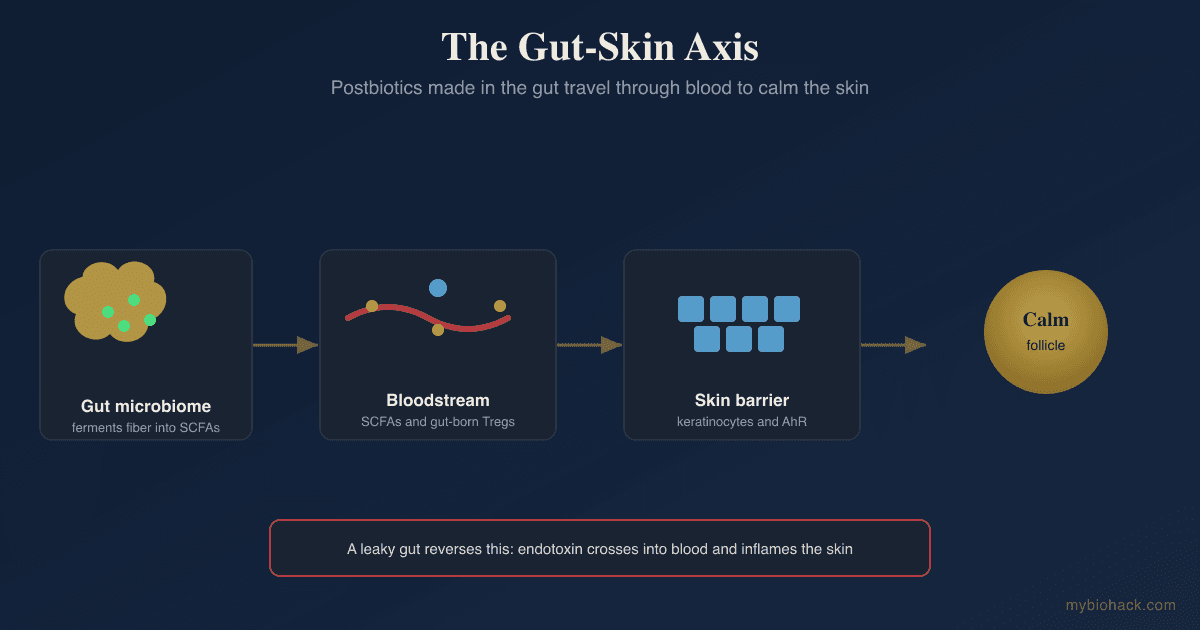
For a wider view of how gut barrier integrity radiates outward to other systems, the gut-skin axis post covers one of the clearest downstream examples.
Jacob Gordon
INHC, FMT-C
Integrative Nutrition Health Coach
I cover mold illness, post-viral recovery, methylation, and complex chronic disease, drawing on ten years of clinical research, work inside a functional medicine clinic, and my own recovery from all of it. Every claim here is cited.
Book a ConsultationRelated Protocols & Supplements
Deep-dive chapters and recommended supplements for this topic
Spore-Based Probiotics
1 cap with food
L-Glutamine
5g 2x/day on empty stomach
Butyrate
300mg 2x/day with meals