Keeping Muscle On GLP-1 Drugs: Semaglutide, Tirzepatide, And Retatrutide
By Jacob Gordon, INHC, FMT-CThis article contains affiliate links. As an Amazon Associate, MyBioHack earns from qualifying purchases at no extra cost to you. We only link products we research and stand behind.
GLP-1 drugs strip fat fast, but a large share of what comes off is muscle, and that is the part you cannot afford to lose.
In this post, we will discuss why semaglutide, tirzepatide, and retatrutide cost you lean mass, how much muscle the trial data actually show people losing, who is most at risk, and an evidence-based protocol to keep the muscle while the fat comes off.

Basics: Why GLP-1 Drugs Cost You Muscle
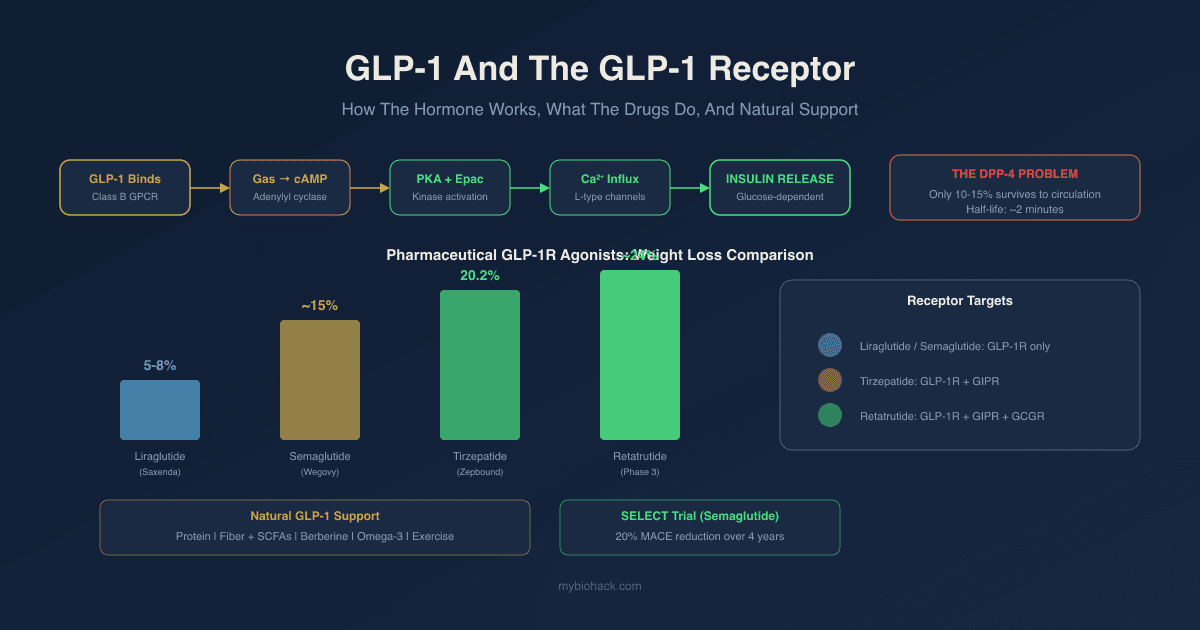
Glucagon-like peptide-1 receptor agonists (GLP-1 RAs) are the class behind semaglutide (Wegovy, Ozempic), tirzepatide (Zepbound, Mounjaro), and the investigational triple agonist retatrutide.
They work almost entirely by suppressing appetite, which drives a large and often rapid caloric deficit.
For a deeper primer on the class, see our overview of GLP-1 receptor agonists and the older single-agonist drug liraglutide.
Here is the part most people miss.
Weight is not fat.
Any time you lose weight through a calorie shortage, whether by dieting or by a drug that makes you eat less, some of that weight is fat-free mass (FFM), which includes skeletal muscle.
This is not unique to GLP-1 drugs.
It is a basic rule of energy balance: a deficit large enough to shrink fat will also pull amino acids out of muscle unless you actively defend it.
What makes GLP-1 drugs different is the size and speed of the deficit, plus a second problem.
The same appetite suppression that melts fat also crushes protein intake, and protein is the single nutrient your body most needs to hold onto muscle.
So you get the worst combination for muscle: a steep energy deficit, low protein intake, and (in older users) an already blunted ability to build muscle from the protein you do eat.
Muscle is not cosmetic.
Skeletal muscle is the largest site of insulin-stimulated glucose disposal in the body and a major driver of resting metabolic rate (RMR), so losing it can quietly worsen the exact metabolic picture the drug was prescribed to fix. R
Low muscle mass, especially when paired with obesity, is independently associated with higher all-cause and cardiovascular mortality. R
How Much Lean Mass Is Actually Lost
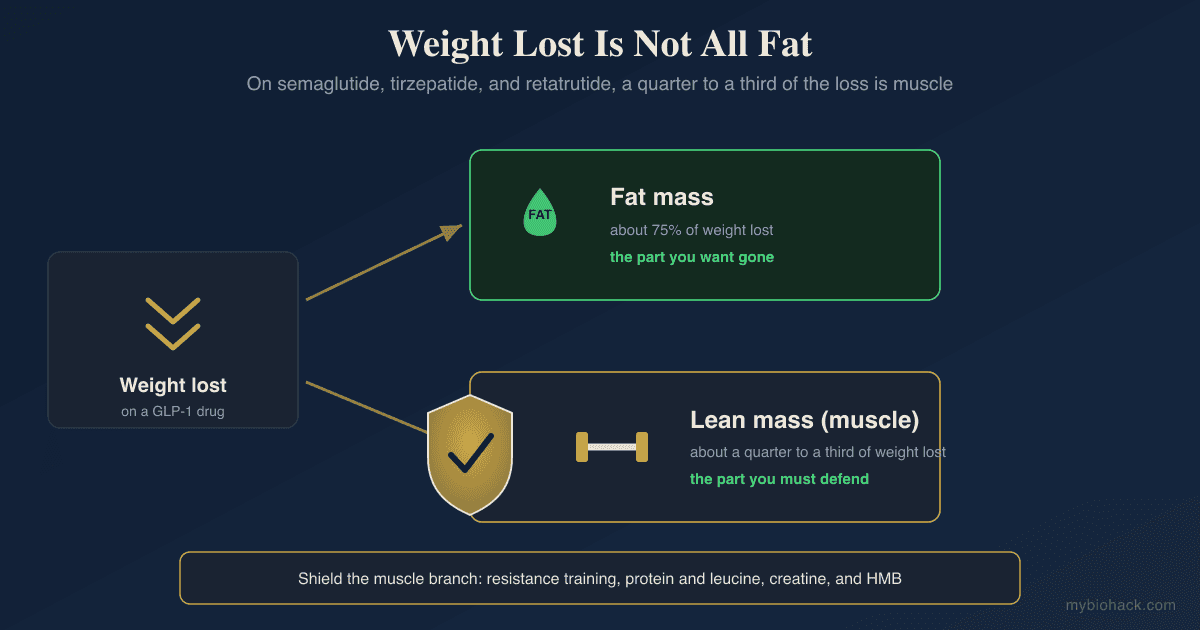
The honest answer is that roughly one quarter to one third of the weight lost on these drugs is lean mass, and the exact fraction depends on the drug, the trial, and who you measure.
The best data come from dual-energy X-ray absorptiometry (DXA) substudies inside the major trials.
Semaglutide (STEP 1).
In the STEP 1 trial, adults with obesity lost about 15% of body weight over 68 weeks on semaglutide 2.4 mg, versus 2.4% on placebo. R
Real-world semaglutide cohorts confirm meaningful reductions in both fat and lean mass, with measurable declines in muscle function in a subset of patients. R
Tirzepatide (SURMOUNT-1).
In the SURMOUNT-1 DXA substudy, tirzepatide reduced body weight by 21.3%, fat mass by 33.9%, and lean mass by 10.9% over 72 weeks. R
Put differently, about 75% of the weight lost was fat and about 25% was lean mass, and that ratio was similar to placebo. R
Retatrutide (triple agonist).
Retatrutide is the most powerful of the three, producing up to roughly 24% body-weight loss at 48 weeks in the phase 2 obesity trial. R
In a phase 2 body-composition substudy in people with type 2 diabetes, retatrutide cut fat mass substantially while lean mass loss made up a somewhat higher share of total weight lost (in the range of one third), which is expected given how much more total weight comes off. R

Two things are worth sitting with here.
First, in percentage-of-weight-lost terms, GLP-1 drugs are not obviously worse than old-fashioned dieting.
The lean-to-fat loss ratio is broadly in line with what caloric restriction alone produces.
Second, and this is the catch, because these drugs cause so much more total weight loss, the absolute grams of muscle lost can be large, and larger absolute muscle loss is what actually matters for strength, metabolic rate, and long-term function.
There is a big MAYBE in the literature about whether GLP-1 drugs have any direct catabolic effect on muscle beyond the caloric deficit.
Skeletal muscle expresses very little GLP-1 receptor, so most of the loss is best explained by the energy deficit and reduced protein intake rather than the drug directly digesting muscle.
That distinction matters, because it means the loss is largely preventable with the right inputs.
Who Is At Risk
Everyone on these drugs loses some lean mass, but the risk is far from evenly distributed.
The following groups should assume they are high risk and act accordingly: (not an exclusive list)
- Fast losers (people dropping weight very quickly on high doses, where the deficit is steepest)
- Low protein eaters (appetite suppression makes protein the first thing to fall off the plate)
- Older adults (the anorexia of aging plus anabolic resistance stack on top of the drug effect) R
- Postmenopausal women and low-testosterone men (sex hormones are permissive for muscle maintenance)
- Sedentary users (no resistance training means no signal telling the body to keep muscle) R
- The already sarcopenic or "skinny-fat" (people who start with low muscle and high fat have the least reserve to lose)
The older-adult case deserves emphasis.
Aging muscle is already less responsive to protein, a phenomenon called anabolic resistance, so an older person eating less on a GLP-1 drug can slide toward sarcopenic obesity, losing functional muscle while still carrying excess fat. R
This is the population where an appropriate protocol is not optional.
How To Preserve Muscle On GLP-1 Drugs
The goal is simple to state: keep the muscle-building signal on (resistance training plus enough leucine-rich protein) while the drug turns the fat-burning signal on.
Everything below is ordered by leverage, not alphabetically, because these are protocol steps.

1. Resistance Train With Progressive Overload
This is the single most effective intervention, and nothing else on this list replaces it.
Resistance training is the signal that tells your body the muscle is still needed, so it is spared during the deficit.
In a meta-analysis of caloric restriction in older adults, resistance training prevented 93.5% of the lean body mass that would otherwise have been lost. R
Train each major muscle group at least twice per week, take most sets close to failure, and add load or reps over time (progressive overload).
You do not need high training volume to protect muscle in a deficit, you need enough intensity and consistency to keep the stimulus present.
Walking and cardio are good for the heart and for the deficit, but they do not defend muscle, so do not let steps replace lifting.
2. Eat 1.2 To 1.6 g/kg Protein And Hit The Leucine Threshold Each Meal
Protein is the raw material and the trigger for muscle protein synthesis (MPS), and it is exactly the thing that collapses when appetite disappears.
Aim for 1.2 to 1.6 g of protein per kg of body weight per day, and toward the higher end (or above) during aggressive weight loss. R
Distribute it across three to four meals of roughly 25 to 40 g each, because MPS responds to a per-meal dose, and older muscle needs a larger per-meal dose to respond at all. R
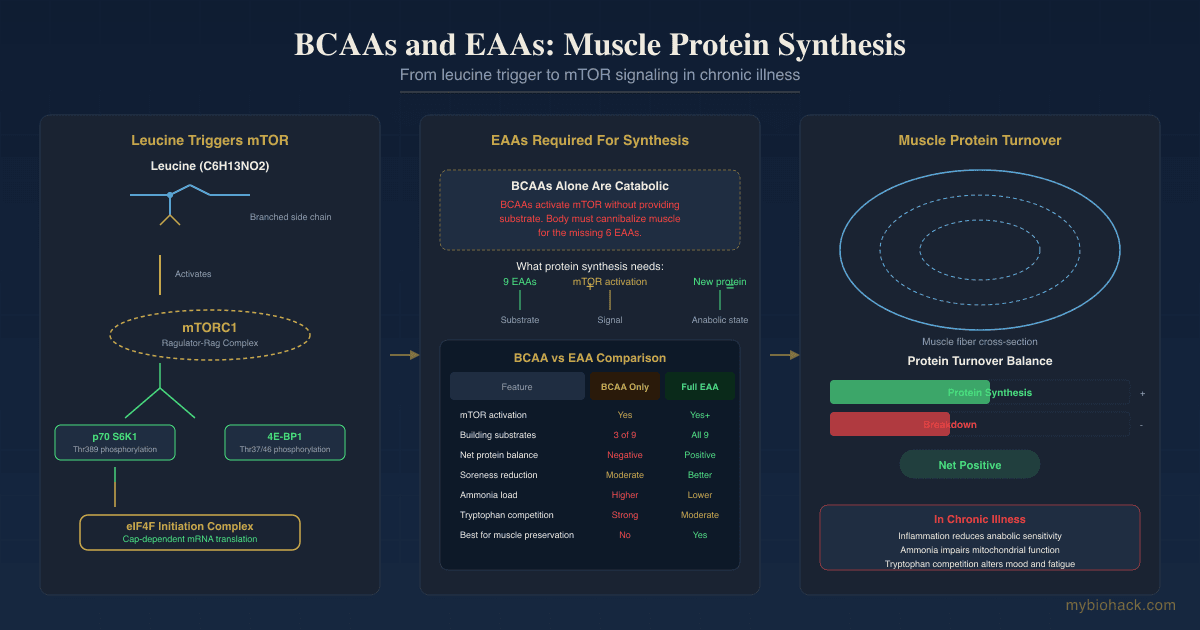
Each of those meals should clear the leucine threshold (around 2.5 to 3 g of leucine, the amino acid that switches on the anabolic machinery), which is roughly what 25 to 30 g of high-quality protein provides. R
When appetite is suppressed and whole-food protein is hard to finish, liquid and supplemental protein does the heavy lifting.
Whey Protein Isolate: a fast-digesting, leucine-dense protein that is easy to drink on days when solid food is unappealing.
Essential Amino Acids: a low-volume, low-calorie way to hit the leucine trigger between meals without needing to eat.
Leucine: a targeted add-on to push a smaller protein meal over the threshold when total intake is low.
3. Supplement Creatine Monohydrate
Creatine is the most evidence-backed supplement for adding and preserving lean tissue, and it pairs naturally with resistance training.
In older adults, creatine combined with resistance training produced about 1.37 kg more lean tissue mass than training alone. R
Creatine Monohydrate: 3 to 5 g daily is the maintenance dose, and a short loading phase of about 20 g/day for 5 to 7 days speeds saturation but is optional.
Creatine also pulls water into muscle, so expect a small scale increase early that is not fat, and see our full writeup on creatine dosing and benefits.
4. Consider HMB If You Are Over 60 Or Losing Weight Fast
Beta-hydroxy-beta-methylbutyrate (HMB) is a leucine metabolite that specifically slows muscle breakdown, which is most useful in exactly the catabolic conditions a steep GLP-1 deficit creates.
In older adults on complete bed rest, 3 g/day of HMB preserved lean mass that the control group lost. R
In older adults with sarcopenia, HMB enhanced the muscle and strength gains from resistance training. R
The evidence is strongest in older and catabolic populations, and weaker in healthy young trained people, so target it accordingly.
HMB: the standard dose is 3 g/day, usually split as 1.5 g twice daily, and our full HMB writeup covers the mechanism in depth.
5. Do Not Under-Fuel Recovery: Energy, Micronutrients, And Vitamin D
A muscle-sparing plan is not a starvation plan, it is a controlled deficit with the muscle inputs protected.
Let the drug create the deficit, but do not stack an aggressive self-imposed crash diet on top of it, because a deeper deficit means more muscle lost.
Cover the micronutrients that muscle contraction and repair depend on, and correct any vitamin D deficiency, which is common and associated with weaker muscle.
Vitamin D3 With K2: dose to move blood 25-OH vitamin D into a healthy range rather than to a fixed pill count, and confirm with testing.
6. Know The Investigational Muscle-Preserving Agents (Experimental)
This tier is not a recommendation, it is context, because it is where the field is heading and readers will ask.
A class of drugs blocks the activin type II receptor (ActRII) and the myostatin-activin pathway, the body's brake on muscle growth, in order to add muscle while fat is lost.
Bimagrumab, an ActRII-blocking antibody, produced simultaneous fat loss and lean mass gain in adults with type 2 diabetes and obesity. R
A phase 2 trial then combined bimagrumab with semaglutide and reported that adding the antibody shifted the composition of weight loss toward fat and away from muscle. R
These agents are investigational, not approved for muscle preservation, and carry their own open safety questions, so treat them as a preview of where GLP-1 combination therapy is going, not as something to seek out now.
The growth-hormone axis is a separate experimental lever some clinicians explore for body composition, covered in our post on tesamorelin.
What To Stay Away From
Habits and choices that accelerate muscle loss on GLP-1 drugs: (not an exclusive list)
- Alcohol in any real quantity (it blunts muscle protein synthesis and displaces protein calories)
- Cardio-only exercise (good for the deficit, useless as a muscle-retention signal without resistance training)
- Crash dieting on top of the drug (deepening an already large deficit trades away muscle for a faster scale drop)
- Escalating the dose faster than needed (a steeper, quicker deficit means more absolute lean mass lost)
- Skipping protein because you are not hungry (the most common and most damaging mistake on these drugs)
- Treating DXA "lean mass" as pure muscle (it includes water and organ tissue, so read trends, not single numbers)
- Unproven peptide and hormone stacks (chasing muscle-preserving compounds from unregulated sources adds risk, not certainty)
One honest note on the "natural alternative" framing.
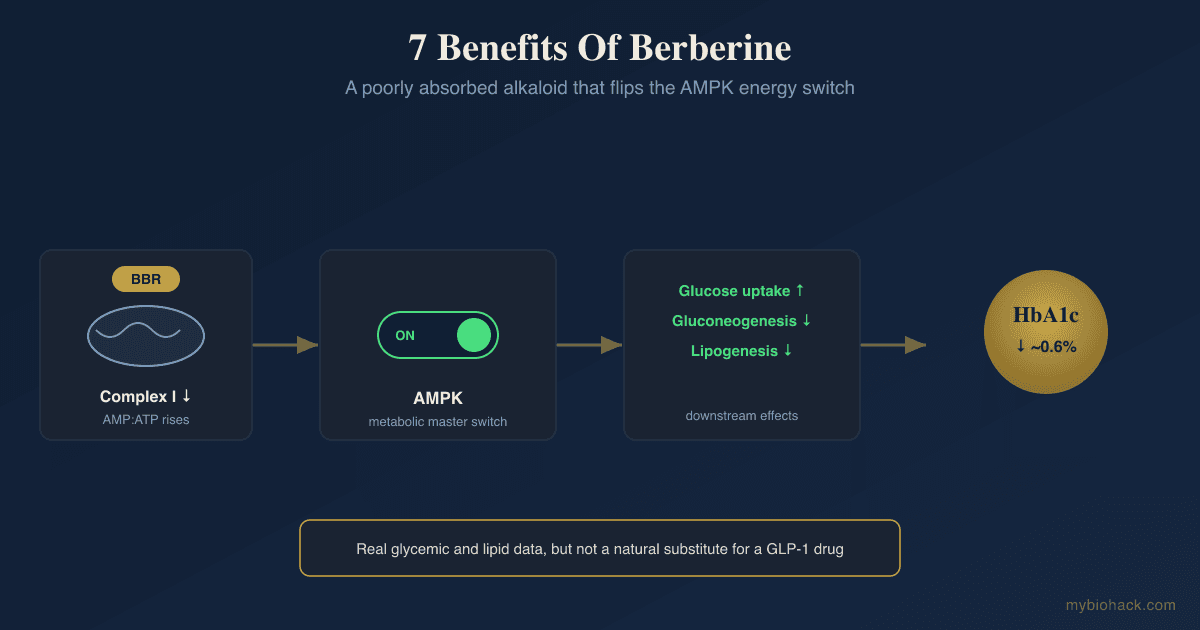
Compounds like berberine are sometimes marketed as gentle GLP-1 substitutes, but they produce far less weight loss and are not a like-for-like swap, so do not assume a natural option sidesteps the muscle question if it is actually driving meaningful weight loss.
Testing
The point of testing here is to measure body composition directly rather than trusting the bathroom scale, and to catch the metabolic and hormonal problems that accelerate muscle loss.
Imaging
DXA is the practical gold standard for tracking fat mass and lean mass over time, and it is what the major trials used, so scan at baseline and every few months to see whether your protocol is actually holding lean mass.
Appendicular lean mass (ALM) from DXA, the lean mass of the arms and legs, is the value used to diagnose sarcopenia, so ask for it specifically. R
Bioelectrical impedance analysis (BIA) scales are a cheaper, less accurate option that can still track a trend if you measure under identical conditions each time.
Blood And Urine Markers
Fasting insulin and HOMA-IR tell you how much of your metabolic problem is insulin resistance, which is closely tied to muscle, and are available individually via the Fasting Insulin test or the Insulin Resistance Panel (Quest).
A Comprehensive Metabolic Panel (Quest) covers glucose, electrolytes, and kidney and liver markers that matter when protein intake and creatine dosing change.
Low testosterone and low estradiol both undermine muscle maintenance, so screen sex hormones, especially in older users and postmenopausal women.
Vitamin D deficiency is common and linked to weaker muscle, and is worth correcting before and during rapid weight loss.
Functional Lab Panels
I use the Cardiometabolic Zoomer (Vibrant Wellness) to assess fasting insulin, lipids, ApoB, and metabolic markers in one panel, which frames the insulin-resistance side of the picture.
I use the Hormone Zoomer (Vibrant Wellness) to assess testosterone, estradiol, DHEA, and cortisol, and the DUTCH Complete (Precision Analytical) is the alternative when I want dried-urine metabolite detail.
I use the Nutrient Zoomer (Vibrant Wellness) to assess vitamin D, B vitamins, minerals, and amino acid status, or order Vitamin D 25-OH (Quest) on its own when I only need the single marker.
If you want help interpreting these against your own body-composition trend, that is exactly the kind of thing a consult or the Health Hub is built for.
Mechanisms Of Action
Simple:
- GLP-1 drugs work by making you eat far less, and any large calorie shortage burns some muscle along with fat.
- Muscle only holds on when you keep feeding it enough protein and loading it with exercise, both of which fall away when your appetite is gone.
- Muscle is where most of your blood sugar goes and a big part of how many calories you burn at rest, so losing it can quietly undo part of the benefit.
Advanced:
- Energy deficit and negative nitrogen balance GLP-1, GIP, and glucagon receptor signaling in the brain and gut suppresses appetite, producing a caloric deficit that shifts the body into net protein breakdown, so skeletal muscle amino acids are mobilized for gluconeogenesis and fuel unless intake and loading defend them. R
- Anabolic resistance and the leucine trigger muscle protein synthesis is gated by mTORC1, which is switched on by leucine reaching a per-meal threshold and by mechanical loading, and in aging muscle this response is blunted, so the low-protein intake typical on GLP-1 drugs fails to turn synthesis on and net breakdown wins. R
- Glucagon agonism and energy expenditure retatrutide's glucagon-receptor arm raises energy expenditure and hepatic substrate turnover on top of appetite suppression, which is part of why it drives the largest total weight loss and therefore the largest absolute lean mass loss to defend against. R
- ActRII and the myostatin-activin brake myostatin and activin signal through the activin type II receptor and SMAD2/3 to restrain muscle growth, and pharmacologically blocking that receptor (as bimagrumab does) removes the brake, which is why ActRII antagonists can add lean mass while GLP-1 drugs subtract fat. R
Genetics
ACTN3
ACTN3 encodes alpha-actinin-3, a structural protein found specifically in fast-twitch (power-generating) muscle fibers.
The common R577X variant creates a stop codon, and people with the XX genotype produce no functional alpha-actinin-3 at all.
rs1815739 (XX): associated with lower fast-twitch power and, in older adults, with lower muscle mass relative to the RR genotype, which appears protective. R
MSTN
MSTN encodes myostatin, the primary negative regulator of skeletal muscle growth, signaling through the activin type II receptor to keep muscle in check.
Rare function-disrupting variants remove that brake.
Humans carrying loss-of-function MSTN variants have increased skeletal muscle mass and strength and less body fat, which is the natural version of what ActRII-blocking drugs try to mimic. R
FTO
FTO is the best-established common obesity gene, acting largely through appetite and energy intake rather than metabolism.
The rs9939609 A allele is associated with higher food intake and weaker post-meal satiety.
rs9939609 (A): carriers tend toward higher BMI and reduced fullness signaling, which is part of why they are overrepresented among people who end up on appetite-suppressing GLP-1 drugs in the first place. R
More Research
For biomarker and body-composition testing I use the Cardiometabolic Zoomer and Hormone Zoomer (Vibrant Wellness) to track the metabolic and hormonal side of muscle retention, alongside serial DXA for the composition trend itself.
Combination therapy is where this problem is being solved, and the bimagrumab-plus-semaglutide phase 2 trial is the clearest proof of concept that you can redirect weight loss toward fat and away from muscle with the right second agent. R
Retatrutide's larger total weight loss is a double-edged result, because the same potency that makes it the most effective fat-loss agent also makes disciplined muscle preservation more important, not less. R
The unresolved question is whether the muscle lost on these drugs is "just" the proportional loss any diet causes or something that carries independent long-term harm, and the honest answer today is that the proportion looks normal but the absolute amount, in the wrong person, does not. R
Weight regain after stopping a GLP-1 drug tends to be fat, not the muscle you lost, so failing to protect muscle on the way down can leave you worse off in body composition than when you started even at the same scale weight.
Jacob Gordon
INHC, FMT-C
Integrative Nutrition Health Coach
I cover mold illness, post-viral recovery, methylation, and complex chronic disease, drawing on ten years of clinical research, work inside a functional medicine clinic, and my own recovery from all of it. Every claim here is cited.
Book a ConsultationRelated Protocols & Supplements
Deep-dive chapters and recommended supplements for this topic
Ashwagandha (KSM-66)
600mg/day
Vitamin D3 + K2
5000 IU + 200mcg/day
Zinc
30mg/day with food