SIRT3: The Mitochondrial Deacetylase That Controls Redox And Metabolism
By Jacob Gordon, INHC, FMT-CSIRT3 is a mitochondrial enzyme that removes acetyl groups from proteins involved in energy production, antioxidant defense, and nutrient metabolism.
In this post, we will discuss how SIRT3 works, why acetylation changes during metabolic stress, which enzymes SIRT3 regulates, and where the evidence remains too early for confident supplementation claims.

What Is SIRT3
Sirtuin 3 (SIRT3) is a mitochondrial NAD+-dependent deacetylase.
It changes the activity of selected mitochondrial proteins by removing acetyl groups from lysine residues.
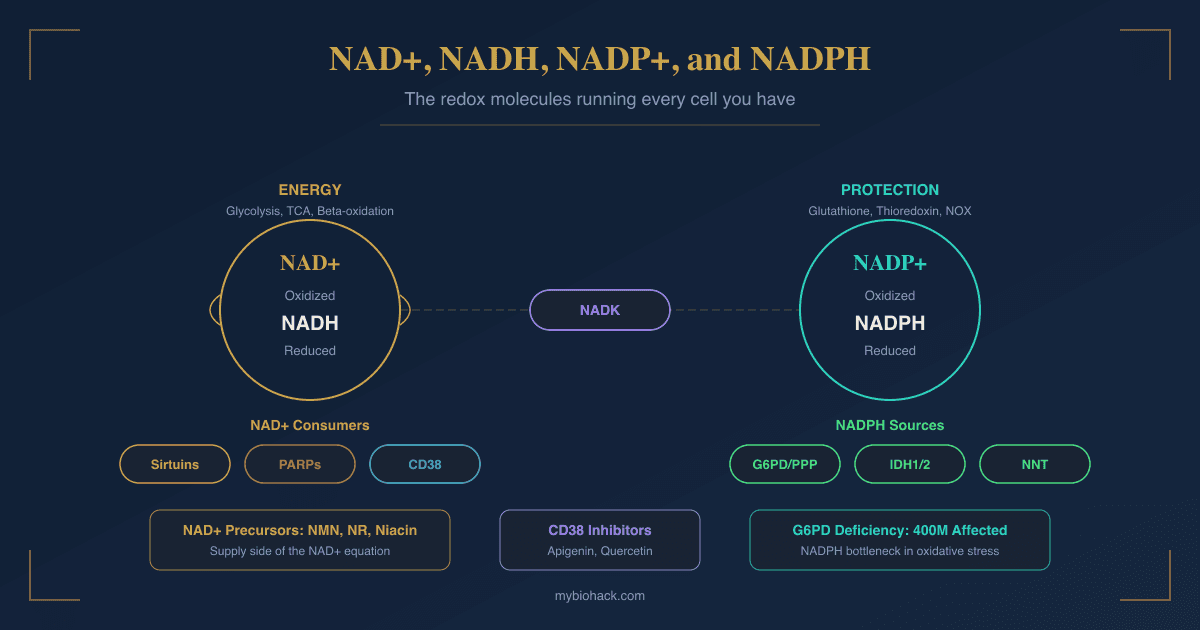
Because the reaction depends on NAD+, SIRT3 activity can reflect the relationship between redox state, nutrient availability, and mitochondrial workload.
SIRT3 does not act as a universal mitochondrial repair switch.
Its effects depend on which proteins are acetylated, the tissue involved, and whether the cell has enough NAD+ and metabolic capacity to respond. R
Acetylation is not a simple damage label.
It is a reversible regulatory mark that can change as nutrient supply, mitochondrial workload, and redox state change.
The same level of acetylation can have different consequences on different substrates, so a global acetylation measurement is difficult to interpret.
What SIRT3 Regulates
SIRT3 can regulate enzymes involved in the tricarboxylic acid cycle, fatty-acid oxidation, oxidative phosphorylation, and antioxidant defense.
One well-studied target is mitochondrial superoxide dismutase, also called SOD2.
SIRT3-mediated deacetylation can increase SOD2 activity in several experimental contexts, which may improve the handling of superoxide. R
SIRT3 also interacts with enzymes such as isocitrate dehydrogenase 2 and components of respiratory metabolism.
The result is not always lower reactive oxygen species because reactive oxygen species are also normal signaling molecules.
The relevant goal is controlled redox signaling with less persistent oxidative injury.
SIRT3 also sits inside a larger network that includes NAD+ synthesis and salvage, mitochondrial protein import, antioxidant recycling, and removal of damaged organelles.
Improving one part of that network may not correct a different bottleneck.
SIRT3 In Aging And Disease
Aging
SIRT3 expression and activity have been studied in relation to aging, mitochondrial dysfunction, and stress resistance.
Animal and cellular studies support an important role, but human aging is influenced by sleep, exercise, nutrition, inflammation, genetics, and disease burden.
A single SIRT3 measurement cannot summarize mitochondrial health.
Metabolic And Neurodegenerative Disease
SIRT3 has been investigated in diabetes, obesity, cardiovascular disease, ischemic injury, and neurodegeneration.
The evidence is strongest for biological plausibility and preclinical mechanisms, while clinical intervention data are more limited. R
In cardiovascular and brain models, SIRT3 activity can influence responses to ischemia, excitotoxicity, and metabolic stress.
These models help identify mechanisms but often use acute injury, genetically modified animals, or doses that do not map directly onto a human supplement.
JD Framing
Jacob's hypothesis is that low NAD+ availability, high nutrient stress, and inflammatory signaling could reduce the ability of SIRT3-dependent programs to buffer mitochondrial damage.
That may contribute to a Junction Dysfunction environment, but SIRT3 status is not a validated standalone explanation for chronic illness.
The practical implication is to look for the upstream conditions that shape NAD+ availability and mitochondrial workload rather than assuming that a low SIRT3 result is the primary lesion.
How To Think About SIRT3 Support
The first mistake is assuming that increasing SIRT3 is always beneficial.
Different tissues may need different levels of redox signaling, and excessive suppression of reactive oxygen species could interfere with adaptation.
The second mistake is confusing an upstream NAD+ strategy with proof that SIRT3 is the limiting step.
Increasing NAD+ availability does not guarantee that SIRT3 expression, mitochondrial localization, substrate acetylation, and downstream function will all improve.
NAD+ is also consumed by other enzymes, including PARPs and other sirtuins.
Changing NAD+ metabolism can therefore have effects beyond SIRT3, and the net result may vary with DNA damage, inflammation, age, and tissue type.
The third mistake is treating animal SIRT3 findings as proof that a supplement changes human mitochondrial acetylation in a clinically meaningful way.

Mechanisms Of Action
Simple:
- SIRT3 uses NAD+ to remove acetyl groups from mitochondrial proteins.
- This can change the activity of metabolic and antioxidant enzymes.
- SIRT3 may help mitochondria adapt to stress, but the effect depends on tissue and context.
Advanced:
- SIRT3-SOD2 signaling can increase the antioxidant capacity of manganese superoxide dismutase through deacetylation. R
- Acetylation-sensitive metabolism can change the activity of enzymes in the TCA cycle, fatty-acid oxidation, and respiratory pathways.
- NAD+ dependence links SIRT3 to the cellular redox state and to competition for NAD+ across several sirtuin and DNA-repair systems. R
- Stress-specific regulation means that SIRT3 may be protective in ischemia or metabolic overload models but is not a blanket substitute for correcting the initiating stressor. R
- Substrate specificity matters, because deacetylating SOD2, IDH2, or a respiratory enzyme can produce different changes in redox balance and metabolic flux.
Genetics
SIRT3
SIRT3 encodes the mitochondrial deacetylase itself.
Common SIRT3 variants have been studied in relation to metabolism and aging, but they do not currently yield a validated supplement or medication plan.
SOD2
SOD2 encodes manganese superoxide dismutase, one of the most important mitochondrial antioxidant enzymes.
SIRT3 can regulate SOD2 activity through deacetylation, which means genotype and post-translational regulation are separate questions. R
IDH2
IDH2 encodes mitochondrial isocitrate dehydrogenase 2, an NADPH-producing enzyme that helps support redox balance.
Its interaction with SIRT3 biology illustrates that mitochondrial antioxidant capacity depends on several linked systems rather than one protein.
FOXO3
FOXO3 is a stress-responsive transcription factor that can regulate antioxidant and autophagy-related programs.
FOXO3 is not a direct replacement for SIRT3, but it helps show how mitochondrial redox biology is distributed across transcriptional and post-translational layers.
More Research
- Activity is harder to measure than expression. SIRT3 protein abundance does not prove that its substrates are appropriately deacetylated.
- NAD+ is not the only variable. Acetyl-CoA, mitochondrial protein turnover, substrate access, and tissue energy demand also matter.
- Clinical biomarkers are limited. Blood measurements may not reflect SIRT3 activity inside heart, brain, or skeletal muscle mitochondria.
- Interventions are still being separated. Exercise, calorie restriction, NAD+ precursors, and drugs can affect overlapping pathways without having identical SIRT3 effects.
- The main open question is human causality. Researchers need trials that measure mitochondrial acetylation and clinical outcomes together.
- A blood test is not a mitochondrial activity assay. Tissue-specific SIRT3 activity is still difficult to measure in routine clinical care.
Jacob Gordon
INHC, FMT-C
Integrative Nutrition Health Coach
I cover mold illness, post-viral recovery, methylation, and complex chronic disease, drawing on ten years of clinical research, work inside a functional medicine clinic, and my own recovery from all of it. Every claim here is cited.
Book a ConsultationRelated Protocols & Supplements
Deep-dive chapters and recommended supplements for this topic
Quercetin
500mg 2x/day
Vitamin D3 + K2
5000 IU + 200mcg/day
Magnesium Glycinate
400mg at bedtime