Table of Contents
Chapter 7
Chapter 7 of 47

13 min readPro Guide

Fucoidan Overview

Fucoidan History

Since Kylin firstly isolated fucoidan in 1913, the structures of fucoidans from different red, brown, and green seaweeds have been investigated. R

Fucoidans are termed in literature as also called fucans, fucosans or sulfated fucans.

Fucoidans from several species of brown seaweed, for example Fucus vesiculosus, have simple chemical compositions, mainly being composed of fucose and sulfate. R

But the chemical compositions of most fucoidans are complex. R

Besides fucose and sulfate, they also contain other monosaccharides (mannose, galactose, glucose, xylose, etc.) and uronic acids, even acetyl groups and protein. R

The structures of fucoidans from different brown algae vary from species to species. R

Species Containing Fucoidans

This is not an exhaustive list of types of algae that have fucoidans:

  • Adenocytis utricularis

  • Alaria angusta

  • Ascophyllum nodosum

  • Bifurcaria bifurcate

  • Chondrus crispus (Irish Sea Moss)

  • Cladosiphon novae-caledoniae

  • Cladosiphon okamuranus (Okinawa mozuku)

  • Dictyota menstrualis

  • Ecklonia cava

  • Ecklonia kurome

  • Ecklonia maxima

  • Fucus distichus

  • Fucus evanescens

  • Fucus serratus

  • Fucus Spiralis

  • Fucus vesiculosus (Bladderwrack)

  • Himanthalia lorea

  • Hizikia fusiforme

  • Laminaria angustata

  • Laminaria digitata

  • Laminaria japonica

  • Laminaria saccharina (Saccharina latissima)

  • Lessonia vadosa

  • Macrocytis pyrifera

  • Padina pavonia

  • Padina gymnospora

  • Pelvetia wrightii

  • Monostroma Nitidum (contains the fucoidan called Rhamnan sulfate)

  • Sargassum hemiphyllum

  • Sargassum horneri

  • Sargassum fusiforme

  • Sargassum polycystum

  • Sargassum siliquosum

  • Sargassum stenophyllum

  • Spatoglossum schroederi

  • Stoechospermum marginatum

  • Undaria Pinnatifida (Wakame or Undaria Pinnatifida sporophylls or Mekabu)

  • Turbinaria conoides

Molecular Weight and Sulfate Content

Fucoidans differ based on their structure and their molecular weight (Mw), which is primarily dependent on its sulfate content.

Mw, also known as molecular mass, is the total mass of all the atoms in a molecule and is calculated by adding up the atomic weights of each atom in the molecule.

Having a high Mw means it’s harder for the cell to uptake (it is more difficult for HMW to cross lipid bilayers), but may acts well as an electrostatic chemoattractant (meaning it can bind to things outside the cell - think glycocalyx, spike, etc)

Having a low Mw means it’s easier to get into the cell, which is more beneficial for vascular repair and cancers.

High Molecular Weight vs Low Molecular Weight

High Mw fucoidans:

  • Laminaria japonica (and Ascophyllum nodosum High Mw) are better against pathogenic bacteria and SARS-CoV-2 (binding to spike). R R

  • Undaria Pinnatifida can restore the intestinal integrity by regulating inflammation and tight junction loss (Zonulin, claudin, etc). R

  • They have greater immunostimulatory effects than low Mw fucoidans in the spleen (activating NK cell activity - more on this later). R

  • They may be more neuroprotective. R

  • Have stronger VEGF-inhibition and antiangiogenic effects R

Low Mw fucoidans:

  • Ascophyllum nodosum has relatively high pro-angiogenic and pro-migratory potential, which is beneficial for vascular repair. R

  • Improves inflammation and endotoxemia. R

Sulfate Content

Differences of sulfated groups may contribute to the beneficial effects of fucoidans. R

Overall, a positive correlation exists between the sulfate content and antioxidant capability, which generally implies increased therapeutic impact of more sulfated fucoidans against diseases whose etiologies include oxidative damage. R

More specifically, highly sulfated fucoidans have shown significant attenuation of lipid accumulation and anti-tumor activity. R

Benefits of Fucoidan

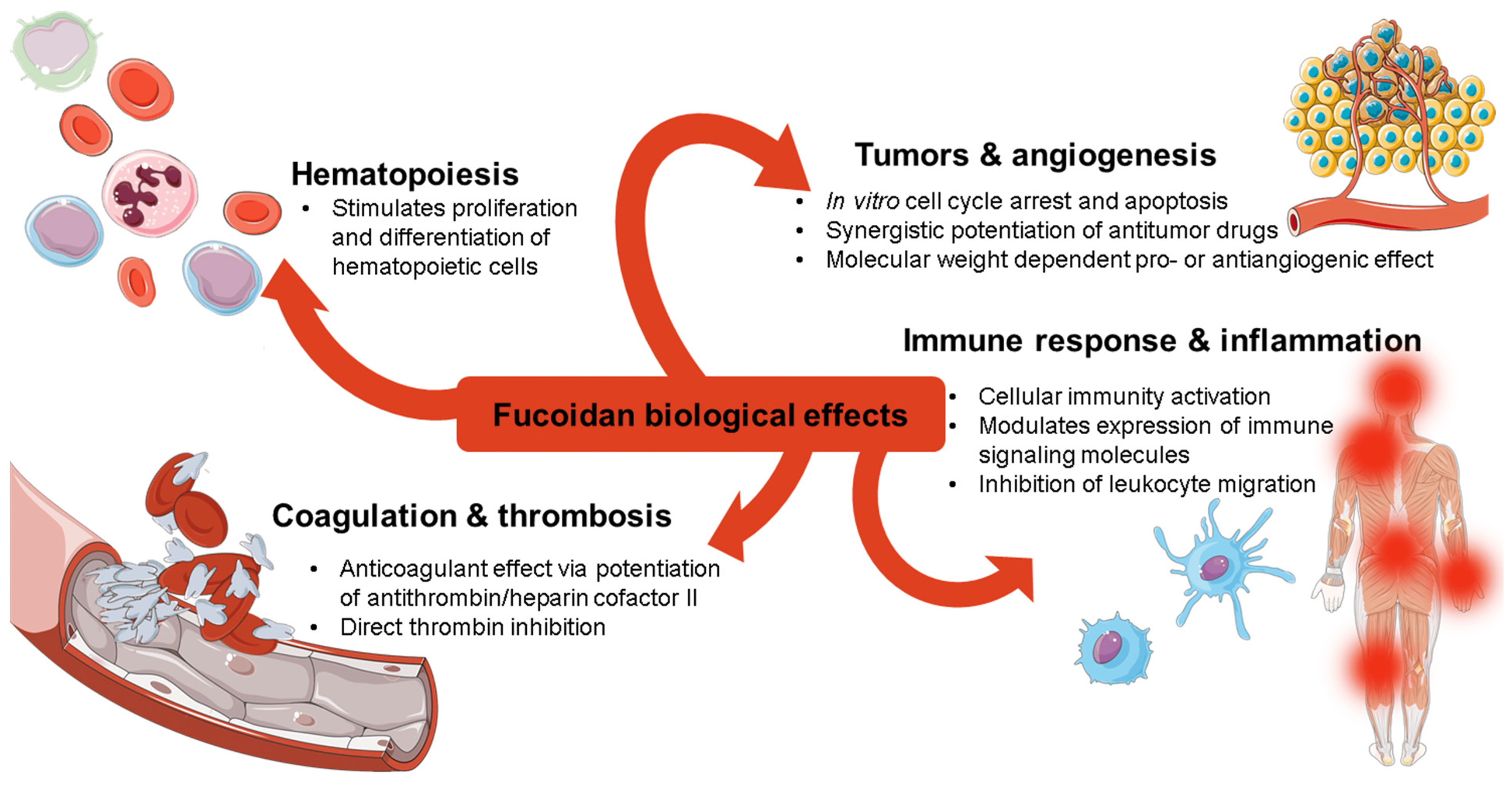
1/ Acts as an Antiviral

Multiple studies has shown fucoidan to be very potent against COVID-19 from Sars-CoV2. R

For example, unbranched fucoidan saccharide was substantially more potent than remdesivir, an approved drug for COVID-19 treatment. R

Not only that, but natural fucoidans inhibit coronaviruses by targeting viral spike protein and host cell furin. R

Fucoidans can also inhibit replication of other viruses:

  • Dengue R

  • EBV R

  • Herpes R R

  • HIV (prophylactically) R

  • HPIV1 R

  • Influenza A R

Fucoidan also promotes the transcription of Nuclear factor erythroid 2-related factor 2 (NRF2). R

NRF2 through multiple pathways is directly antiviral (figure above) and stops exosome creation. R

2/ Improves Tight Junctions, Vaso-Adaptation and Sticky Blood

Fucoidans (such as Rhamnan sulfate or Laminaria japonica) can help improve the glycocalyx layer of the blood vessels. R R

Fucoidan can help improve tight junction function (via ANG/TIE axis). R

Fucoidans can regulate human platelet aggregation (via PEAR1 and GPIbα) and blood clotting. R

For example, fucoidan with a high Mw inhibited coagulation, complement, and the cytokines PDGF-BB, RANTES, and IP-10, while activating MCP-1. R

Fucoidans (from Laminaria japonica) can also improve the vascular response during clotting (PGI2) and oxidative stress-based challenges (H2O2). R

Also with clotting, low Mw fucoidans can improve deep venous thrombosis via Endothelin-1 (ET-1), Von Willebrand factor (VWF) and Thrombomodulin (TM). R

Fucoidans also may improve stroke outcomes (via MAPK inhibition). R

By reducing Hypoxia Inducible Factor 1-alpha (HIF-1a), fucoidans may also improve hypoxia. R

High Mw fucoidan extract (from Fucus evanescens) protects blood vessels from from a sticky immune system during endotoxemia-based inflammation. R

3/ Improves Acute Endotoxemia

Endotoxemia is where bacterial byproducts get into the bloodstream and organs, thus triggering a persistent inflammatory response followed by immunosuppression.

Multiple forms of fucoidans can compete with bacterial endotoxin for binding to toll-like receptors and reduce the effect of LPS stimulation (thus reducing PGE2, TNF-α, IL-1β and IL-6). R R

For example, fractionated fucoidans from Ecklonia cava can significantly reduced NO and TNF-α, IL-1β and IL-6 production by LPS-stimulated macrophages. R

4/ Combats Fatigue, Improves Mitochondria, And Fat Synthesis

Fucoidans seem to have Exercise Mimetic properties.

Exercise mimetics, as the name implies, means a mimetic has similar effects on mitochondria that exercise has on your mitochondria.

For example. fucoidans (from Undaria Pinnatifida and Ecklonia Cava) can turn on Uncoupling Proteins (UCPs) which create more healthy Brown Fat (fat cells with more mitochondria vs white fat which is low in mitochondria). R R

This means fucoidan may act against the accumulation of bad fat around organs while increasing mitochondrial output (UCP-1, PRDM16, and PGC1a). R R R

In mice, the combination of fucoxanthin, hesperetin, caffeic acid, and Undaria Pinnatifida fucoidans were able to improve treadmill distance and an upregulate genes that stimulate angiogenesis and mitochondrial biogenesis for 8 weeks compared to control. R

In humans, fucoidan (Undaria Pinnatifida) supplementation was safe and able to improve cytokine levels vs controls after high intensity exercise and prevents Exercise-induced muscular damage (EIMD) which is similar to Post Exertional Malaise (PEM). R

It is also able to improve recovery chemokines, possibly making recovery better. R

Fucoidan may also improve muscle size and strength. R R

In mice, fucoidan increased muscle size and strength after 4 weeks of supplementation in both exercised and no‐exercised mice suggesting an important influence of fucoidan on skeletal muscle physiology. R

Also in mice, fucoidan (from Laminaria japonica) supplementations increased the grip strength and endurance swimming time in a dose-depend manner. R

In the same study, fucoidan treatments also produced dose-dependent decreases in serum levels of lactate and ammonia (two features of PEM), and also an increase in glucose level after the 15-min swimming test. R

5/ Has Cancer Properties

Fucoidans seem to have broad spectrum activities on cancers and regulate tumors on multiple levels. R

In humans, fucoidans may be beneficial adjuncts for: R

  • Bladder Cancer

  • Bone Cancer

  • Breast Cancer (and TNBC)

  • Colon Cancer

  • Liver Cancer

  • Lung Cancer

  • Multiple Myeloma

  • Ovarian Cancer

  • Pancreatic Cancer

  • Prostate Cancer

  • Thyroid Cancer

High levels of Sirtuin 6 (SIRT6) is associated with the healthy activity of killing bad cancer cells. R

Fucoidans (from Fucus distichus, Fucus vesiculosus, Cytoseira tamariscofolia, Cytoseira nodacaulis, and Alaria esculenta) have dose-depenedent SIRT6 stimulating activity. R

Fucoidans can inhibit Vascular Endothelial Growth Factor (VEGF) levels, a growth factor for capillaries in cancer colonies. R

In many clinical trials, fucoidans (like from Undaria Pinnatifida or Okinawa mozuku) were able to reduce chemotherapy side effects, (like sfx from letrozole and tamoxifen or FOLFOX6/FOLFIRI chemotherapy). R

Eating a fucoidan rich diet can strongly inhibit tumor growth when co-administrated with PD-1 antibodies (more on PD-1 later on in this series). R

Fucoidan also activates p53 (which negates the survival mechanism of cancer) and activate cell death (via caspase). R

6/ Relieves Some Forms of Pain

Fucoidan is anti-pain. R

For example, fucoidan may render the pain inducing inflammatory part of seaweeds (carrageenan) as inert (reducing myeloperoxidase). R

7/ Modulates Immunity and Dampens Allergies

In humans, fucoidan from Okinawa mozuku) was able to safely increase Natural Killer (NK) cell activity after 8 weeks of supplementation (that’s good for after an infection so you don’t get another viral infection). R

This trend of NK cell activation was similar in male cancer survivors as well. R

In addition to inducing NK activation, ample studies have established that fucoidan treatments alone promote the maturation of dendritic cells (DCs) through binding to toll-like receptors (TLR) and scavenger receptors-A (SR-A) on the surface of DCs. R

In mice, Okinawa mozuku-derived fucoidan could enhance macrophage phagocytosis (immune cells able to eat up pathogens and debris and thus less foam cells), increase IgM, IgG, and IgA production, and suppresses IgE production. R

Fucoidan can also improve allergies by upregulating Galectin-9 (GAL9). R

GAL9 is able to stop mast cell degranulation and it can bind to IgEs. R

Fucoidan can improve asthma. R

For example, in a human double blind placebo controlled study with asthmatic patients, fucoidan could reduce asthmatic symptoms after 12 weeks (results showed that the levels of IL-1β and IL-6 trend decreased in the fucoidan group at the 24th week compared with the control group -> the levels of IL-8 significantly decreased in the fucoidan group at the 12th and 24th week compared with the control group). R

8/ May Protect Eyesight and Hearing

Eyesight - Fucoidan may help with Age-related Macular Degeneration (AMD) by reducing ROS. R

Hearing - Fucoidan can protect the cochlea from cisplatin-induced ototoxicity (hearing loss) by upregulating the NRF2 pathway. R

9/ Has Anti-Inflammatory Properties

Fucoidans have consistently been shown to reduce inflammatory markers and improve resilience of the immune system with no known toxicity or adverse side effects. R

For example, in study investigating a 4-week daily oral administration of 100 mg per day and 1000 mg per day of fucoidan (Fucus vesiculosus, Macrocystis pyrifera, Laminaria japonica) in healthy adults, found both doses reduced basal IL-6 levels and cytotoxic T-cell activity. R

Fucoidan can also inhibit COX-2 (like NSAIDs), and thus decrease PGE2 levels, but without the leaky junctions that NSAIDs come with. R

10/ Improves Stem Cells and Senescense

Stem cells can become senescent (lazy and not dying).

Stem cells may help improve toxin-induced stem cell senescence. R

Fucoidan enhances the growth and creation of Mesenchymal Stem Cells (MSCs) through FAK-Akt axis. R

11/ Promotes A Healthier Gut and Microbiome

Fucoidans from Undaria Pinnatifida can prevent Receptor for AGEs (RAGE)-mediated intestinal damage and tight junction leakage. R

In high-performance athletes, fucoidan supplementation from a combination of Fucus vesiculosus + Undaria Pinnatifida was able to improve fecal concentrations of calprotectin, Secretory Immunoglobulin A (sIgA) and lysozyme levels. R

Heliobacter pylori is a bacteria in the gut that can cause ulcers and cancer.

Fucoidans have antimicrobial properties against H. pylori. R

Parabacteroides distasonis is the type strain for the genus Parabacteroides, a group of gram-negative anaerobic bacteria that commonly colonize the gastrointestinal tract of numerous species. R

In a double-blind, randomized, placebo-controlled study of patients undergoing chemoradiotherapy, low-molecular-weight fucoidan (from Sargassum hemiphyllum) was able to increase parabacteriodes levels while reducing side effects of chemo such as skin rashes, itching, and fatigue. R

When it comes to parasites, fucoidan mediates the Leishmania donovani effect by activating host immune responses. R

12/ Speeds Up Wound Healing and Improves Bone Density

Fucoidan promotes angiogenesis and accelerates wound healing through AKT/Nrf2/HIF-1α signalling pathway. R

Fucoidan can also expedite bone repair and promote angiogenesis by stimulating the release of VEGF, as well as by stimulating the expression of VEGF, nitric oxide synthesis (NOS), and eNOS activation, thereby increasing angiogenesis in ischemic regions. R

Fucoidans (from Sargassum hemiphyllum, Undaria Pinnatifida and Laminaria japonica) can increased bone density by stimulating Alkaline Phosphatase (ALP), Osteocalcin (OC), mineral deposition, and Bone Morphogenetic Protein 2 (BMP2), which are associated with bone mineralization in osteoblasts. R R

By reducing degradation of the Extracellular Matrix (ECM), fucoidan hydrogel injection may improve intervertebral disc (IVD) degeneration (IDD). R

13/ Reduces Proteopathies and Improves Brain Health

Fucoidan has shown to improve redox capacity in nerves exposed to diesel exhaust fumes. R

Fucoidans (at super high concentrations) can also improve glutamate-induced excitotoxicity in the brain by modalating AMPA and NMDA receptors. R

A disturbed Blood Brain Barrier (BBB) and activation of macrophages (microglia) in the brain are very common after exposure to miRNAs, Prions, and Viruses. R

Fucoidans can also improve the BBB (via P-selectin) and neurodegeneration by blocking macrophages from crossing and thus attenuating the inflammatory response in the brain. R

Fucoidan can alleviate b-amyloid-induced neurotoxicity in basal forebrain neurons [155].

Transmissible spongiform encephalopathies, or prion diseases, are fatal neurodegenerative disorders that include Creutzfeldt-Jakob disease (CJD) and Gerstmann-Straussler Scheinker syndrome in humans and scrapie, bovine spongiform encephalopathy (BSE), and chronic wasting disease in animals. R

Sulfated polysaccharides, such as heparin, dextran sulfate, and pentosan polysulfate (PPS), are known either to prolong incubation periods in animals with prion diseases or to inhibit formation of pathogen-related abnormal prion protein (PrP) in prion-infected cells. R

Daily uptake of fucoidan might be prophylactic against prion diseases caused by ingestion of prion-contaminated materials. R

For example, in animals, dietary seaweed fucoidan can delay the onset of prions disease when given orally for 6 days after infection, but not when given before the infection. R

Fucoidans can also inhibit oxidative stress and mitochondrial dysfunction through the upregulation of the expression of SIRT3 after traumatic brain injury. R

14/ Liver

Scarring of the liver is common in liver disorders such as Non-Alcoholic Fatty Liver Disease (NALFD) and Non-alcoholic steatohepatitis (NASH).

Fucoidans (such as fucus vesiculosus) can inhibit scarring of the liver by xenobiotics (non-human toxins) by decreasing transaminase (like ALT) leakage and autophagy as well as obtaining optimal levels of intracellular fiber, which ultimately prevents fibrosis. R

Fucoidans may also improve insulin resistance by stimulating the expression of sirtuin-1 in the liver, which activates AMPK and alleviates insulin resistance. R

15/ Improves Lipid Profiles

Sub-chronic administration of fucoidan (from Fucus vesiculosus) can reduce levels of Low-Density Lipoprotein Cholesterol (LDL-C) and while elevating High-Density Lipoprotein Cholesterol (LDL-C) levels. R R


Caveats

Fucoidan has also been proposed as a contraceptive mimetic as it inhibits the binding of sperm to the human zona pellucida. R

My Experience with Fucoidan

Over the past few years I’ve been going ham on fucoidans.

Actually I’ve been using Ecklona Cava since 2017 (as a sleep aid).

I’ve been on and off again taking Laminaria japonica and Undaria Pinnatifida, as they are reasonably inexpensive to get.

These two when combined with Pycnogenol has given me so much energy, but I like to cycle supplements for maintenance.

So, currently I am taking Rhamnan sulfate and fucus vesiculosus.

Next one I will to be trying is mozuku.

My Thoughts on Fucoidan

My hypothesis on longevity and lower death rates in Japan is due to the high consumption of Wakame (aka Undaria Pinnatifida) with their sushi etc.

Also, as fucoidan may render the pain inducing inflammatory part of seaweeds (carrageenan) as inert has me thinking that’s why carrageenan has been vilified in vitro as being highly inflammatory, but in human studies does not translate when they eat seaweed which is high in carrageenan. R R

Which Fucoidans to Use?

Fucoidans can be taken alone or in combination.

In the literature, using combinations of high and low molecular weight fucoidans seem to have the best trade offs and that is what I typically do.

Think of it as including diverse spectrums of highly sulfated polyphenols.

Some examples of what I would do…

Before Covid:

Prophylactically, I would use the combination of Ascophyllum nodosum, and Laminaria japonica to prevent spike from entering the cell or degrading the glycocalyx.

After Covid:

After the acute phase of an infection, I would use Aterosil and brown seaweed extract to start while recovering (and also taking it easy, as you should know you’re healing internal wounds here).

This combo is more angiogenic, which is necessary after having lots of internal wounds.

Later adding in Pycnogenol (for improved energy) as well as Ecklonia cava (for sleep).

Regular Health:

I use different fucoidans for different purposes and will combine.

Mechanisms (technical)

Simple:

  • Increases ALP R

  • Increases AMPK R

  • Increases BMP2 R

  • Increases Calprotectin R

  • Increases Caspace-3 R

  • Increases Caspase-8 R

  • Increases Caspase-9 R

  • Increases CAT R R

  • Increases CDK2 R

  • Increases CDK4 R

  • Increases CREB R

  • Increases Cyclin D1 R R

  • Increases Cyclin E R R

  • Increases E-Cadherin R

  • Increases eNOS R

  • Increases FOXO1 R

  • Increases FOXO3 R

  • Increases GAL9 R

  • Increases Glucose (utilization) R

  • Increases GLUT4 R

  • Increases GPX R

  • Increases GSH R

  • Increases HO-1 R

  • Increases IDO-1 R R

  • Increases IgA R

  • Increases IgG R

  • Increases IgM R

  • Increases Lysozyme R

  • Increases MCP1 (CCL2) R

  • Increases NO R

  • Increases NQO1 R

  • Increases NRF2 R R

  • Increases OR R

  • Increases PARP R

  • Increases PGC1a R R

  • Increases PRDM16 R

  • Increases p53 R R

  • Increases sIgA R

  • Increases SIRT1 R R

  • Increases SIRT3 R

  • Increases SIRT6 R R

  • Increases SOD (1 and 2) R R R

  • Increases S1P R

  • Increases TIE2 R

  • Increases TIMP R

  • Increases UCP1 R R

  • Increases UCP3 R R

  • Increases VEGF R

  • Increases ZO1 R

  • Reduces AGEs R

  • Reduces AKT R

  • Reduces ALT R

  • Reduces Ammonia R

  • Reduces ANGPT1/2 R R

  • Reduces ARP3 R

  • Reduces AST R

  • Reduces α-SMA R

  • Reduces Beclin-1 R

  • Reduces bFGF R

  • Reduces CAIX R

  • Reduces CDC42 R

  • Reduces CD31 R

  • Reduces Claudin-1 R

  • Reduces Collage Type 1 (synthesis) R

  • Reduces Cortactin R

  • Reduces COX-2 R

  • Reduces CXCR4 R

  • Reduces CYP2E1 R

  • Reduces ENA-78 (CXCL5) R

  • Reduces ERK R

  • Reduces ET-1 R

  • Reduces FLT1 R

  • Reduces FLT4 R

  • Reduces GLUT-1 R

  • Reduces HDAC R

  • Reduces HIF1a R

  • Reduces Hyaluronidase

  • Reduces IgE R R

  • Reduces IGF-I R

  • Reduces IL-1beta R

  • Reduces IL-4 R

  • Reduces IL-6 R

  • Reduces IL-8 (CXCL8) R

  • Reduces IL-12 R

  • Reduces iNOS R

  • Reduces JAK (2) R

  • Reduces KDR R

  • Reduces KDRL R

  • Reduces Lactate R

  • Reduces LDH R

  • Reduces MAPK R

  • Reduces MDA R

  • Reduces MDC (CCL22) R

  • Reduces MGSA/NAP-3 (CXCL1) R

  • Reduces MIP3 (CCL20) R

  • Reduces MMP2 R

  • Reduces MMP9 R

  • Reduces MPO R

  • Reduces MT1-MMP R

  • Reduces mTOR R

  • Reduces N-Cadherin R

  • Reduces N-WASP R

  • Reduces NF-kb R

  • Reduces Occludin R

  • Reduces OSR1 R

  • Reduces PDGF R

  • Reduces PD-L1 R

  • Reduces PGE2 R

  • Reduces PI3K R R

  • Reduces PPP2R1A R

  • Reduces RAGE R

  • Reduces RANTES (CCL5) R

  • Reduces SDF-1 R

  • Reduces Smad R

  • Reduces Snail R

  • Reduces Src R

  • Reduces STAT (1/3) R

  • Reduces TC R

  • Reduces TG R

  • Reduces TGF-beta R R

  • Reduces TM R

  • Reduces TNF-α R

  • Reduces TWIST R R

  • Reduces VEGF/VEGFR R

  • Reduces Vimentin R

  • Reduces VWF R

  • Reduces WNK1 R

  • Reduces ZO1 R

Now, Let’s Get Back To Rebuilding The Forest

Next, we will talk about how the microcapillary system works and how that causes people to develop vascular POTS or the new name for it - Vaso-Adapative Disorder (VAD).

End of Chapter 7
Up Next
Unlock with Pro